Loading...
marine-life#goby and pistol shrimp#marine symbiosis#underwater photography tips
The Odd Couple: A Diver’s Guide to the Goby and Pistol Shrimp Symbiosis
Pro Dive Vibes
February 28, 20269 min read

As you descend along the sloping walls of a vibrant reef, it is easy to get mesmerized by the kaleidoscopic swirl of anthias or the majestic glide of a passing hawksbill turtle. Most divers spend their bottom time looking up or out, searching for the "big stuff." However, if you want to witness one of the most sophisticated social contracts in the ocean, you need to turn your gaze downward.
Beyond the coral heads lies the often-ignored sandy patch—a vast, sun-drenched expanse that many dismiss as a "marine desert." But look closer at those ripples in the sand. If you remain still, you will witness the "Odd Couple" of the underwater world: the Alpheidae (pistol shrimp) and the Gobiidae (goby). This isn't just a chance encounter; it is a masterclass in mutualism, a biological partnership where two vastly different species cooperate to survive in a landscape with nowhere to hide.
The Blind Bulldozer: Meet the Pistol Shrimp
The first half of this duo is a member of the Alpheus genus, commonly known as the pistol shrimp. In this partnership, the shrimp is the master excavator and structural engineer. Because the sandy bottom is prone to collapse and shifting currents, the shrimp must spend nearly every waking hour bulldozing sand, moving pebbles, and reinforcing the walls of its subterranean home.
However, the pistol shrimp has a significant evolutionary handicap: it is nearly blind. In the open, exposed environment of the sand flats, a blind crustacean is nothing more than a snack for a passing wrasse or snapper.
Despite its poor eyesight, the pistol shrimp is famous for its "pistol" claw. As we explored in our guide to specialized fish anatomy, Beyond the Bite: Unveiling the Surprising Purpose of Teeth in Reef Fish, nature often equips small creatures with incredible tools. The shrimp’s specialized claw doesn't just pinch; it snaps shut at such high speeds that it creates a cavitation bubble. When this bubble collapses, it produces a sonic "crack" louder than a jet engine and a flash of light, stunning prey or deterring predators. But even with a sonic cannon, you can't hit what you can't see.
The Sentry on Duty: Meet the Watchman Goby
Enter the second half of the duo: the Watchman Goby. While the shrimp provides the manual labor, the goby provides the high-definition security.
Evolution has gifted the goby with exceptional eyesight. Their eyes are often perched high on their heads, capable of rotating independently to scan 360 degrees for threats. They are also incredibly sensitive to pressure changes and vibrations in the water column. While the shrimp is busy moving mountains of sand, the goby sits motionless at the burrow entrance, acting as a living early-warning system.
There are dozens of species of "shrimp gobies," each with its own stunning color patterns.
| Common Name | Scientific Name | Key Identifying Feature |
|---|---|---|
| Yellow Watchman | Cryptocentrus cinctus | Bright yellow body with blue spots |
| Randall’s Goby | Amblyeleotris randalli | Orange stripes and a prominent dorsal "fan" |
| Wheeler’s Goby | Amblyeleotris wheeleri | Reddish-brown bands and blue speckles |
| Yasha Goby | Stonogobiops yasha | Vibrant red stripes and long white dorsal fin |
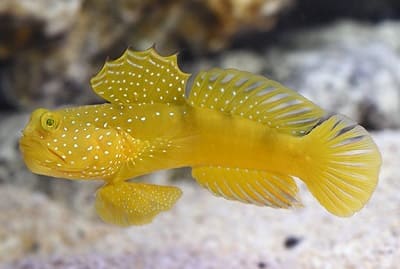
The Social Contract: How the Partnership Works
The relationship between these two is a classic "Room and Board" agreement. The shrimp provides a safe, meticulously maintained home (the room), and in exchange, the goby provides protection and security (the board).
Unlike the service-based interactions we see in The Reef’s Spa Day: Understanding the Social Dynamics of Underwater Cleaning Stations, where a cleaner fish might briefly interact with a predator, the goby-shrimp bond is a long-term, domestic partnership. They often live together for their entire adult lives.
The most fascinating aspect of this contract is the tactile communication. Because the shrimp cannot see the threat, it maintains constant physical contact with the goby. If you watch closely, you will see the shrimp extend one or both of its long antennae, resting them lightly on the goby’s tail or flank. This is the "umbilical cord" of their survival.
Expert Tip: The shrimp will almost never leave the burrow unless it can feel the goby. If the goby moves even a few centimeters away, the shrimp will frantically wave its antennae until it re-establishes contact.
The Language of Touch: Decoding the Tail Flick
Communication in the animal kingdom takes many forms. While we’ve discussed how cephalopods use "living pixels" to communicate in Thinking with Their Skin: The Visual Language of Octopuses and Cuttlefish, the goby and shrimp rely on a haptic language (the language of touch).
- The "All Clear": When the goby is sitting still or gently undulating its fins, the shrimp knows it is safe to continue bulldozing sand.
- The Warning Signal: If the goby detects a potential predator, it performs a rapid, high-frequency tail flick. This vibration is transmitted instantly through the shrimp’s antennae.
- The Retreat: If the threat gets too close, the goby will perform a sudden, powerful "bolt" into the burrow. The shrimp, sensing the violent movement, retreats backward into the depths of the tunnel in a fraction of a second.
This system is so effective that it is rare to find a shrimp goby without its partner. They move as a single unit, synchronized by a language of vibrations.
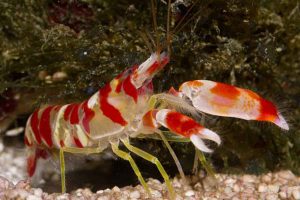
Observing the Duo: A Diver’s Code of Conduct
For a diver, observing this interaction requires a different skillset than wreck diving or drift diving. If you approach a goby-shrimp pair like you’re exploring the SS Thistlegorm, you will see nothing but an empty hole in the sand.
To witness the "Odd Couple" in action, follow this checklist:
- Check your buoyancy: Ensure you can hover inches above the sand without touching it or kicking up silt.
- Watch your shadow: Predatory birds and fish often attack from above. If your shadow crosses the burrow, the goby will signal an immediate retreat.
- Identify the mound: Look for a small "volcano" of sand or a collection of small shells and coral rubble—this is the shrimp's construction debris.
- The "Five-Minute Rule": Once you find a burrow, settle into a stationary hover about 2-3 meters away. Wait. It usually takes about 2 to 5 minutes for the pair to feel safe enough to emerge again.
- Breathe slowly: Large, noisy bubbles can spook the goby. Try to maintain a calm, rhythmic breathing pattern.
You should try to poke the burrow to see them come out — Never disturb the burrow. This causes unnecessary stress and can lead to the collapse of the shrimp's hard work, leaving them vulnerable to predators.
Photography Tips: Capturing the Interaction
Capturing the goby and shrimp is the "holy grail" for many macro photographers. It requires patience, the right gear, and perfect timing.
Lens Selection
Because these creatures are small (usually 3cm to 10cm) and very skittish, you need focal length. A 60mm macro lens is good, but a 105mm (or 90mm on mirrorless) is the gold standard. This allows you to maintain a greater working distance, reducing the chance of spooking the goby while still getting a frame-filling shot.
The "Wait for the Pop"
The most dynamic shot isn't just the goby sitting there; it’s the moment the shrimp emerges. The shrimp typically works in cycles: it digs, gathers a "load" of sand against its chest, and then marches out to dump it. Time your shots for the moment the shrimp is fully visible, with its antennae clearly touching the goby.
Lighting
The sandy background acts like a giant reflector. If your strobes are too powerful, you will "blow out" the highlights, turning the sand into a featureless white blob.
- Use lower strobe power.
- Position your strobes out and slightly back to create shadows that define the texture of the sand.
- Consider using a "snoot" to light only the goby and shrimp, leaving the surrounding sand dark.

Citizen Science: Beyond the Observation
Your observations of these pairs can actually contribute to marine biology. As we discussed in Citizen Science for Divers: Turn Your Underwater Photos into Vital Marine Data, documenting species distribution is vital for conservation.
Scientists are still discovering new species of both gobies and shrimp, and they are particularly interested in host specificity. While some gobies are happy with any shrimp partner, others are "monogamous" to a single species of Alpheus.
If you spot a pairing that looks unusual—perhaps a goby with a color morph you haven't seen before, or a pair in a geographic region where they aren't usually documented—upload your photos to platforms like iNaturalist or REEF.org. You might be the first person to document a range expansion for that species!
Conclusion: The Beauty of Underwater Cooperation
The symbiosis between the goby and the pistol shrimp is a powerful reminder that the reef is not just a collection of individuals, but a complex web of dependencies. Much like the Caribbean Crabs that use sponges for camouflage, the goby and shrimp have found a way to thrive by leaning on each other’s strengths.
Next time you find yourself over a "boring" patch of sand, don't rush past it. Settle down, control your buoyancy, and wait. When that tiny, blind bulldozer emerges to dump its load of sand, and you see it check in with its watchful sentry, you’ll realize that the most incredible stories on the reef are often the ones happening right beneath your fins.
The sandy bottom is far from empty—it’s a bustling neighborhood of tiny engineers and vigilant guards, all working together to survive in the big, blue world. Happy spotting, and remember: in the world of the Odd Couple, teamwork makes the dream work!