Loading...
marine-life#cleaning stations#cleaner wrasse#marine mutualism
The Reef’s Spa Day: Understanding the Social Dynamics of Underwater Cleaning Stations
Pro Dive Vibes
February 27, 202610 min read
The Ocean’s Most Exclusive Club: An Introduction to Cleaning Stations
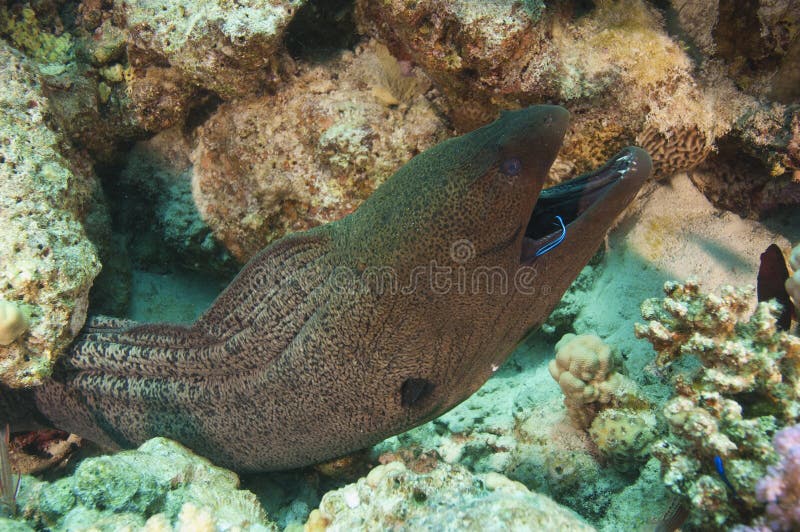
Imagine descending through the blue, the sunlight dancing on the reef, when you happen upon a massive Moray Eel. Instead of being tucked away in a crevice, it’s out in the open, jaws agape, looking strangely relaxed. Tiny, neon-blue fish are darting in and out of its mouth, while a small shrimp marches across its eye. This isn't a scene of a predator about to strike; it’s a "spa day."
In the diving world, we call these hubs cleaning stations. These are specific geographical locations on a reef—often a prominent coral head or a rocky outcrop—where marine life gathers to have parasites, dead skin, and infected tissue removed by specialized "cleaner" species. It is one of the most sophisticated examples of mutualism in nature: a biological interaction where both parties benefit. The "client" gets a health boost and relief from irritating pests, while the "cleaner" gets a reliable, high-protein meal.
These stations are the "town squares" of the underwater world. They are the only places on the reef where the usual rules of the food chain are temporarily suspended. Here, the social dynamics are as complex as any human society, involving advertising, queuing, and even a bit of white-collar crime.
Meet the Service Providers: The Cleaners of the Reef
The success of a cleaning station depends entirely on the reputation and visibility of its staff. On Indo-Pacific reefs, the undisputed stars are the Bluestreak Cleaner Wrasse (Labroides dimidiatus).
Cleaner Wrasse: The Primary Specialists
These small, cigar-shaped fish are easily identified by their striking blue and black horizontal stripes. To attract clients, they perform a signature "dance"—a rhythmic, oscillating swimming pattern that signals they are open for business. This dance is a crucial form of communication, ensuring that a hungry Grouper recognizes them as a service provider rather than a snack.
Cleaner Shrimp: Using Antennae to Signal Service
While wrasse handle the daytime rush, various species of shrimp—such as the Pacific Cleaner Shrimp and the Banded Coral Shrimp—provide specialized services, often in the darker recesses of the station. They use their long, white antennae to wave frantically at passing fish, a behavior known as "signaling."
Spotting the Small Stuff
Finding these tiny cleaners requires a keen eye. If you've spent time practicing the techniques from our guide, The Nudibranch Hunter’s Handbook, you’ll find those same skills invaluable here. Look for "biological hotspots"—areas where fish seem to be hovering unnaturally or changing color. By slowing down and focusing on a single coral head, you’ll begin to see the frantic movement of the shrimp and the zig-zagging wrasse that you might have missed on a fast-paced drift dive.
The 'Cheaters': The Wolf in Sheep's Clothing
Not everyone at the cleaning station is there to help. The Bluestriped Fangblenny is an evolutionary "cheat." It has evolved to look almost exactly like the Cleaner Wrasse, mimicking its colors and even its dance. However, instead of removing parasites, the Fangblenny takes a literal "bite" out of the client, nipping off a piece of healthy flesh or scales before darting away.
| Feature | Cleaner Wrasse | Fangblenny (Mimic) |
|---|---|---|
| Mouth Position | Terminal (at the tip) | Underneath the snout |
| Behavior | Careful picking | Sudden "hit and run" nip |
| Goal | Parasite removal | Eating healthy tissue |
| Movement | Smooth, rhythmic dance | Jerky, aggressive bursts |
The Clients: From Tiny Damsels to Pelagic Giants
The clientele at a cleaning station is incredibly diverse. On any given dive, you might see a resident Damselfish waiting its turn next to a visiting "pelagic" (open ocean) giant.
The Diversity of Visitors
- Resident Reef Fish: Groupers, Snappers, and Parrotfish are regulars who visit their local station multiple times a day.
- Pelagic Giants: Sharks, Manta Rays, and even Mola Mola (Sunfish) will travel long distances to reach specific cleaning stations. These large animals often have higher parasite loads due to their size and the vast distances they travel.
Why Big Predators Wait in Line
For a shark or a ray, parasite removal isn't just about comfort; it’s about survival. Ectoparasites like gnathiid isopods can cause significant blood loss and spread disease. If a shark’s gills are clogged with parasites, its ability to oxygenate its blood decreases, impacting its hunting efficiency. This is why you will see a three-meter-long shark hovering patiently while a tiny wrasse works on its sensitive gill slits.
Priority Service
Interestingly, there is a "pecking order." Researchers have observed that cleaners often prioritize visiting pelagics over local residents. Why? Because the residents aren't going anywhere, but the Manta Ray might only be passing through. The cleaners seem to understand "customer retention" better than most human businesses!

The No-Eat Zone: Understanding the Evolutionary Truce
One of the most frequent questions divers ask is: Why don't the predators just eat the cleaners? It seems like an easy snack for a Barracuda to gulp down a wrasse.
The answer lies in the high value of long-term health. A single meal provides temporary energy, but a reliable cleaning service provides a lifetime of health benefits. Over millions of years, evolution has hard-wired a "truce" into the DNA of reef predators.
Dental Hygiene for Giants
In our previous exploration of reef anatomy, Beyond the Bite: Unveiling the Surprising Purpose of Teeth in Reef Fish, we discussed how diverse tooth structures are essential for survival. At a cleaning station, this is put to the test. Cleaners will actually enter the mouths of large predators to pick scraps of food and parasites from between those specialized teeth.
Expert Insight: This "Social Contract" is so strong that even when a predator is startled and needs to leave the station quickly, it will usually give a "shudder" or a specific jaw-gape signal to allow the cleaners to exit its mouth safely before it swims away.
Underwater Body Language: Signaling and Communication
To get the most out of observing a cleaning station, you need to understand the body language being used. It is a silent dialogue of color and posture.
The Client’s Pose
When a fish wants to be cleaned, it adopts a "solicitation posture." This usually involves:
- Mouth-opening: Signaling for dental work.
- Gill-flaring: Allowing access to the delicate gill filaments.
- Vertical Hovering: Some fish will point their heads up or down, remaining perfectly still to show they are not a threat.
Color Changes
Some species, like Goatfish or Surgeonfish, can dramatically change their skin color when they arrive at a station. By turning a darker or lighter shade, they create a high-contrast background that makes it easier for the cleaners to spot pale or translucent parasites.
Tactile Stimulation
Cleaner wrasse don't just use their mouths; they use their fins to "massage" the client. This tactile stimulation has been shown to lower the levels of cortisol (the stress hormone) in the client fish. It’s the reef equivalent of a calming spa massage, making the client more likely to stay still and return in the future.

Diver Etiquette: How to Observe Without Breaking the Peace
As divers, we are privileged guests at these stations. However, our presence can easily disrupt the delicate social flow. If the clients get scared off, the cleaners lose their food source, and the reef’s health suffers.
The Golden Rule: Keep Your Distance
Stay at least 3 to 5 meters away from the main cleaning area. Use your zoom lens if you have a camera, but do not "poke" your dome port into the station. If you get too close, the "clients" will perceive you as a predator and flee.
Buoyancy Mastery
The key to watching a cleaning station is to become part of the landscape. This requires excellent buoyancy. Find a patch of sand (avoiding live coral) and settle into a neutral hover. The less you move, the more likely "shy" species like sharks or turtles will approach the station while you are there.
Bubble Management
Exhaling a giant cloud of bubbles directly under a cleaning station is like setting off a fire alarm in a spa. The noise and vibration are highly disruptive.
- Position yourself "down-current" from the station.
- Avoid swimming directly underneath the "hover zone" where mantas or sharks are circling.
- Practice slow, rhythmic breathing to minimize acoustic disturbance.
The 'Waiting Room'
Identify the perimeter. Most stations have a "waiting room" where fish circle while waiting for their turn. If you find yourself in the middle of a school of circling Snappers, you are likely blocking the entrance to the station. Back away and watch the queue form properly.
Why Cleaning Stations Matter for Reef Conservation
Cleaning stations are more than just a curiosity; they are vital to the health of the entire ocean.
- Biodiversity Hotspots: Areas with active cleaning stations have significantly higher fish biomass and species diversity than areas without them.
- The Health Impact: Scientific studies have shown that when cleaner wrasse are experimentally removed from a reef, the overall health of the fish population declines rapidly, with increased rates of infection and injury.
- The Role of Clean Water: These interactions rely on visibility and the health of the surrounding environment. As we noted in our piece on Marine Algae: The Unsung Heroes of Reefs, a balanced ecosystem—where algae are kept in check by herbivores—is essential for keeping these "spa" sites clear and accessible.
Cleaning stations are just a minor part of the reef — actually, they are the cornerstones of reef resilience. Without them, the "residents" would succumb to disease, and the "visitors" would stop coming, leading to a collapse in local biodiversity.
Conclusion: The Harmony of the Reef
The next time you’re underwater, don't just swim past that busy-looking coral head. Stop, settle your buoyancy, and watch the drama unfold. You’ll see the delicate dance of the wrasse, the impatient hovering of a Grouper, and perhaps even a "cheater" trying to snag a quick bite.
Understanding the social dynamics of cleaning stations reminds us that the reef is not just a collection of random animals; it is a highly organized, cooperative society. By observing these sites with respect and patience, we gain a front-row seat to one of the most sophisticated examples of harmony in the natural world.
Ready to see it for yourself? On your next dive, challenge yourself to spend 20 minutes at a single cleaning station. You’ll be amazed at how much "drama" occurs when you simply take the time to look. Don't forget to check your air and your no-decompression limits—time flies when you're at the spa!
Further Reading
- The Secret Lives of Cleaner Fish: Ocean Janitors, Parasite Pickers, and Evolutionary Oddballs - discoverwildscience
- Marine cleaning stations: Where do fish go for a spa?
- Discover the Importance of Cleaning Stations in the Ocean - The Green Odyssea
- The Underwater Ritual Divers Love: How Cleaning Stations Work – La Galigo