Loading...
marine-life#damselfish behavior#reef fish aggression#marine biology
Small Fish, Big Attitude: Why the Damselfish is the Reef’s Fiercest Guardian
Pro Dive Vibes
February 28, 20268 min read

You’re hovering over a pristine patch of brain coral, adjusting your buoyancy and admiring the intricate polyps, when suddenly—thwack! You feel a sharp nip on your glove or see a tiny, iridescent blur darting toward your mask. You look around for the culprit, half-expecting a rogue triggerfish or perhaps a grumpy grouper, only to find yourself face-to-face with a creature no larger than your palm.
Welcome to the world of the Damselfish.
For many divers, being "attacked" by a three-inch fish is a rite of passage. It is one of the great ironies of the underwater world: while we spend our surface intervals discussing the "big stuff"—sharks, rays, and turtles—the most fearless creature we encounter on the reef is often the smallest. Members of the family Pomacentridae are the ocean’s most dedicated territorialists, proving that size is a poor indicator of courage (or attitude) in the marine world.
Meet the Family: Beyond the Famous Cousins
When most people think of the Pomacentridae family, they immediately picture the orange-and-white stripes of the Clownfish. While we’ve explored the microscopic secrets of their survival in our guide, Beyond the Sting: The Chemical Romance Between Anemones and Clownfish, the broader Damselfish family is staggering in its diversity.
With over 300 species found across the globe, from the temperate kelp forests of California to the tropical heart of the Coral Triangle, Damselfish are the "blue-collar workers" of the reef. However, their personalities vary wildly. While some species are docile plankton-feeders that school in the thousands, others are the self-appointed bouncers of the reef, patrolling a few square meters of limestone with an iron fin.
The Algae Gardener: Why They Fight So Hard
It is easy to dismiss a Damselfish’s aggression as "mean," but there is a sophisticated biological reason for their fury. Many species are algae farmers. Unlike most fish that roam the reef in search of a meal, these Damselfish cultivate a specific "algae lawn" on the surface of dead coral heads.
The Farmer Hypothesis
Damselfish aren't just defending a home; they are protecting their grocery store. They practice a form of intensive mariculture that is rare in the animal kingdom. They will actively "weed" their territory, removing undesirable species of algae or debris and throwing them outside the boundary of their farm. By doing so, they encourage the growth of their favorite, highly nutritious filamentous algae.
This creates a high-stakes ecological trade-off:
- The Reward: A private, high-calorie buffet that is always available.
- The Cost: A massive expenditure of energy required to drive off every single herbivore—from massive parrotfish to wandering divers—that might want a snack.
This behavior is supported by their specialized physiology. As we discussed in Beyond the Bite: Unveiling the Surprising Purpose of Teeth in Reef Fish, the tooth structure of a fish is a direct reflection of its lifestyle. Damselfish possess rows of small, comb-like teeth perfectly adapted for grazing on delicate algae and, as many divers can testify, providing a surprisingly effective "pinch" to human skin.

The Sound of Fury: Acoustic Aggression
If you’ve ever felt a "thump" in the water while a Damselfish is charging you, you aren't imagining things. These fish are some of the most vocal residents of the reef. Long before they resort to physical contact, they use sound as a primary deterrent.
Damselfish produce distinct chirping, popping, and clicking noises by gnashing their pharyngeal teeth together or vibrating their swim bladders. These sounds serve as a high-decibel warning: "You are in my space, and I am prepared to escalate."
In our exploration of underwater acoustics, The Symphony of the Sea: A Diver’s Guide to Identifying Common Reef Sounds, we noted that sound travels four times faster in water than in air. For a Damselfish, this means their "shouting" is an incredibly efficient way to signal aggression to rivals and predators alike. If you hear a rapid-fire "pop-pop-pop" near a coral head, it’s time to check your proximity; you’re about to be charged.
Evolutionary Logic: Why Being a Bully Pays Off
From an evolutionary standpoint, the extreme aggression of a Damselfish seems like a risky strategy. Why would a tiny fish pick a fight with a five-foot diver or a predatory grouper?
The answer lies in the energy-to-survival ratio. In the post Nature’s Lethal Sloths: The Evolutionary Logic of the Reef’s Deadliest Slow-Mo Dwellers, we examined how some creatures use venom to save energy. Damselfish take the opposite approach: they use high-energy displays to prevent a fight from happening in the first place.
| Strategy | Energy Cost | Risk Level | Result |
|---|---|---|---|
| Fleeing | Low | High | Loss of food source/nest |
| Hiding | Low | Medium | Starvation/Loss of territory |
| Aggression | High | Low (usually) | Retains food and protects eggs |
By acting like a "crazy" opponent, Damselfish often convince much larger predators that the effort of a fight isn't worth the reward. Most predators, like snappers or groupers, respect these boundaries because a high-energy, nipping Damselfish is an annoying distraction that could lead to injury or simply waste time. Furthermore, this aggression is vital for nest protection. Male Damselfish are the primary caregivers, guarding clutches of eggs with a ferocity that ensures the next generation of "bullies" survives.
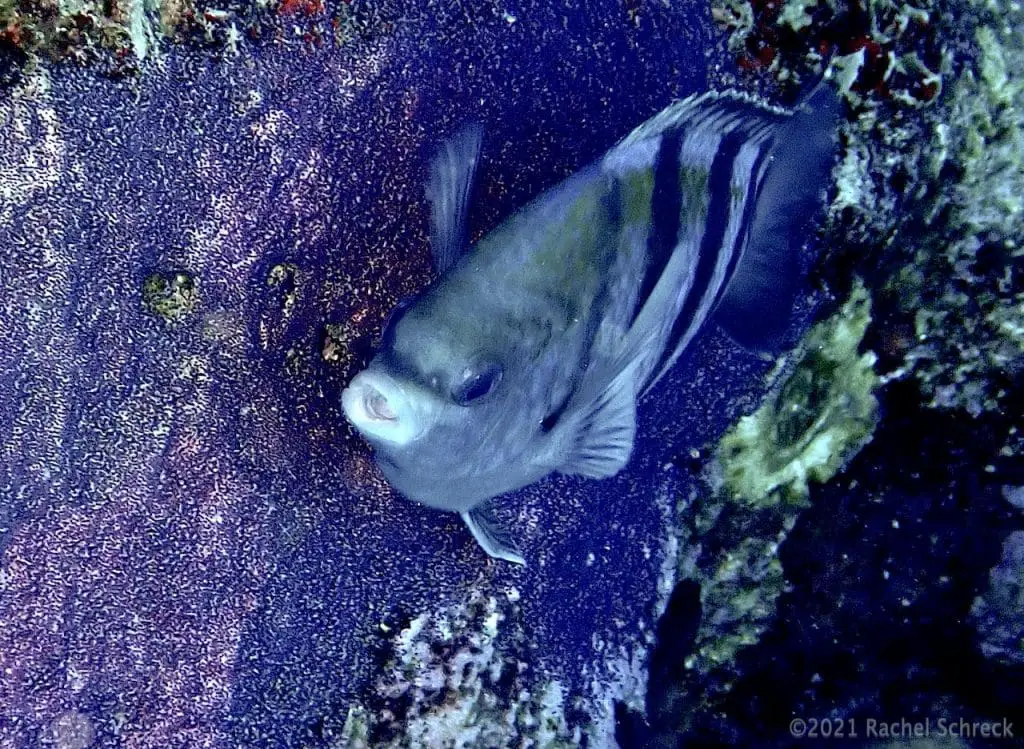
Species Spotlight: The Reef’s Most Notorious Enforcers
While all Damselfish have spunk, a few species have earned a reputation among the global diving community as the "heavyweights" of the family.
- The Garibaldi (Hypsypops rubicundus): The bright orange state fish of California. These are the giants of the family, reaching up to 14 inches. They are legendary for their "thumping" sounds and will fearlessly charge divers who linger too long near their rocky crevices.
- The Three-Spot Damselfish (Stegastes planifrons): The tiny black terror of the Caribbean. Don't let its size fool you; this fish is responsible for more diver "bites" than almost any other species in the Atlantic.
- The Dusky Farmerfish (Stegastes nigricans): The master of the intensive algae farm. They have been observed successfully defending their lawns against schools of much larger surgeonfish.
The Diver’s Guide to 'Damsel Etiquette'
Interacting with a territorial Damselfish requires a bit of understanding. Much like the pectoral fin drops and arching described in Shark Body Language: A Diver’s Guide to Reading Reef Predator Intentions, Damselfish have a specific "pre-attack" ritual.
Recognizing the Warning Signs
- The Rapid Dash: The fish will swim in a quick, zig-zag pattern toward you and then back to its hole. This is the "final warning."
- The Gill Flare: By puffing out their operculum (gill covers), they attempt to look larger and more intimidating.
- The Acoustic Pop: As mentioned, if you hear the clicking, you are already in the "strike zone."
Expert Tip: Damselfish are particularly attracted to shiny objects. Your camera port, the chrome on your regulator, or a shiny dive computer can trigger an attack. If a Damselfish is targeting your camera, avoid pushing the camera toward it—this is seen as a massive act of aggression. Instead, tuck your hands in and slowly drift backward.
The Photographer’s Checklist
If you want to photograph a Damselfish without being harassed:
- Maintain neutral buoyancy (don't kick up sand or touch the reef).
- Approach slowly from the side, rather than head-on.
- Keep your strobes tucked in until you are in position.
- Respect the "invisible bubble" of their territory (usually 1-2 meters).
-
Try to pet the fish— Never attempt to touch or feed them; it disrupts their natural "farming" cycle.
The Ecological Importance of the Reef’s Biggest Bully
It’s easy to view the Damselfish as a nuisance, but they are actually vital to the health of the coral reef. Their aggression promotes biodiversity. By fiercely defending their small patch of algae, they prevent any one species of herbivore from overgrazing a section of the reef. This creates a "patchwork" ecosystem where different types of coral and algae can coexist.
Furthermore, Damselfish play a role in the complex "social contract" of the reef. While they are bullies to most, they often allow specific "cleaner" species into their territory. In The Reef’s Spa Day: Understanding the Social Dynamics of Underwater Cleaning Stations, we saw how even the most aggressive fish will call a "truce" to have parasites removed. The Damselfish’s territory often serves as a safe haven for these smaller, beneficial organisms.
Unlike the chemical defenses of the Nudibranch or the shy, sunset rituals of the Mandarinfish, the Damselfish relies on pure, unadulterated grit.
Conclusion: Respect the Grit
The next time you’re on a dive and a three-inch fish decides to take a stand against you, take a moment (after moving away) to appreciate the sheer determination on display. In a world of apex predators and vast oceans, the Damselfish stands its ground, tending its garden and guarding its family against all odds.
They remind us that the reef is not just a beautiful backdrop for our dives; it is a collection of fiercely defended homes, complex farms, and tiny warriors. So, keep your fingers tucked in, listen for the clicks, and give the reef’s fiercest guardian the respect it has rightfully earned.
Have you ever been "bullied" by a Damselfish? Tell us about your encounter in the comments below, or share your best tips for photographing these feisty farmers!