Loading...
marine-life#underwater sounds#reef noise#snapping shrimp
The Symphony of the Sea: A Diver’s Guide to Identifying Common Reef Sounds
Pro Dive Vibes
February 28, 20269 min read

When Jacques Cousteau released his groundbreaking documentary Le Monde du silence (The Silent World) in 1956, he introduced the public to a realm of serene, hushed beauty. But as any modern diver who has spent a quiet safety stop hovering near a coral head knows, the ocean is anything but silent. In fact, it is a cacophony of clicks, pops, grunts, and whistles. To a marine biologist, the reef sounds less like a library and more like a busy construction site crossed with a percussion ensemble.
For marine organisms, sound is often the primary sense. While we divers rely heavily on our vision—searching for the camouflage of a frogfish or the shimmer of a silverside—light is absorbed quickly by water, and visibility is frequently limited to a few dozen meters. Sound, however, is a different beast. It travels approximately four and a half times faster in water than in air and can carry vital information across entire ocean basins.
Learning to identify these sounds doesn't just make you a more observant diver; it transforms your relationship with the environment. When you stop looking and start listening, you begin to perceive the reef as a living, breathing social network.
The Constant Crackle: The Secret of Snapping Shrimp
If you’ve ever descended onto a tropical reef and wondered why it sounds like someone is perpetually frying bacon or like a giant bowl of Rice Krispies is popping around your ears, you’ve met the Alpheidae family. These are the snapping shrimp, and they are the undisputed loudest residents of the reef.
Despite their small size (usually only 3-5 centimeters), these shrimp produce a sound so intense it can interfere with submarine sonar. Interestingly, the sound doesn't come from the physical contact of their claws hitting each other. It’s a masterclass in physics known as cavitation.
When the shrimp snaps its specialized claw shut, it ejects a high-speed jet of water. This jet moves so fast that it creates a low-pressure bubble. When that bubble collapses, it generates a shockwave, a flash of light (sonoluminescence), and temperatures that briefly reach over 4,700°C—nearly as hot as the surface of the sun.
Why the Crackle Matters
A loud, constant crackle is a biological indicator of a high-biodiversity habitat. Snapping shrimp require complex structures—crevices, sponges, and coral branches—to hide. If you find yourself on a reef where the "static" is deafening, you are likely in a healthy, thriving ecosystem.
The Crunch and Scrape: Herbivores at Work
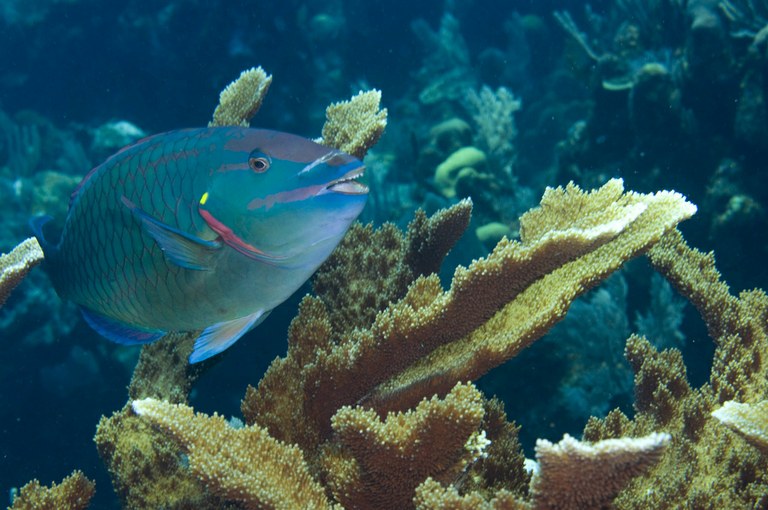
While the shrimp provide the background static, the "percussion" of the reef comes from the herbivores. The most prominent of these is the Parrotfish. If you drift near a large boulder or a brain coral, you will inevitably hear a rhythmic scrape-scrape-scrape.
This is the sound of the parrotfish’s "beak"—which is actually a mosaic of fused teeth—grinding against the calcium carbonate of the reef to reach the endolithic algae growing inside. In our previous exploration, 'Beyond the Bite: Unveiling the Surprising Purpose of Teeth in Reef Fish', we discussed how these specialized dental structures are evolved for more than just eating; they are geological tools.
The Sand-Making Process
As you listen to that crunching sound, you are literally hearing the creation of a tropical beach. A single large parrotfish can excrete over 300 kilograms of fine white sand per year.
| Sound | Likely Source | Biological Action |
|---|---|---|
| Loud, rhythmic scraping | Parrotfish | Feeding on coral/algae |
| Delicate clinking/tapping | Sea Urchins | Moving spines across rock |
| Sharp, single crunch | Triggerfish | Crushing a mollusk shell |
| Soft rasping | Limpets/Chitons | Radula scraping rock surfaces |
Don't overlook the Sea Urchins. During night dives, when the reef's "night shift" comes out, you can often hear the subtle clink of their spines against the substrate or the rasping of their "Aristotle's Lantern" (their complex mouthparts) as they graze.
Drummers and Grunters: How Fish Vocalize
Fish are surprisingly talkative, but they don't have vocal cords. Instead, they use two primary methods: stridulation and drumming.
Stridulation (The "Grind")
This is the sound made when fish rub hard skeletal parts together. Many species of Grunts get their name from rubbing their pharyngeal teeth (teeth located in the throat) together, using their gas-filled swim bladder to amplify the sound. It sounds like a low, raspy croak.
Drumming (The "Thump")
Species like Groupers, Damselfish, and Toadfish possess specialized "sonic muscles" attached to their swim bladders. By contracting these muscles at high speeds, they "drum" on the bladder, creating low-frequency thumps or hums.
- Damselfish: These feisty reef gardeners often produce sharp "honks" or "pops" when defending their algae patches from intruders (including curious divers!).
- Groupers: During twilight hours or mating aggregations, groupers produce deep, booming "drums" that can be felt as much as heard.
Expert Tip: To hear fish vocalizations, try to minimize your own noise. Move away from your buddy's bubbles, hold onto a (non-living!) rock if there is current, and take slow, controlled breaths. The "honk" of a territorial damselfish is often accompanied by a sudden darting movement toward your mask.
The High-Pitched Chatter: Cetaceans and Beyond
If you are lucky, your dive might be soundtracked by the most sophisticated communicators in the ocean.
Dolphins
Dolphin vocalizations fall into two categories: whistles and clicks. As we detailed in 'Decoding Dolphin Communication', whistles are social signatures used for identification, while clicks are used for echolocation. To the human ear, dolphin chatter sounds like a series of high-pitched squeaks, chirps, and "rusty hinge" noises.
Humpback Whales
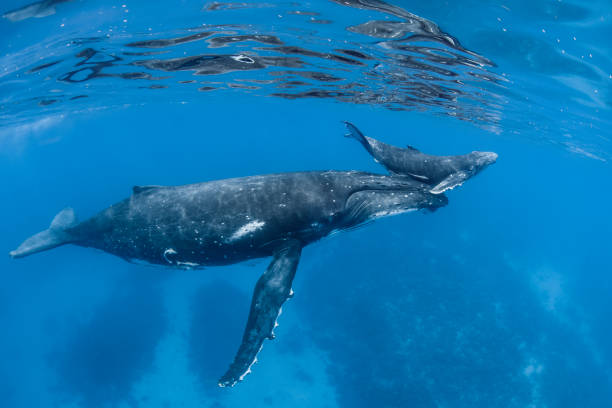
During the winter months in many tropical regions, the song of the Humpback whale dominates the water column. Unlike the clicks of dolphins, whale song is a low-frequency experience. You don't just hear the moans and cries; you feel them vibrating in your chest cavity and through your regulator. These songs can last for 20 minutes and can be heard from miles away.
The Challenge of Direction: Why You Can’t Find the Source
One of the most frustrating experiences for a diver is hearing a loud clank or a dolphin whistle and spinning around, only to find nothing. This is what we call The Acoustic Paradox.
In the air, our brains calculate the direction of sound by the time delay between the sound hitting one ear and then the other (Interaural Time Difference). Because sound travels 1,500 meters per second in water—four times faster than in air—the delay is too short for our brains to process. Furthermore, sound in water often bypasses the ear canal entirely, vibrating the bones of the skull directly via bone conduction.
To your brain, this makes the sound feel like it is inside your head or coming from every direction at once.
- Stop moving and remain neutral.
- Scan the blue water for movement rather than following your ears.
- Look for bubbles or behavioral changes in smaller fish (they can localize sound better than you!).
Man-Made Noise: Distinguishing Gear and Engines
Not all reef sounds are biological. As a diver, part of your situational awareness involves identifying "technophony"—man-made noise.
- Boat Engines: A high-pitched, rhythmic whir or thrum. If the pitch is increasing and getting louder, a boat is approaching. Because of the directional issues mentioned above, never surface without a DSMB (Delayed Surface Marker Buoy) if you hear engine noise.
- Regulator "Whoosh": Your own breathing is the loudest thing you'll hear. To truly listen to the reef, you need to master the art of the long, slow exhale.
- Tank Bangers and Bolts: A sharp, metallic ping is almost always a dive guide trying to get your attention. It’s a distinct, non-natural sound designed to cut through the organic "mush" of reef noise.
The ocean is a place of silence — It is actually one of the noisiest environments on Earth, we just need to tune our ears to the right frequencies.
The Sound of Health: Why a Noisy Reef is a Happy One
Marine biologists are increasingly using passive acoustic monitoring as a tool for conservation. A "noisy" reef is usually a healthy one. Research has shown that larval fish and coral polyps use the sound of the reef—the snapping shrimp crackle and the fish grunts—as a "homing beacon" to find suitable habitats to settle in.
However, noise pollution from shipping and construction can disrupt this. In our post 'The Reef’s Spa Day', we discussed the delicate social contracts at cleaning stations. Recent studies suggest that heavy boat noise can stress both "cleaners" and "clients," leading to a breakdown in these vital symbiotic relationships.
As a diver, you can contribute to this field through Citizen Science. By using underwater housings for action cameras with decent microphones, you can record the soundscapes of the reefs you visit. These recordings provide a snapshot of the reef's health that visual data alone might miss.

Conclusion: Becoming an Underwater Listener
Next time you descend, I challenge you to do more than just look for "the big stuff." During your five-minute safety stop, or while you are hovering over a patch of reef, close your eyes (briefly!) and focus on the "Big Three":
- The Snap of the shrimp.
- The Crunch of the parrotfish.
- The Grunt of the territorial damselfish.
Developing your "sea ears" deepens the diving experience, turning a 2D visual tour into a 4D immersive symphony. The reef is talking; it’s time we started listening.
Ready to turn your next dive into a data-gathering mission? Check out our guide on Citizen Science for Divers to see how your observations can help protect the soundscapes of the future!
Further Reading
- The Symphony of the Reef - Divers Alert Network
- The Ocean's Symphony: How Marine Life Creates Music That Scientists Are Racing to Decode - Marine Biodiversity Science Center
- The Sound of (Reef) Music | Scuba Diving
- Listen to a toadfish’s grunt! AI helps decode a ‘symphony’ of ocean sounds | Oceans | The Guardian