Loading...
marine-life#tool-using wrasse#blackspot tuskfish#fish intelligence
Tool-Using Wrasses: How to Spot the Reef’s Most Intelligent Architects
Pro Dive Vibes
June 22, 20269 min read

Beyond the Three-Second Memory: Meet the Reef’s Smartest Residents
For decades, the humble fish has been the victim of one of the most persistent biological slanders: the claim that they possess a three-second memory. If you’ve ever spent a dive watching a wrasse systematically dismantle a complex reef structure to get to a snack, you know this couldn't be further from the truth. In reality, many marine species possess sophisticated cognitive abilities that rival those of birds and primates.
Among the most impressive are the tool-using wrasses. While we typically associate tool use with the high-level intelligence of chimpanzees cracking nuts or crows bending wires, certain members of the Labridae (wrasse) family have mastered a similar feat beneath the waves.
In the marine world, tool use is defined as the use of an external object to achieve a specific goal. While a wrasse doesn't "hold" a hammer in its pectoral fins, its use of a stationary rock as an anvil to smash open hard-shelled prey represents a massive cognitive breakthrough. It requires foresight, the ability to plan a sequence of actions, and the physical coordination to execute a high-speed strike.
The evolutionary advantage is clear: thinking your way through a meal allows these fish to access high-protein food sources—like thick-shelled bivalves and armored crustaceans—that other predators simply cannot reach. By utilizing the physical properties of the reef, they have effectively expanded their menu and secured their place as the reef's most intelligent architects.
The Anvil Technique: A Masterclass in Underwater Engineering
Watching a wrasse at work is a lesson in patience and physics. The process, often referred to as the "smash and grab" behavior, isn't a random act of aggression; it is a calculated engineering feat.
The Step-by-Step Breakdown
- Selection: The wrasse identifies a target, such as a cockle or a large crab, buried in the sand or tucked into a crevice.
- Transport: Once the prey is secured in its mouth, the fish doesn't try to eat it immediately. Instead, it swims—sometimes significant distances—to a specific location.
- The Strike: Upon reaching its preferred "anvil," the wrasse performs a rapid, lateral flick of its head. It uses the momentum of its entire body to slam the prey against the hard surface of the rock.
- Repetition: This isn't a one-hit wonder. The fish will strike the object repeatedly, often rotating it between hits to find the structural weak point of the shell.
- Consumption: Once the shell shatters, the wrasse meticulously picks out the soft tissues, leaving behind a pile of debris.
Interestingly, these fish don't just use any random rock. They are known to select, transport, and even maintain their preferred anvil stones. They will clear away sand and encroaching algae to keep the surface hard and effective.
As a diver, you can actually use your ears to find these workshops. In our guide Beyond the Bubbles, we discuss how to identify marine life by sound. If you hear a rhythmic, metallic 'clink-clink-clink' echoing through the water, stop and look toward the nearest rubble patch. You aren't hearing a diver hitting their tank; you’re likely listening to a wrasse in the middle of a construction project.
The Blackspot Tuskfish: The Master Craftsman of the Pacific
If there is a "poster child" for underwater intelligence, it is the Blackspot Tuskfish (Choerodon schoenleinii). Found throughout the Western Pacific, particularly on the Great Barrier Reef, this species has become a celebrity among marine biologists for its consistent and documented use of tools.
Physical Adaptations for the Job
The Blackspot Tuskfish is built for heavy labor. They possess:
- Specialized 'Tusks': These are actually prominent, forward-facing teeth that allow them to grip slippery shells and pry stubborn mollusks from the substrate.
- Powerful Jaws: Their jaw musculature is designed for high-torque movements, essential for the "flick-and-smash" technique.
- Keen Eyesight: They have highly mobile eyes that can scan the sand for the tiniest movement or the slight bulge of a buried bivalve.
While the adults are the master craftsmen, identifying them can be tricky because their appearance changes so drastically throughout their lives. If you see a fish that looks like a Tuskfish but isn't exhibiting these complex behaviors, it might be a younger individual. Check out The Great Reef Makeover to learn how to identify juvenile tuskfish, which often prioritize hiding and growing over the complex (and risky) task of tool-assisted hunting.

Architects of the Rubble: Comparing Wrasses and Parrotfish
When we think of fish "shaping" the reef, we usually think of the parrotfish. However, the way a wrasse interacts with its environment is fundamentally different from its colorful cousins.
| Feature | Tool-Using Wrasses | Parrotfish |
|---|---|---|
| Primary Action | Smashing shells on anvils | Scraping algae and coral |
| Physical Impact | Creates localized debris piles | Produces vast amounts of sand |
| Goal | Extracting high-protein meat | Digesting algae and coral polyps |
| Landscape Effect | Clears and maintains "workshops" | Reshapes the entire reef structure |
While we’ve previously explored how parrotfish act as The Sand Makers, tool-using wrasses are more like "micro-architects." They create disturbed rubble zones. These areas might look messy to the untrained eye, but they are ecologically vital. By breaking open shells and turning over rocks, wrasses create opportunities for smaller scavengers to feed, effectively kickstarting a mini-ecosystem within the rubble.
Top Dive Destinations for Witnessing Tool Use
Ready to see these underwater Einsteins in action? You’ll need to head to specific regions where the water is clear and the rubble patches are plenty.
- The Great Barrier Reef, Australia: This is the epicenter of Blackspot Tuskfish research. Sites like Heron Island and the Ribbon Reefs offer shallow, sunlit areas where you can watch tuskfish working on their anvils in just a few meters of water.
- Palau and the Rock Islands: Here, you can spot the Orange-dotted Tuskfish. They frequent the shallow lagoons and inner reefs, often using large coral heads as their anvils.
- Komodo National Park, Indonesia: If you are Surviving the Current at Komodo’s Crystal Rock, don't just look into the blue for sharks. Take a moment to scan the rubble patches at the base of the pinnacle. The high-nutrient waters here support a massive population of crustaceans, making it a "buffet line" for clever wrasses.
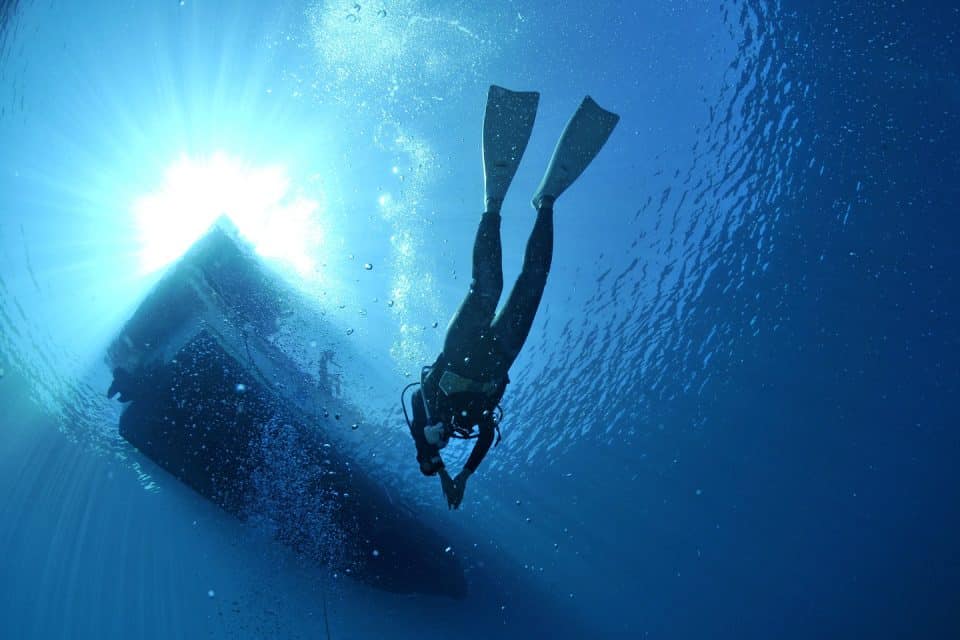
The Diver’s Guide to Spotting an 'Underwater Workshop'
Finding a tool-using wrasse requires a shift in perspective. Instead of looking for the fish, look for the evidence of their work.
- Identify the Workshop: Look for a large, flat-topped rock that is noticeably cleaner than the surrounding area. Around the base of this rock, you will often find a "midden"—a pile of broken, bleached shells that clearly didn't get there by accident.
- Look for 'Cleared' Patches: Wrasses will often blow jets of water into the sand to uncover prey. If you see a series of small, circular depressions in a rubble field, a wrasse is likely nearby.
- The Stealth Approach: Once you find a potential site, don't swim directly toward it. Use the techniques we recommend in The Nudibranch Hunter’s Handbook—move slowly, control your buoyancy, and hover a few meters away. If you chase the fish, it will drop its hard-earned meal and flee.
Pro Tip: If you see a wrasse swimming with purpose while holding something large in its mouth, do not follow it closely. It is heading to its anvil. Stay back, stay still, and wait for the "clink."
Social Intelligence: Cleaning Stations vs. Tool Use
The intelligence of wrasses isn't limited to solo engineering; they are also masters of social negotiation. In The Reef’s Spa Day, we discussed how cleaner wrasses manage complex "social contracts" with predators.
It is fascinating to consider the cognitive load these fish handle. On one hand, they must remember the "faces" of regular clients at a cleaning station. On the other, they must remember the locations of their best anvil stones and the most productive hunting grounds.
This dual-threat intelligence—social and technical—is why wrasses are a favorite for underwater photographers. They aren't just swimming; they are deciding. You can see it in their eyes as they track your movement, weighing whether you are a threat or just another part of the scenery.
Protecting the Reef’s Intellectuals
As fascinating as these behaviors are, they are also fragile. Tool-using wrasses rely on a very specific set of environmental conditions that are currently under threat.
- Habitat Loss: We often focus on protecting live coral, but for a tuskfish, the rubble zone is just as important. When we anchor in rubble or "clean" dive sites by removing loose rocks, we are destroying the workshops these fish have maintained for years.
- Ocean Acidification: As the ocean's pH drops, it becomes harder for mollusks to build their shells. While this might seem like it makes the wrasse’s job easier, it actually disrupts the entire food chain. If the bivalve populations crash, the wrasses lose their primary reason for using tools.
How Divers Can Help
- Protect the Rubble: Avoid kicking or disturbing loose rock patches during your safety stop.
- Document Behavior: If you capture video of a wrasse using a tool, upload it to citizen science platforms like iNaturalist.
- Support Marine Protected Areas (MPAs): MPAs that include "unattractive" sandy and rubble zones are vital for these intelligent hunters.
The future of marine ethology (the study of animal behavior) is being written by divers like you. Every time we document a fish solving a problem, we move one step closer to truly understanding the complex minds that inhabit our oceans. On your next dive, don't just look for the big stuff—listen for the clink and look for the architect. You might just witness a cognitive breakthrough in real-time.
What’s the smartest behavior you’ve ever seen on a dive? Tell us in the comments below or tag us in your "clink" videos on Instagram!
Further Reading
- Reefs show architectural expertise with complex shapes for survival | University of Hawaiʻi System News
- Reef architects - Woods Hole Oceanographic Institution
- Cleaner wrasse show self awareness in stunning mirror experiments | ScienceDaily
- Cleaner wrasses: The cleaner fish of the sea - Planet Forward