Loading...
marine-life#juvenile reef fish identification#fish ontogeny#marine biology for divers
The Great Reef Makeover: Why Juvenile Fish Look Nothing Like Their Parents
Pro Dive Vibes
April 25, 20269 min read

You’ve likely been there: you’re hovering over a vibrant patch of brain coral, hovering in neutral buoyancy, when a tiny, frantic fish with neon-blue spots and a zig-zag swimming style catches your eye. You check your waterproof ID slate or wait until you’re back on the boat to consult the "Reef Bible," only to find... nothing. The fish you saw isn't there. Or rather, it is there, but it looks like a completely different species.
Welcome to the ultimate identity crisis of the coral reef. In the world of marine biology, this phenomenon is known as ontogenetic color change. It’s not just a "growing phase" like a teenager getting taller; it is a total biological makeover. On the reef, looking like your parents can actually be a death sentence. To survive the gauntlet of predators and the territorial wrath of their own kind, juvenile fish have evolved to be the ocean's greatest master of disguise.
Survival of the Brightest: The Evolutionary Strategy Behind the Switch
Why would a species go through the metabolic effort of completely changing its color, pattern, and sometimes even its body shape? It isn't for aesthetic reasons; it’s a high-stakes survival strategy.
Avoiding Intraspecific Aggression
The reef is a crowded neighborhood where real estate is limited. Many adult fish are fiercely territorial, guarding their specific patch of coral or rubble against any competitors of the same species. If a juvenile looked exactly like a miniature adult, it would be seen as a direct threat—a "squatter" looking to steal food and territory. By sporting a completely different color palette, the juvenile sends a biological signal: "I’m not a competitor; I’m just a kid." This reduces intraspecific aggression, allowing the youngsters to forage in peace without being chased off by grumpy adults.
Batesian Mimicry
Sometimes, the best way to avoid being eaten is to look like something that tastes terrible. We’ve previously explored how The Chemical Arms Race makes nudibranchs and flatworms toxic to predators. Many juvenile fish, such as the Many-spotted Sweetlips, take advantage of this. They don’t just look like toxic flatworms; they mimic their frantic, undulating movement. A predator sees a "dancing" juvenile fish and thinks, "That looks like a mouthful of poison," and moves on.
Niche Partitioning
Different appearances often signal different lifestyles. A juvenile might live in the shallow seagrass beds, while the adult lives on the deep reef wall. Their colors are tailored to their specific niche. This separation ensures that the different generations of the same species aren't competing for the same resources, a concept known as niche partitioning.
The Parrotfish Transformation: From Tiny Striper to Sand-Making Machine
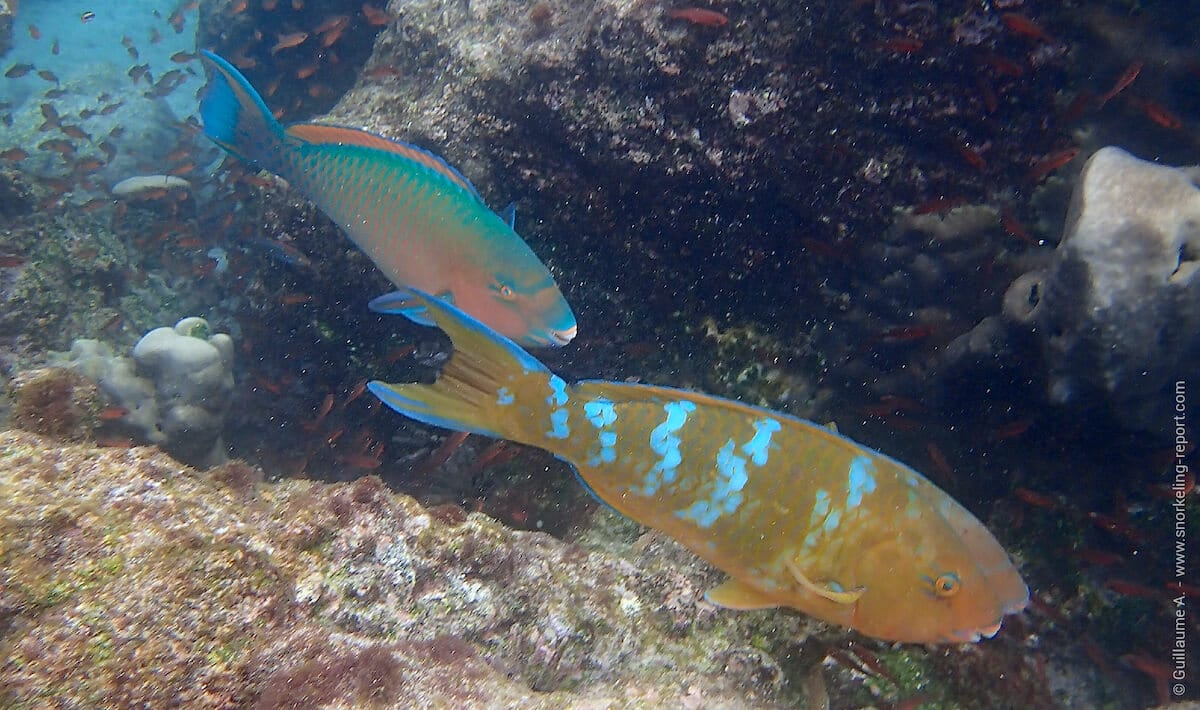
Parrotfish are the poster children for "The Great Reef Makeover." If you’ve read our post on The Sand Makers, you know these fish are vital reef architects. But identifying them is a nightmare for novice divers because they pass through three distinct phases.
| Phase | Common Appearance | Social Status |
|---|---|---|
| Juvenile | Drab browns, greys, or simple stripes | Solitary or small groups |
| Initial | Reddish-browns, purples, or duller greens | Usually female, school together |
| Terminal | Vibrant neons, blues, greens, and pinks | Dominant male, highly territorial |
In many parrotfish species, they are protogynous hermaphrodites, meaning they start life as females and can later transition into dominant males. This transition is accompanied by a "Terminal Phase" color explosion. Parrotfish stay the same color their whole lives—in reality, a single species can look like four different fish depending on its age and sex.
The Master Mimics: Sweetlips, Batfish, and the Art of the Dance
If you ever see a fish that looks like it’s having a caffeinated seizure, you’ve likely found a juvenile Sweetlips. These juveniles are famous for their "erratic dance." By swimming with a wiggly, head-down motion and sporting large, dark spots, they perfectly mimic a piece of unpalatable debris or a toxic nudibranch.
Then there is the Juvenile Pinnate Batfish. In its youth, it is a stunning, jet-black creature with a brilliant orange fringe around its entire body. It looks nothing like the silver, disc-shaped adult. This "Halloween" color scheme mimics a toxic flatworm. As the batfish grows larger and its body becomes too big to pass as a worm, it sheds the orange trim and adopts the silver camouflage of the open water.
Expert Tip: When you spot a juvenile Sweetlips, stay still and control your buoyancy. They are often found under ledges or near the base of coral heads. Their "dance" is mesmerizing, but if you get too close, they will dart into the reef and stop their display.
From Neon to Neutral: The Strategy of Angelfish and Damselfish
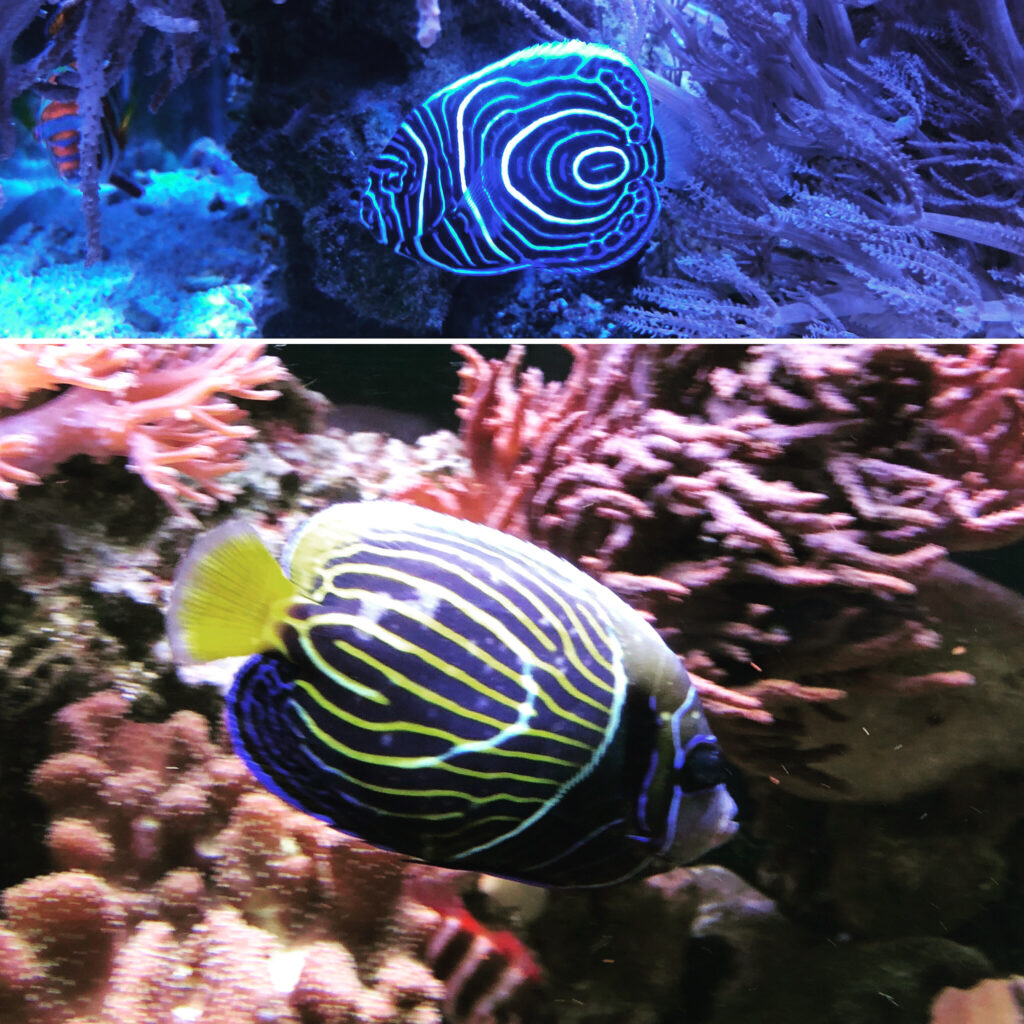
The contrast between juvenile and adult Angelfish is perhaps the most dramatic in the ocean. The Emperor Angelfish, for example, begins life as a dark blue fish with concentric white and light-blue circles. As it matures, these circles straighten out into horizontal yellow and blue stripes, and a black mask forms over the eyes.
Why the Change?
- Visibility vs. Camouflage: Juveniles often inhabit "cleaner stations." Their bright, contrasting patterns might act as a signal to larger fish that they are there to provide a service (removing parasites) rather than being a snack.
- Territorial Signaling: As Damselfish mature, they become some of the most aggressive fish on the reef. They often lose their "electric" juvenile spots and turn a more uniform, drab color. This shift signals to other Damselfish that they are now mature enough to defend a territory.
How Diet and Habitat Shape the Face: Teeth and Growth
A fish’s makeover isn't just skin deep; it’s also structural. As we discussed in Beyond the Bite, a fish's dentition is perfectly adapted to its diet. Juvenile fish often have much smaller, finer teeth designed for picking tiny plankton out of the water column.
As they grow, their mouth structure changes. A juvenile Triggerfish might start by eating small crustaceans, but as its jaw strengthens and its "trigger" matures, it moves on to crunching through sea urchins and hard-shelled mollusks. This physical evolution often mirrors their migration from "nursery" habitats like mangroves and seagrass beds (where they are protected by camouflage) to the high-energy environment of the outer reef.
Avoiding the 'Midnight Shift': Juvenile vs. Adult Hunting Tactics
The transition from day to night is the most dangerous time on the reef. In our guide to The Midnight Shift, we noted how apex predators use the "crepuscular" hours to hunt. Juvenile predators, like young Snappers or Groupers, face a double challenge: they need to hunt, but they are also small enough to be hunted by the adults of their own species.
To survive, juveniles often employ different hunting tactics than adults:
- The Crevice Strategy: While adult predators might roam the open water during twilight, juveniles stay tucked into small crevices, darting out only for a split second to grab prey.
- Color Dampening: Many juveniles have the ability to "mute" their colors at night, turning a mottled grey or brown to blend into the shadows of the reef, a feat they share with some cephalopods.
- The Big Sleep: Finding a safe spot for "the big sleep" is vital. Juveniles will often wedge themselves into holes that are too small for larger predators to enter.
Pro Tips for Identifying Juvenile Fish on Your Next Dive
Identifying these "teenagers" of the reef requires a different set of skills than standard fish ID. Here is how to sharpen your eyes:
- Focus on the Silhouette: Colors change, but the basic fin structure and body shape (the silhouette) often remain similar. Look at the tail shape and the position of the dorsal fin.
- Search for the 'Eye Spot': Many juveniles, like the Four-eye Butterflyfish, have a large, dark spot (ocellus) near their tail. This "fake eye" confuses predators into attacking the wrong end of the fish, giving the juvenile a chance to escape.
- Check the 'Nursery' Areas: Don't just look at the big coral heads. Spend time looking in the rubble, the sandy patches, and the seagrass. This is where the "master mimics" usually hide.
- Observe the Movement: If it’s wiggling like a leaf or a worm, it’s likely a juvenile. Adults tend to have more purposeful, streamlined swimming patterns.
Safety Reminder: Remember the Look But Don't Touch rule. Juvenile fish are incredibly fragile. Their stress levels can skyrocket if they are chased, which can lead to exhaustion and make them easy targets for predators. Observe from a distance and let them continue their "dance."
Conclusion: The Ever-Changing Canvas of the Coral Reef
The next time you’re underwater and see a fish that doesn't seem to fit any description, don't be frustrated. You aren't seeing a "missing link"; you are witnessing one of nature's most sophisticated survival strategies in action. The "drab to fab" (and sometimes "fab to drab") journey of these reef inhabitants is a testament to the incredible biodiversity of our oceans.
By slowing down and looking for these hidden life stages, you’ll discover a whole new layer of the reef's story. Every crevice and every patch of sand holds a master of disguise waiting to be found. So, on your next dive, keep your eyes peeled for the "fake eyes," the "toxic" dancers, and the neon-spotted youngsters. The reef is never just one thing—it is an ever-changing canvas, and its inhabitants are the ultimate performance artists.
Ready to see these master mimics for yourself? Check out our latest dive schedules and join us as we explore the hidden corners of the reef where the next generation is hiding in plain sight!
Further Reading
- Why Are Juvenile Marine Angelfish So Different From Adults? | Reef Builders | The Reef and Saltwater Aquarium Blog
- Why don't young fish look like adults? | Nausicaa
- Mastering Copepod Life Cycle in Aquarium for Thriving Reef Tanks
- Spiny Baby Sea Bass Illustrates Surprising Physiques of Young Fish | Scientific American