Loading...
marine-life#nudibranch hunting#spotting sea slugs#macro diving tips
The Nudibranch Hunter’s Handbook: How to Spot Tiny Sea Slugs Without a Macro Lens
Pro Dive Vibes
February 27, 202610 min read
Introduction: The Hidden World at Your Fingertips
For many divers, the early years of the sport are defined by a "bigger is better" mentality. We spend our surface intervals talking about the 4-meter manta ray that glided overhead or the elusive whale shark that cruised past the drop-off. But eventually, every diver reaches a plateau where the big stuff, while still majestic, starts to feel like a lucky roll of the dice. That is when the shift happens. You stop looking at the blue and start looking at the reef—really looking at it.
Welcome to the world of macro diving. Specifically, welcome to the cult of the nudibranch. These tiny, shell-less mollusks are the crown jewels of the ocean floor, boasting color palettes that would make a neon sign look dull. The best part? You don't need a $5,000 camera rig with dual strobes and a dedicated macro lens to appreciate them. While professional photographers spend hours framing a single shot, the "naked eye" hunter finds a different kind of satisfaction: the meditative joy of slow diving and the genuine thrill of the "find."
Spotting a 15mm creature in a vast, sprawling reef is the ultimate underwater scavenger hunt. It requires patience, precision, and a shift in perspective. By slowing your breathing and narrowing your focus, you aren't just diving; you are participating in the reef's secret life.
The Biological Advantage: Why They Are Where They Are
To find a nudibranch, you have to think like one. These creatures are essentially "naked snails" that traded their heavy shells for a more sophisticated defense system. As we explored in 'The Chemical Arms Race: Why Nudibranchs Are the Ocean’s Most Colorful Rebels', these slugs are the ultimate survivors. They don't hide in holes like octopuses or blend into the sand like flatfish. In fact, they often do the opposite.
This is "nudi-logic": because they are packed with toxic chemicals or "stolen" stinging cells from their prey, they want to be seen. Their vibrant colors serve as a warning sign—aposematic coloration—telling predators, "I taste terrible and I might kill you."
Unlike the subjects in 'Camouflage Masters: Spotting the Sneaky Creatures of the Sea', nudibranchs are often sitting right out in the open. They aren't trying to be invisible; they are just very, very small. Their biological confidence means that once you know their preferred habitats, they are surprisingly easy to spot because they aren't actively running away from you.
Follow the Food: The Secret to Finding Slugs
Nudibranchs are incredibly picky eaters. Most species specialize in eating one specific thing, and they will rarely be found more than a few inches away from their next meal. If you want to find the slug, you must first find the salad bar.
Searching for Sponges
Dorid nudibranchs—the ones with the "tuft" of gills on their back—are obsessed with sponges. They don't just eat them; they often take on the pigment of the sponge they are consuming. Look for sponges that have circular "bite marks" or patches of discoloration. If you see a bright orange sponge with a tiny, slightly-more-vibrant orange lump on it, you’ve likely found your target.
Looking for Hydroids and Bryozoans
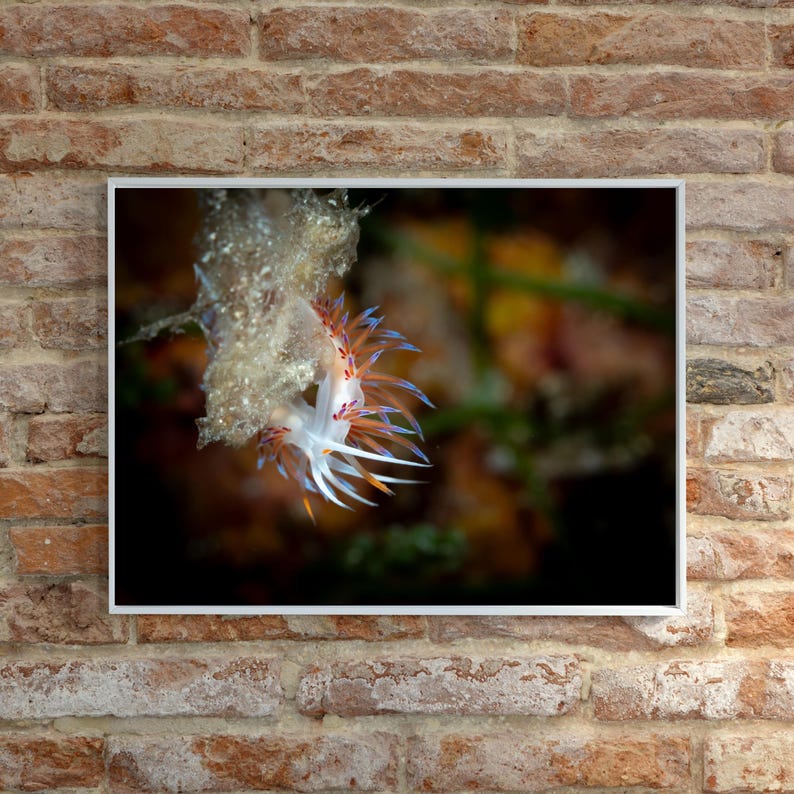
Aeolid nudibranchs—distinguishable by the "shaggy" finger-like projections (cerata) covering their bodies—prefer hydroids. To the untrained eye, hydroids look like tiny, white or brownish ferns or feathers sticking out of the reef.
Expert Tip: Gently watch the hydroids in the current. If you see a "lump" that isn't swaying at the same rhythm as the rest of the fronds, it’s probably an Aeolid hanging on for a snack.
Identifying Feeding Trails
Sometimes the clue isn't the animal itself, but the mess it left behind. Nudibranchs leave "feeding trails" where they have stripped the polyps off a soft coral or scraped the surface of a sponge. They also leave behind very distinct egg ribbons—spiraling, rose-like structures that are often more visible than the slugs themselves. If you see a bright red or white egg spiral, the parent is almost certainly nearby.
| Nudibranch Type | Primary Food Source | Identifying Feature |
|---|---|---|
| Dorid | Sponges | Branchial plume (butt gills) |
| Aeolid | Hydroids/Anemones | Cerata (shaggy "hairs") |
| Sacoglossan | Algae | Often green; "solar powered" |
Developing Your 'Macro Eyes'
The biggest hurdle for most divers is that their brains are wired to look for fish-shaped objects. To find nudibranchs, you need to develop a "Search Image." This is a cognitive trick where you train your brain to filter out the background noise and only alert you when it sees a specific shape or texture.
- The Texture Scan: Stop looking for "slugs" and start looking for "out of place textures." The reef is made of rough coral and porous sponges. A nudibranch has a smooth, gelatinous, or velvety texture that reflects light differently.
- The Peripheral Shift: Don't stare directly at one spot. Use your peripheral vision to detect the slightest movement. While nudibranchs move slowly, their rhinophores (the "horns" on their heads) or their gills might twitch in the current.
- Master Your Buoyancy: You cannot see a
1cmcreature if you are kicking your fins to stay level. You must be able to hover perfectly still, inches from the reef, without touching anything. - Slow Down:
You can cover the whole reef in one dive— actually, the best macro hunters might only move10 metersin a60-minutedive.
Visual Clarity: Seeing the Small Stuff
If your vision is blurry, your "macro eyes" won't stand a chance. This starts with basic mask hygiene. A fogged mask is the enemy of the nudibranch hunter. Ensure you are using a high-quality defogger and that your mask fit is perfect to avoid constant clearing, which disturbs the very silt you're trying to avoid.
As discussed in 'Beyond the Mask: See Clearly Underwater', choosing the right lens is vital. If you find yourself squinting at your dive computer, you might need a mask with positive diopter (reading) inserts.
For those who want to see the microscopic detail of a nudibranch's rhinophores without a camera, a simple underwater magnifying glass is a game-changer. These inexpensive tools allow you to see the intricate patterns and "lamellae" on the slug that are otherwise invisible to the naked eye.
Lighting the Way: Using a Torch to Make Colors Pop
Water absorbs light starting at the red end of the spectrum. By the time you are at 15 meters, that brilliant purple and orange nudibranch looks like a dull grey blob. This is why a high-lumen dive light is your most important tool—even on a bright, sunny day.
- The Color Pop: A torch brings back the reds, purples, and hot pinks. A sudden flash of "impossible" color against the brown reef is the number one way to spot a nudi.
- The Side-Lighting Technique: Don't point your light directly at the reef. Aim it from the side. This creates shadows that reveal the 3D relief of the creature. A flat-lit nudibranch blends into its background, but a side-lit one casts a shadow that makes it "jump" off the surface.
- Lumens Matter: For macro hunting, you don't need a wide beam. A spot beam of about
500-1000 lumensis perfect for highlighting tiny sections of the reef without scaring away nearby fish.

Where and When to Look: Prime Nudibranch Real Estate
While you can find nudibranchs on any healthy reef, some environments are "Gold Mines."
- Muck Diving: Don't be fooled by silty, sandy bottoms. Locations like Lembeh Strait or Anilao are world-famous because nudibranchs love the nutrient-rich runoff found in "ugly" environments. Look for any solid object in the sand—a discarded bottle, a single rock, or a stray piece of wood.
- Current-Swept Corners: Nudibranchs don't like being tossed around, but they love the food that current brings. Look on the leeward side of rocks in high-current areas.
- Seasonal Blooms: Just like flowers, certain nudibranch species "bloom" at different times of the year. Ask your local dive guide what is "in season." You might find hundreds of Chromodoris one month and none the next.
The Ethical Hunter: Look but Don't Touch
As a "Pro Dive Vibes" reader, you know that we respect the ocean. Nudibranchs are incredibly fragile. Their "horns" (rhinophores) are highly sensitive sensory organs, and their gills are exposed to the elements.
Warning: Never use a "muck stick" or your finger to move a nudibranch for a better view or a photo. This can damage their delicate tissues or stress them into "autotomizing" (shedding) parts of their body.
Nudi-Hunter Checklist:
- Maintain neutral buoyancy (no "finger-propping" on coral).
- Keep your torch at a distance to avoid overheating the animal.
- Avoid stirring up silt with your fins; it can smother the nudibranch's gills.
- Observe for a few minutes, then move on to let others see.
Beyond the Nudi: Other Micro-Treasures to Watch For
Once you have trained your eyes to find nudibranchs, a whole new world opens up. The same "slow and low" technique will help you spot other incredible creatures that most divers swim right over.
- Decorator Crabs: These are the ultimate masters of disguise. As mentioned in 'Caribbean Crabs: A Diver's Guide', these crabs attach sponges and algae to their shells. If you see a piece of "sponge" walking across the reef, you've found one.
- Pygmy Seahorses: Usually found on Gorgonian fans, these are the "boss level" of macro hunting. They are often smaller than a grain of rice.
- Ghost Pipefish: Often found hovering vertically near crinoids or seagrass, mimicking the blades of grass or the arms of the lily.
Conclusion: Becoming a Resident Reef Expert
Learning to spot nudibranchs changes the way you dive. It turns a standard recreational dive into an active exploration. You’ll find that your air consumption improves because you are moving less and breathing more deeply. You’ll find that your buoyancy becomes second nature because you have a reason to stay perfectly still.
But perhaps the greatest reward is the social one. There is a unique satisfaction in being the diver who signals the group, points to a seemingly empty patch of reef, and watches as the dive guide’s eyes go wide with excitement at your rare find.
Start your own "Nudi-Log" today. Document the species, the depth, and the food source you found them on. Before long, you won't just be a diver; you'll be a resident reef expert, seeing the world that everyone else is missing.