Loading...
marine-life#manta ray identification#mobula ray vs manta ray#marine life identification
Manta or Mobula? The Biological Keys to Identifying Every Ray You See
Pro Dive Vibes
June 25, 20269 min read

There is a specific kind of silence that falls over a dive group when a shadow passes overhead. It isn’t the silence of fear, but of collective awe. Whether you are drifting over a deep-sea pinnacle in the Azores or hovering at a cleaning station in the Maldives, the sight of a winged giant gliding through the blue is the pinnacle of the diving experience. These are the "winged giants" of our oceans—the family Mobulidae.
For many divers, any large ray with cephalic "horns" is simply a "Manta." However, as your diving experience grows, so should your biological curiosity. Distinguishing between a Manta and a Mobula (the "Devil Ray") isn't just about bragging rights in the dive boat; it is a fundamental skill for conservation. Much like our guide to identifying reef health, being able to accurately report what you see helps scientists track population trends and migration patterns.
In this guide, we will unlock the five biological keys to identifying every ray you see, turning you from a casual observer into a citizen scientist.
The Family Tree: Understanding the Mobulid Reclassification
Before we dive into the physical markers, we need to address a major shift in the scientific world. For decades, we categorized these animals into two distinct genera: Manta and Mobula. However, a groundbreaking 2017 taxonomic study using DNA sequencing proved that Mantas are actually just very large Mobulas.
Today, all these rays belong to the genus Mobula. However, for the sake of identification and common nomenclature, we still refer to the massive giants as "Mantas" and the smaller, pointier-winged cousins as "Devil Rays" or "Mobulas."
| Common Name | Current Scientific Genus | Typical Habitat |
|---|---|---|
| Oceanic Manta | Mobula birostris |
Pelagic/Open Ocean |
| Reef Manta | Mobula alfredi |
Coastal Reefs |
| Devil Ray | Mobula mobular |
Offshore/Deep |
| Munk's Ray | Mobula munkiana |
Coastal/Schools |
Knowing this reclassification is the first step in understanding that these animals are more closely related than they appear. While they share a common ancestor, their feeding strategies and environments have carved out distinct physical differences.
Key #1: The Mouth – Terminal vs. Subterminal
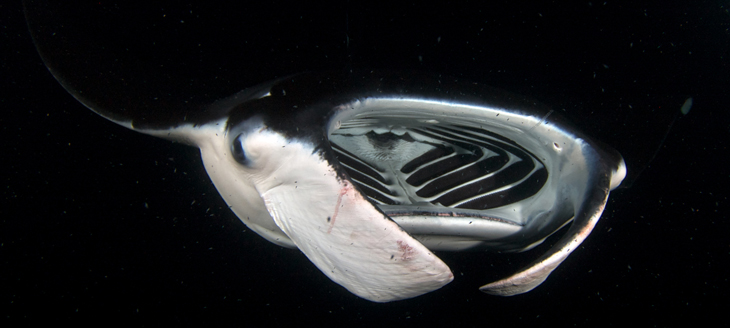
The most definitive biological key to identifying a ray is the placement of its mouth. This is a direct result of how the animal has evolved to feed on plankton.
The 'Manta Mouth' (Terminal)
In Manta rays (M. birostris and M. alfredi), the mouth is terminal. This means it is located at the very front of the head, looking like a wide, horizontal slit between the cephalic fins. When a Manta opens its mouth to feed, it looks like a giant cavernous intake. This placement allows them to swim straight through dense clouds of plankton at the surface or in the water column.
The 'Mobula Mouth' (Subterminal)
In almost all other Mobula species, the mouth is subterminal. This means it is located on the underside of the head, slightly tucked back from the leading edge of the snout. If you are looking a Mobula ray head-on, you might not see its mouth at all. This underslung position is more similar to what you see in shark body language and other rays like the Eagle Ray.
Expert Tip: If the ray looks like it has a "smile" right at the front of its face, it’s a Manta. If the face looks more like a smooth, rounded snout with the mouth hidden underneath, it’s a Mobula.
Key #2: Cephalic Fins – The 'Horns' of the Dilemma
Those iconic "horns" are actually modified pectoral fins called cephalic fins. Their purpose is purely functional: they act as funnels to push plankton-rich water into the ray's mouth.
Manta Fins: The Large Paddles
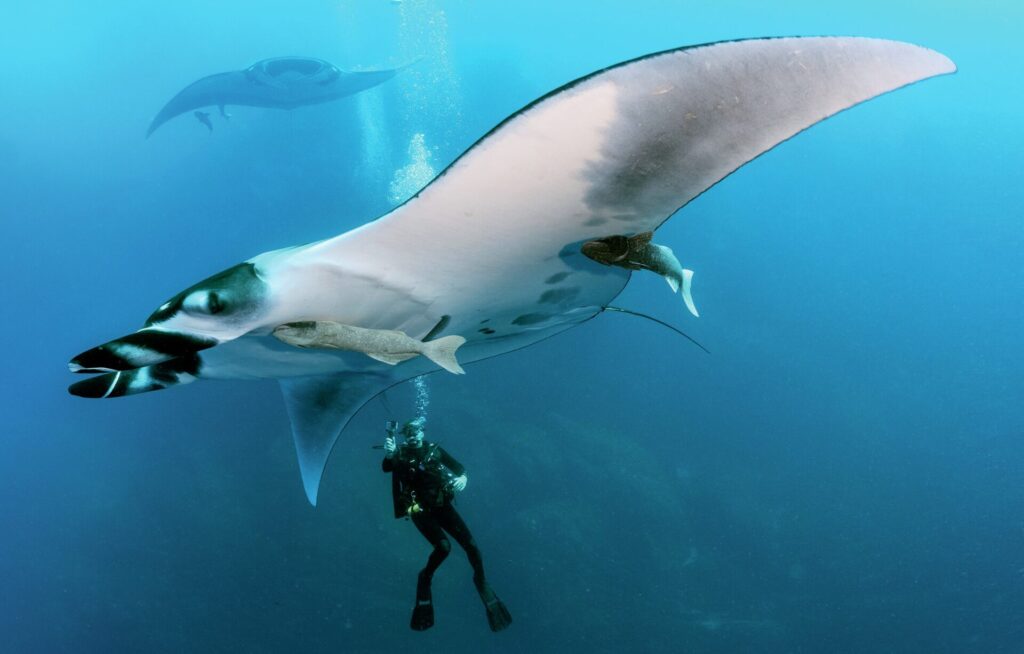
Manta cephalic fins are large, flexible, and paddle-like. When the ray is not feeding, it rolls these fins into tight, thick cylinders that look like scrolls. When they unfurl, they are wide and powerful, capable of directing massive amounts of water.
Mobula Fins: The Pointy Horns
In contrast, Mobula rays have shorter, pointier cephalic fins. Even when they are swimming without feeding, these fins often remain somewhat rigid and "horn-like." They are usually much thinner than a Manta’s rolled fins and have a more triangular appearance. This is why they earned the name "Devil Ray."
Key #3: Size and Scale – From Mini-Mobulas to Oceanic Titans
Size is often the first thing a diver notices, but it can be deceptive underwater due to magnification. However, the scale of these animals is a major clue.
- The Oceanic Manta (
Mobula birostris): These are the true titans. They can reach wingspans of up to7 meters(23 feet). If the ray looks like a small airplane and makes you feel tiny, it is likely an Oceanic. - The Reef Manta (
Mobula alfredi): Slightly smaller but still impressive, Reef Mantas average3 to 5 meters. They are the ones you’ll most likely see at cleaning stations. - The 'Mini' Mobulas: Most other Mobula species are significantly smaller, ranging from
1 to 3 meters. If you see a "miniature manta" that is only about a meter wide, it is almost certainly a species like the Munk’s Devil Ray.
How to estimate size underwater:
Don't rely on your memory—compare the ray to something of a known size. Is the wingspan wider than your dive buddy is tall? If yes, you are looking at at least 2 meters. Does it dwarf a standard 12-liter scuba tank? Use these references to get a more accurate estimate for your logbook.
Key #4: Tail Tales – Stingers, Lengths, and Spines
The tail is often the most overlooked part of the ray, yet it holds vital clues. Many divers wonder, "Can a Manta Ray sting me?" The answer is a definitive no.
- Manta Tails: Both Oceanic and Reef Mantas have relatively short, whip-like tails that are usually shorter than their body length. Crucially, Mantas do not have a stinging spine. They are completely defenseless in that regard, relying on their size and speed for protection.
- Mobula Tails: Many Mobula species have tails that are significantly longer than their bodies. Furthermore, some species (like the Giant Devil Ray) actually possess a serrated stinging spine at the base of their tail, similar to a stingray.
While they are not aggressive, it is important to treat all elasmobranchs with respect. Much like we discuss in our guide to ethical whale shark encounters, maintaining a respectful distance is key to a safe and prolonged interaction.
Key #5: Coloration and Markings – Nature’s Paintbrush
If you can get a clear view of the ray's back (dorsal) or belly (ventral), you have the "gold standard" of identification.
Dorsal Markings (The Back)
- Oceanic Mantas: Look for a distinct "T" shape in white on their shoulders. The black area forms a sharp "T" against the white.
- Reef Mantas: Look for a "Y" shape. The white markings on their shoulders are more rounded, and the black area between them looks like a soft "Y."
- Mobulas: Their backs are often more uniform in color—usually a dark brown, grey, or blue-black—without the bold white shoulder patches seen in Mantas. Some species may have white tips on their dorsal fins.
Ventral Spots (The Belly)
This is where the magic happens. Every Manta Ray has a unique pattern of spots on its belly, much like a human fingerprint. As we explored in our post on Manta Ray Fingerprints, these spots allow researchers to identify individual animals over decades.
- Reef Mantas: Usually have spots between their gill slits and all across their bellies.
- Oceanic Mantas: Generally have no spots between their gill slits; their spots are clustered further down toward the bottom of the belly.
- Mobula Rays: Often have plain, white bellies with very few, if any, distinct spots.
Behavioral Clues: The Social Lives of Rays
Sometimes, it isn't how the ray looks, but how it acts that gives it away.
The 'Flying' Mobulas
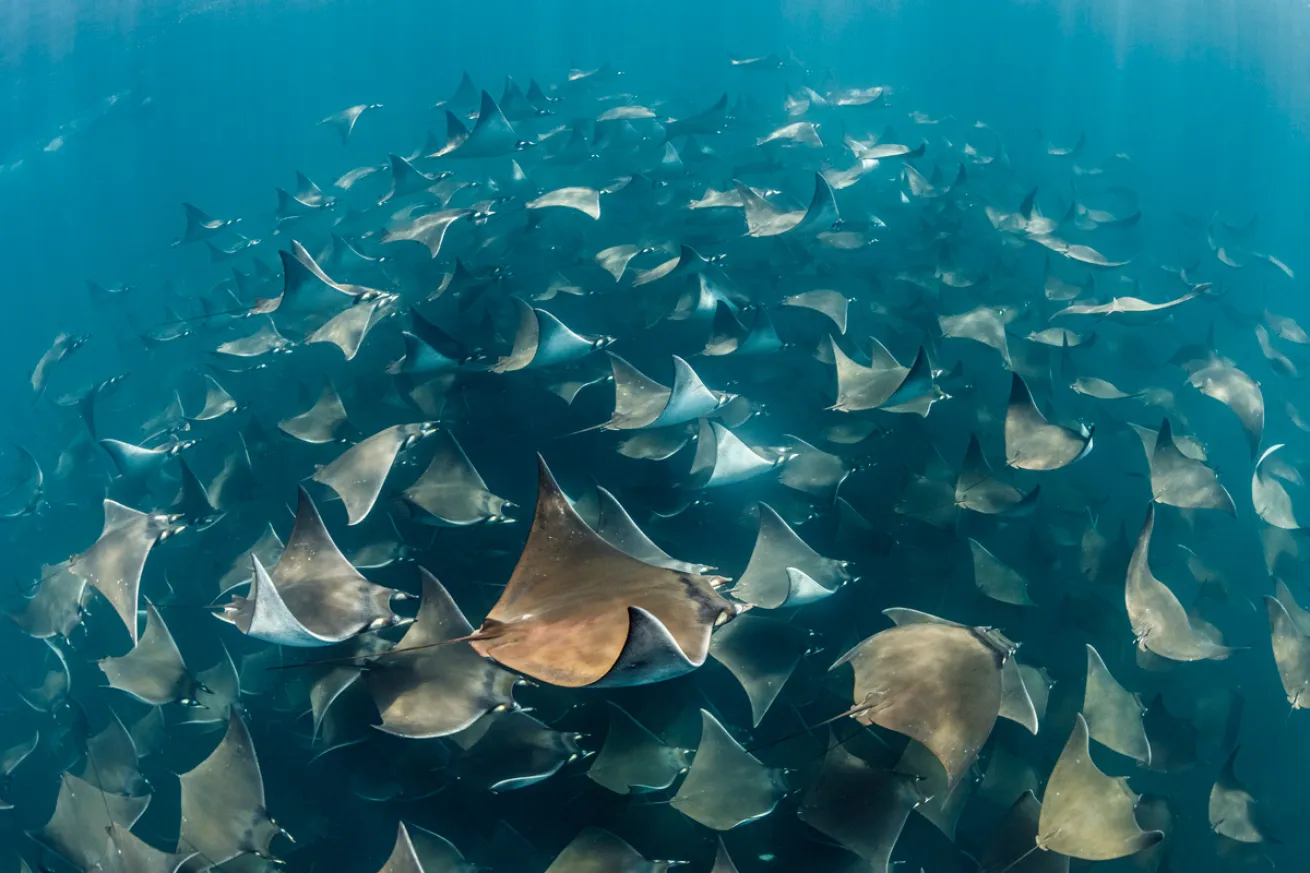
If you see a ray leap entirely out of the water, performing acrobatic flips before belly-flopping back down, you are watching a Mobula. This "breaching" behavior is a hallmark of species like the Munk’s Devil Ray. They also tend to travel in massive schools—sometimes numbering in the thousands—creating a "carpet" of rays in the water.
Manta Socializing
Mantas are more likely to be found in smaller groups or alone. They are famous for their "courtship trains," where several males follow a single female in a high-speed underwater dance. They are also much more likely to frequent "cleaning stations," where they hover motionless while small wrasse pick parasites off their skin. If you find a ray "hanging out" with divers at a reef, it is almost certainly a Reef Manta.
The Diver’s ID Checklist: A Quick Reference for Your Next Logbook
To help you on your next dive, use this mental checklist the moment you spot a winged shadow:
- Mouth Position: Is it at the very front (Manta) or underneath (Mobula)?
- Cephalic Fins: Are they large paddles (Manta) or short horns (Mobula)?
- Size: Is it massive (Manta) or under 2-3 meters (likely Mobula)?
- Tail: Is it short and smooth (Manta) or long and potentially spined (Mobula)?
- Shoulder Markings: Can you see a "T" or "Y" white pattern?
- Belly Spots: Did you get a photo of the "fingerprint"?
Reporting Your Sightings
Once you’ve made your ID, don’t let that data go to waste! Organizations like Manta Trust and **Marine