Loading...
marine-life#Goby and Pistol Shrimp symbiosis#shrimp goby behavior#marine mutualism
The Reef’s Unlikely Roommates: A Guide to Goby and Pistol Shrimp Symbiosis
Pro Dive Vibes
March 16, 20268 min read

Imagine a roommate who pays the rent by building and maintaining a luxury subterranean apartment while you act as the full-time security guard. In the human world, this sounds like a dream arrangement. In the underwater world, it is a daily reality for one of the most fascinating duos on the reef: the goby and the pistol shrimp.
This partnership is a textbook example of mutualism, a type of symbiotic relationship where both species benefit significantly from the presence of the other. While many divers spend their bottom time hunting for "the big stuff," those who take a moment to peer at the sandy patches surrounding the coral heads are often rewarded with a front-row seat to this miniature soap opera. In this guide, we will dive deep into the biology of these "unlikely roommates," explore the high-tech weaponry of the shrimp, and provide you with the skills needed to observe their complex communication without scaring them back into their burrows.
The Watchman: Why the Goby is the Ultimate Lookout
The goby, belonging to the massive and diverse Gobiidae family, is the eyes and ears of the operation. Evolution has stripped these small fish of heavy armor or significant defensive weapons, leaving them highly vulnerable to predators like groupers, snappers, and eels. To survive on the exposed sand flats, they have developed extraordinary sensory adaptations.
The most striking feature of a "Watchman Goby" is its eyes. Positioned high on the head, these bulbous orbs can rotate independently, providing a near-360-degree field of vision. They are finely tuned to detect the slightest change in light or the rapid movement of a predator’s shadow. While we often look at how we decode cephalopod color changes to understand the intent of an octopus, the goby’s communication is far more physical. They don't rely on shifting pigments; they rely on high-speed reflexes and body language.
Without a burrow, a goby is a snack. However, because they lack the physical tools to dig deep into the hard-packed sand and coral rubble, they have outsourced the labor. By partnering with a shrimp, the goby gains a secure retreat that is constantly being renovated and expanded.
The Engineer: The Pistol Shrimp’s Sub-Sand Construction
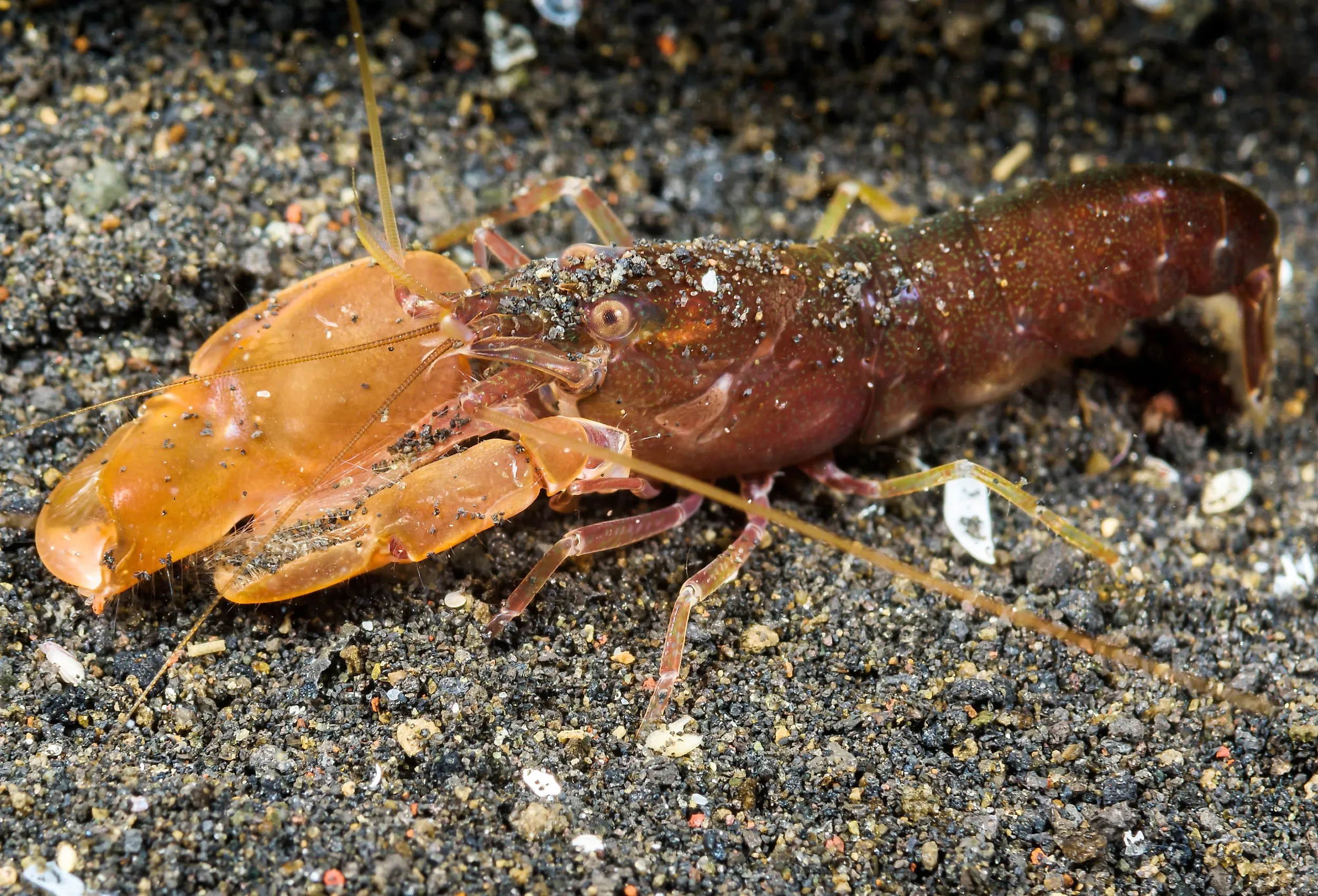
If the goby is the security guard, the pistol shrimp (family Alpheidae) is the heavy machinery. These crustaceans are the "bulldozers" of the seabed. Using their smaller claws like shovels and their larger bodies to push debris, they work tirelessly to clear sand, pebbles, and shell fragments from their tunnels.
However, the pistol shrimp has a major biological disadvantage: it is nearly blind. In the murky world of a subterranean tunnel, eyesight isn't a priority, but the moment the shrimp steps outside to dump a load of sand, it becomes an easy target. This is where the Caribbean crabs and other reef crustaceans differ; while many crabs rely on camouflage or hard shells to survive in the open, the pistol shrimp relies entirely on its roommate's vision.
The shrimp’s role is one of constant maintenance. Ocean currents and the movement of larger fish are forever threatening to collapse the burrow entrance. You will often see the shrimp emerging from the hole, pushing a mound of sand like a tiny tractor, only to disappear and return seconds later with more.
The Science of the 'Snap': The Pistol Shrimp’s Secret Weapon
The pistol shrimp isn't just a construction worker; it's also packing heat. One of its claws is disproportionately large, and it doesn't function like a normal pincer. Instead, it works like a hammer and anvil.
When the shrimp snaps this claw shut at speeds exceeding 100 km/h, it creates a high-pressure water jet. This movement is so fast that it creates a cavitation bubble. As this bubble collapses, it generates a massive amount of energy, including:
- Acoustic Pressure: The "snap" can reach up to
218 decibels, making it one of the loudest sounds in the ocean. - Extreme Heat: For a tiny fraction of a second, the temperature inside the collapsing bubble reaches roughly
4,700°C—nearly as hot as the surface of the sun. - Sonoluminescence: The collapse produces a brief flash of light, though it is invisible to the naked eye.
This "Big Bang" is used to stun small prey or ward off intruders. For the goby, this sound serves as a secondary alarm system. If the goby misses a predator's approach, the literal shockwave from its roommate’s claw is a clear signal that it’s time to retreat.
The Handshake: How They Communicate Through Touch
The most incredible part of this relationship is the Antennal Contact system. Because the shrimp cannot see the danger, it maintains a physical "handshake" with the goby. Whenever the shrimp is outside the burrow, it keeps at least one of its long, sensitive antennae in constant contact with the goby’s tail or body.
This is a sophisticated form of non-verbal communication, much like the "social contracts" we observe at underwater cleaning stations. The goby uses a series of specific tail flicks to transmit data:
- The Gentle Quiver: "All clear, keep digging."
- The Sharp Twitch: "Potential danger detected, stay alert."
- The Rapid Flick and Dive: "Immediate threat! Retreat now!"
The shrimp is incredibly sensitive to these vibrations. If the goby darts into the hole, the shrimp is usually right on its heels, often disappearing before the goby has even fully entered.
Diversity in Partnership: Common Species You’ll Encounter
While there are dozens of species of both gobies and shrimps, certain pairings are iconic in the diving world. Depending on where you are diving, the colors and sizes may vary, but the behavior remains remarkably consistent.
| Goby Species | Shrimp Partner | Primary Region |
|---|---|---|
| Yellow Watchman Goby | Tiger Pistol Shrimp | Indo-Pacific |
| Wheeler’s Shrimp Goby | Red-Banded Pistol Shrimp | Indian Ocean |
| Orange-Spotted Goby | Belligerent Pistol Shrimp | Western Pacific |
| Randall’s Goby | Candy Stripe Pistol Shrimp | Coral Triangle |
In biodiversity hotspots like Cape Kri in Raja Ampat, you can find dozens of these pairs within a single square meter of sand. Some gobies have even evolved specialized fin shapes—longer, more rigid dorsal fins—to act as better signaling flags for their shrimp companions.

The Evolutionary 'Why': Benefits of Mutualism
Why did these two species evolve such a complex dependency? The answer lies in survival statistics and energy conservation.
Mutualism is just a friendly coincidence — actually, it is a hard-coded survival strategy. Research shows that gobies in partnership with shrimps have a much higher survival rate than those attempting to live in natural crevices. By having a custom-built home, the goby saves energy that would otherwise be spent searching for cover.
Similarly, the shrimp’s ability to forage and maintain its burrow is vastly increased when it doesn't have to stop every three seconds to check for predators. This allows both animals to focus on feeding and reproduction. As we noted in our look at fish teeth and mouth structures, specialized traits like the goby’s mouth—designed for sifting sand and signaling—support this collaborative lifestyle.
A Diver’s Guide to Spotting the Duo
Spotting a goby and shrimp pair requires a change in perspective. You have to stop looking at the reef and start looking at the "wasteland" of the sand flats.
How to Find Them
- Look for the 'Sand Fan': An active burrow usually has a semi-circular fan of freshly excavated sand and small rocks leading away from the entrance.
- Scan for the Sentinel: Look for the goby first. They usually sit just outside or at the very edge of the hole, propped up on their pelvic fins.
- Watch for Movement: If you see a tiny puff of sand coming out of a hole, a shrimp is hard at work.
Observation Etiquette
- [ ] Stay Low: Get as close to the sand as possible without touching it.
- [ ] Control Your Buoyancy: Heavy breathing or erratic movements will send them diving.
- [ ] Be Patient: It may take 2-5 minutes of stillness before the shrimp feels safe enough to resume work.
- [ ] Mind the Tunnels: Never plant a finger or a muck stick near the entrance, as you may collapse the delicate tunnel system.
Pro Tip for Photographers: To capture the "handshake," use a long macro lens (100mm or equivalent). This allows you to maintain a respectful distance. Focus on the goby’s tail where the shrimp’s antenna rests, and wait for the shrimp to emerge with a load of sand.

Conclusion: The Importance of Small-Scale Symbiosis
The relationship between the goby and the pistol shrimp is a powerful reminder that the reef is not just a collection of individuals, but a complex web of cooperation. While it’s easy to be distracted by the intentions of reef predators or the "sunset dance" of Mandarin fish, the health of the ocean often rests on these micro-wonders.
These tiny roommates show us that survival isn't always about being the biggest or the strongest; sometimes, it’s about finding the right partner and learning how to communicate. On your next dive, take a moment to settle near the sand, steady your breathing, and watch the ultimate reef partnership in action. You’ll find that even the smallest residents of the ocean have incredible stories to tell.