Loading...
marine-life#Mola Mola#Ocean Sunfish#marine biology
Mola Mola Encounters: Why the World’s Heaviest Bony Fish Visits the Shallows
Pro Dive Vibes
June 4, 20269 min read

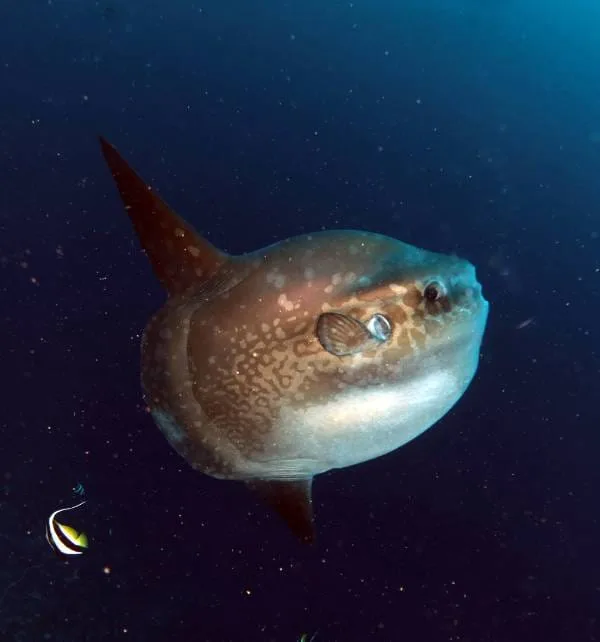
If you were to ask a child to draw a fish and then stop halfway through, you’d likely end up with something resembling a Mola mola. Often described as a "floating head" or a "biological work in progress," the Ocean Sunfish is one of the most surreal sights a scuba diver can encounter. With its truncated body, giant eyes, and tall, flapping dorsal and anal fins, it looks like it belongs in a prehistoric sea rather than a modern reef.
Yet, this bizarre appearance hides a biological powerhouse. The Mola mola holds the prestigious title of the world’s heaviest bony fish. While we often think of the massive Whale Shark as the heavy hitter of the ocean, it belongs to a different class entirely. The Mola is the king of the Osteichthyes (bony fish), with some specimens weighing in at over 2,300kg (5,000 lbs) and reaching lengths of 3 meters or more.
Scientifically, the Mola belongs to the order Tetraodontiformes, making it a surprising relative of the pufferfish and triggerfish. There are three primary species divers might encounter: the common Mola mola, the giant Mola alexandrini (Bump-head Sunfish), and the more elusive Mola tecta (Hoodwinker Sunfish). Each shares the same fundamental design: a body that ends abruptly in a rudder-like structure called a clavus instead of a traditional tail.
Bony vs. Cartilaginous: The Mola Mola vs. The Whale Shark
To appreciate the Mola’s size, we first have to understand the fundamental split in fish evolution. Fish are generally divided into two groups: Chondrichthyes (sharks and rays with cartilaginous skeletons) and Osteichthyes (fish with skeletons made of bone).
While the Whale Shark is significantly larger than the Mola, its skeleton is made of flexible cartilage. The Mola mola, however, builds its massive frame out of hard, calcified bone. This makes its weight-to-size ratio incredible. Reaching 2,000kg+ on a diet of mostly water-based organisms is an evolutionary feat that requires a unique skeletal structure.
| Feature | Mola Mola (Ocean Sunfish) | Whale Shark (Rhincodon typus) |
|---|---|---|
| Classification | Bony Fish (Osteichthyes) |
Cartilaginous Fish (Chondrichthyes) |
| Max Weight | ~2,300kg |
~20,000kg |
| Skeleton | Calcified Bone | Flexible Cartilage |
| Tail Type | Clavus (Pseudo-tail) |
Heterocercal (True tail) |
| Defense | Thick skin and depth | Massive size |
The Mola’s skeleton has evolved to be relatively light for its size to compensate for its lack of a swim bladder. Instead of using a gas-filled organ to maintain buoyancy, the Mola relies on a thick layer of low-density subcutaneous gelatinous tissue. This allows them to move between the crushing pressures of the deep and the surface without the risk of an expanding or contracting air sac.
The Vertical Commute: Life Between the Extremes
For a long time, researchers believed Molas were lazy drifters, at the mercy of ocean currents. We now know they are actually high-performance "vertical commuters."
The Mola mola spends a significant portion of its life in the mesopelagic zone, diving to depths of 600 meters or more. Down in the darkness, they hunt for their primary food sources: siphonophores and jellyfish. These deep-sea foraging trips are physically demanding; the water at those depths is near freezing, which slows the Mola’s metabolism and chills its core temperature.
So, why does a deep-sea specialist spend so much time in the shallows where recreational divers can see them? The answer lies in the need to recover from these extreme dives. When you see a Mola at 20 meters on a reef or floating at the surface, you aren't just seeing a fish—you’re seeing a giant battery that has come to the shallows to recharge.
Sunbathing and Thermal Refueling
The name "Sunfish" isn't just a poetic descriptor; it’s a scientific observation. Molas are frequently seen lying flat on their sides at the ocean surface, seemingly basking in the sun.
This behavior is a critical part of their survival strategy known as behavioral thermoregulation. After spending hours in the cold, dark depths hunting, the Mola’s internal temperature drops significantly. By floating at the surface and exposing its massive surface area to the sun’s rays, the Mola "recharges" its body heat.
This thermal refueling is essential for:
- Digestion: Their metabolic enzymes require warmth to process the massive amounts of jellyfish they consume.
- Muscle Function: Warmer muscles allow for more efficient swimming and faster escapes from predators like sea lions or orcas.
- Metabolic Recovery: Warming up helps clear the physiological debt incurred by deep-sea diving.
Pro Tip: If you see a Mola basking on the surface while you're on the dive boat, don't jump in immediately. This is a vulnerable state for the fish, and a sudden splash can spook them before they’ve finished their "recharge."
The Spa Treatment: Why Molas Love Cleaning Stations
While sunbathing helps with temperature, the Mola’s visits to the reef are often motivated by a more irritating problem: parasites.
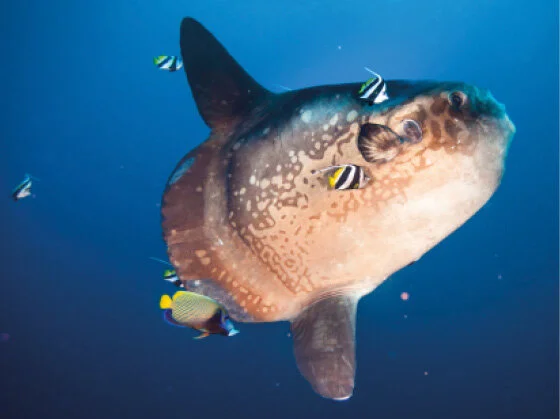
Molas are essentially floating hotels for hitchhikers. Because of their slow swimming speeds and massive surface area, they can carry up to 40 different genera of parasites simultaneously. From flatworms to crustaceans, these parasites burrow into the Mola’s thick skin and even inhabit its gills and mouth.
To combat this, Molas utilize the reef’s "Social Contract." Much like the dynamics we explored in The Reef’s Spa Day, Molas head to specific cleaning stations where they signal for help. By swimming into a head-up or head-down vertical position, they tell the local reef fish that they are "open for business" and won't eat the cleaners.
- Cleaner Wrasse and Butterflyfish: These reef residents will swarm the Mola, picking off parasites that the giant fish cannot reach itself.
- Avian Assistance: In a rare cross-species interaction, Molas basking at the surface have been observed allowing seabirds, such as gulls, to land on them and pluck parasites directly from their skin.
Seeing a 2-ton Mola being meticulously groomed by a 2-inch Butterflyfish is one of the most humbling displays of symbiosis in the ocean.
The Diet of a Giant: How to Grow Massive on Jellyfish
It seems counterintuitive that an animal weighing two tons could survive on a diet consisting almost entirely of jellyfish—creatures that are 95% water and notoriously low in calories.
The secret lies in volume and specialized anatomy. As we noted in our guide to the purpose of teeth in reef fish, the Mola doesn't have traditional individual teeth. Instead, their teeth are fused into a beak-like structure, similar to a parrotfish but without the grinding plates.
To eat, the Mola uses suction feeding, pulling jellyfish into its mouth and then using a second set of jaws located in its throat—known as pharyngeal teeth—to shred the gelatinous prey before it reaches the stomach. To maintain its massive physique, a Mola must consume hundreds of pounds of jellyfish and salps every single day.
Where and When to See the Mola Mola
Because Molas follow cold-water upwellings and jellyfish blooms, their appearances are often seasonal. If you want to cross the Mola mola off your bucket list, these are the world's premier hotspots:
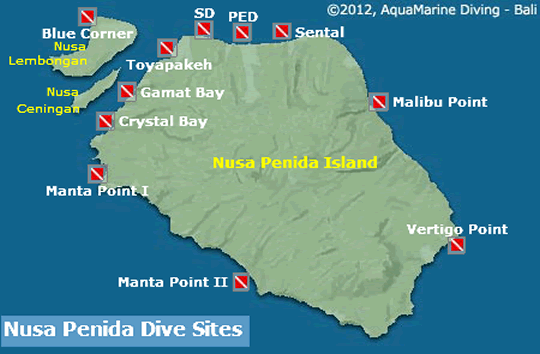
1. Nusa Penida & Nusa Lembongan, Indonesia
This is arguably the most famous place for Mola sightings. Between July and October, cold currents from the deep Indian Ocean rise to the surface (upwelling), bringing Molas to the cleaning stations at sites like Crystal Bay and Blue Corner.
- Conditions: Expect strong currents and thermoclines where the water temperature can drop from
28°Cto18°Cin seconds.
2. The Galapagos Islands, Ecuador
The Galapagos offers year-round Mola encounters, particularly around Punta Vicente Roca on Isabela Island. The deep, nutrient-rich waters here provide a constant buffet for Sunfish.
3. The Alboran Sea (Mediterranean)
The coast of southern Spain is a major migratory corridor for Molas. Divers often see them here in the spring and early summer as they move between the Atlantic and Mediterranean.
Ethical Encounters: How to Dive with a Sunfish Responsibly
Molas are sensitive giants. Despite their size, they are easily spooked and can be physically harmed by improper diver behavior.
You can touch a Mola because their skin is like sandpaper — Actually, you should never touch a Mola. Their skin is covered in a thick layer of protective mucus. Touching them can rub this layer off, leaving the fish vulnerable to infections and the very parasites they are trying to get rid of.
Follow this checklist for a respectful encounter:
- Maintain Distance: Stay at least
5 metersaway to avoid making the fish feel cornered. - Do Not Blow Bubbles Directly Underneath: Large plumes of bubbles can startle a Mola, causing it to flee the cleaning station prematurely.
- Avoid the Path of Travel: Never swim directly in front of a Mola; always stay to the side.
- No Flash Photography: In the clear, shallow water where Molas are cleaned, ambient light is usually sufficient. Heavy strobes can spook them.
- Choose Eco-Conscious Operators: Look for shops that follow the "Mola Code of Conduct" (common in Bali and the Galapagos).
Using the lessons from our Whale Shark guide, remember that we are guests in their home. A calm, still diver will almost always get a longer, more intimate encounter than one who chases the fish.
The Future of the Sunfish: Conservation and Challenges
The Mola mola is currently listed as Vulnerable by the IUCN. While they aren't usually targeted by commercial fisheries, their habit of basking at the surface and their slow movement makes them highly susceptible to bycatch. In some fisheries, Molas can make up nearly 30% of the total catch weight, only to be discarded.
Plastic pollution is another grave threat. Because Molas specialize in eating jellyfish, they frequently mistake floating plastic bags for their prey. Once ingested, plastic can cause fatal blockages in their complex digestive tracts.
The good news? Divers are helping. Through citizen science platforms, divers can upload photos of Mola sightings. Because the patterns of parasites and skin markings can be unique, biologists use these photos to track migration patterns and population health.
Conclusion: Embracing the Weirdness of the Reef
The Mola mola is a reminder that the ocean still holds mysteries that defy our expectations of "normal." It is a deep-sea giant that sunbathes like a tourist, a 2,000kg behemoth that eats "water," and a prehistoric