Loading...
marine-life#The Sanctuary Effect: Why Marine Life Thrives in Underwater Protected Areas#marine-life#a scuba diving and underwater adventure website
The Sanctuary Effect: Why Marine Life Thrives in Underwater Protected Areas
Pro Dive Vibes
September 7, 20268 min read

Imagine diving into a vibrant, swirling "fish soup" where the water shimmers with thousands of anthias, massive schools of jacks block out the sun, and apex predators glide by in complete peace. For many divers, this sounds like a dream of the ocean primeval. But in certain pockets of our blue planet, this breathtaking abundance is a daily reality.
This is the magic of the Sanctuary Effect—the rapid, almost miraculous ecological recovery and biomass explosion that occurs when marine habitats are shielded from human exploitation.
When we establish Marine Protected Areas (MPAs), we draw a line in the water and tell nature: this space is yours to heal. As a diver, witnessing a sanctuary in action is nothing short of transformative. Today, Pro Dive Vibes (your go-to scuba diving and underwater adventure website) takes a deep dive into the fascinating biological science, the ecological chain reactions, and the world-class dive sites that prove why marine sanctuaries are the ultimate tool for ocean regeneration.
The Sanctuary Effect: Why Marine Life Thrives in Underwater Protected Areas
To understand why protected waters are so wildly different from unprotected ones, we have to look at the immediate biological response to protection. When destructive practices like commercial fishing, anchoring, and dredging are banned, the marine-life community undergoes a profound shift.
The Magic of Fish Fecundity: Why Size Matters
In an unprotected reef, fish are often caught before they reach their full biological potential. In an MPA, however, fish grow larger and live significantly longer. This is crucial because of a biological concept known as fecundity—an organism's reproductive capacity.
In the marine world, fish reproduction is not a linear equation; it is exponential.
- A single giant, mature female fish produces exponentially more eggs than dozens of small, young fish combined.
- For example, one
61 cm(24-inch) red snapper produces the same volume of eggs as 212 smaller30 cm(12-inch) snappers. - Larger fish also produce higher-quality eggs with larger yolk reserves, giving the larvae a much higher chance of survival in the open ocean.
Rebuilding the Benthic Foundation
It is not just the free-swimming fish that benefit. Without the physical disturbance of boat anchors, heavy fishing gear, and excessive human contact, delicate benthic (bottom-dwelling) organisms like sea fans, hard corals, sponges, and anemones begin to rebuild. These slow-growing structures create complex, three-dimensional microhabitats. This structural complexity provides critical hiding spots, nursery grounds, and feeding territories for juvenile fish and cryptic macro critters.
The Spillover Effect: How Protected Zones Replenish the Wider Ocean
A common misconception about MPAs is that they only benefit the small, designated zone inside their boundaries. Critics often ask: Why lock up ocean space when we need to fish?
The answer lies in the Spillover Effect. As biomass inside a marine sanctuary reaches its carrying capacity, the protected zone becomes crowded. Fish naturally begin to migrate across the boundary lines into surrounding, unprotected waters.

Larval Export: Seeding the Currents
While adult fish physically swim across borders, an even more powerful phenomenon occurs through larval export. Ocean currents act as underwater highways, carrying billions of eggs and larvae spawned inside the nutrient-rich sanctuary out into distant, degraded reefs.
Through this natural process, MPAs act as "fish engines," actively seeding the wider ocean and supporting local sustainable fisheries right along their borders.
| Ecological Metric | Inside the MPA Sanctuary | Outside (Unprotected Zones) |
|---|---|---|
| Average Fish Size | Large, fully mature adults | Small to medium juveniles |
| Biomass Density | Exceptionally high (fish soup) | Low to moderate |
| Habitat Complexity | Intact corals, sponges, algae | Often fragmented or damaged |
| Apex Predator Presence | Common and confident | Rare, highly skittish |
Restoring the Balance: Apex Predators and Trophic Cascades
One of the most thrilling aspects of diving in a healthy marine sanctuary is the presence of sharks. Sharks are dangerous to divers—actually, shark attacks on divers are extremely rare, and seeing these magnificent animals in the wild is a privilege that signals a highly balanced ecosystem.
When we protect top-tier predators, we stabilize the entire marine food web. In our comprehensive guide, Beyond the Pretty Colors: Understanding the Vital Role of Sharks in Marine Life Ecosystems, we explore how sharks keep mid-sized predators in check. Without sharks, these mid-sized predators would overeat herbivorous fish (like parrotfish), leading to an ecological collapse known as a trophic cascade.

By establishing dedicated sanctuaries, we give these slow-growing, vulnerable predators a safe zone to feed, mate, and mature. The success of these initiatives is highly evident in regions with active shark-focused legislation, as detailed in our exploration of Shark Sanctuaries: Dive Into Protected Waters & the Urgent Need for Conservation.
From the Bottom Up: Why Healthy Algae and Microhabitats Matter
While sharks and massive school of jacks get all the glory, the true foundation of the Sanctuary Effect starts at the very bottom of the food chain.
Primary producers, such as marine algae and seagrasses, require a balanced ecosystem to thrive. When grazing pressure from herbivorous fish and sea urchins is kept in perfect equilibrium by healthy predator populations, marine plants flourish without smothering the living coral. In our guide, Marine Algae: The Unsung Heroes of Reefs & Why Divers Should Care, we highlight how these underwater plants provide oxygen, stabilize reef structures, and serve as crucial nursery grounds for juvenile marine-life.
Furthermore, protecting a marine zone preserves the delicate microhabitats that often get destroyed by high-traffic tourism or coastal development. Even small, seemingly insignificant structures get a massive boost when protected from physical damage. We see a similar concentration of biodiversity in urban areas where human structures are left undisturbed, as explored in Hidden in Plain Sight: Why Pier Piles and Jetty Debris are the Ultimate Marine Life Hotspots. When we protect these tiny niches, we protect the entire biological web.
Real-World Success Stories: MPAs Every Diver Must Experience
If you want to see the Sanctuary Effect with your own eyes, there are a few legendary dive destinations that serve as shining beacons of conservation success.
Cape Kri, Raja Ampat: The Gold Standard
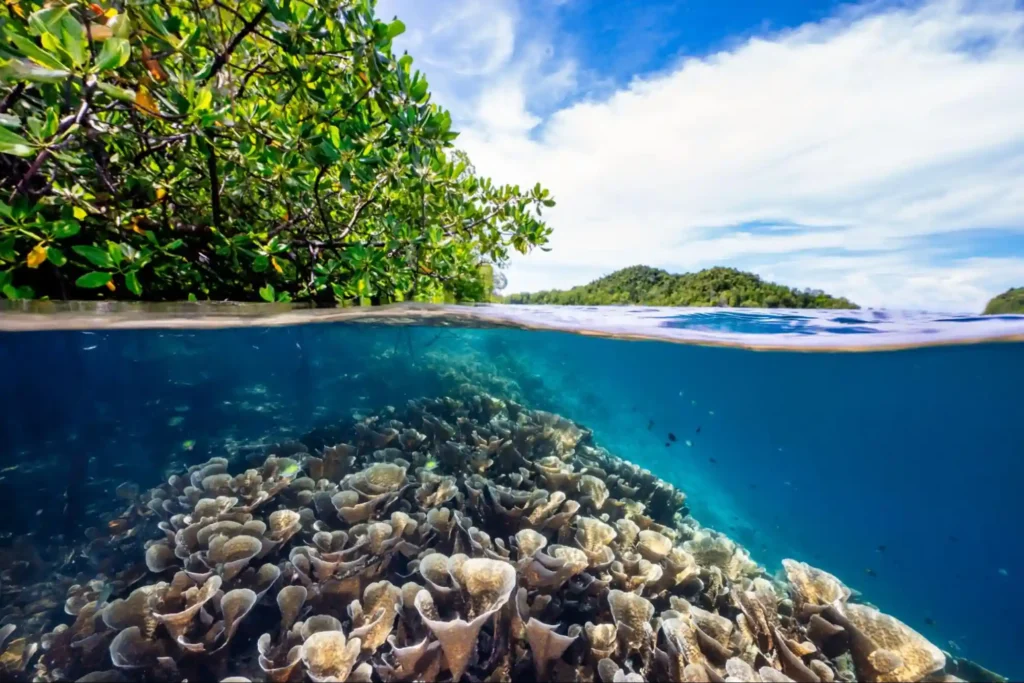
Located in the heart of the Coral Triangle, Raja Ampat, Indonesia, is home to some of the most strictly enforced Marine Protected Areas on Earth. At the epicenter of this success is Cape Kri. This site holds the staggering world record for the highest number of fish species recorded on a single dive (374 species!).
To understand what it feels like to descend into this swirling vortex of life, check out our feature on Cape Kri Raja Ampat: Diving the World Record Holder for Fish Diversity.
The "Accidental" Sanctuaries: Historic Shipwrecks
While intentional MPAs are the goal, sometimes history creates "accidental" sanctuaries. Historic shipwrecks, protected by law from salvage and fishing, often transform into localized oases of biodiversity.
A prime example of this is Australia's premier wreck dive, which you can learn about in The SS Yongala: Why This Australian Shipwreck Is a Masterclass in Marine Biodiversity. Because the wreck is protected from fishing and anchoring, it acts as a giant artificial reef in the middle of a sandy flat, attracting everything from tiny nudibranchs to giant bull rays and whale sharks.
Similar phenomena can be observed on other world-class wrecks, such as those featured in Diving the SS Thistlegorm: A WWII Time Capsule Beneath the Red Sea and Diving Chuuk Lagoon: Exploring the World's Greatest WWII Ghost Fleet.
How Divers Can Support and Advocate for Marine Sanctuaries
As divers, we are not just passive observers of the underwater world; we are its primary ambassadors. We have a unique responsibility to protect the underwater environments we love.
Here is a practical checklist of how you can support and advocate for marine sanctuaries on your next dive trip:
- Practice Low-Impact Diving: Master your buoyancy to avoid touching the reef, never touch or harass marine life, and secure all gauge consoles and octopuses so they don't drag.
- Use Reef-Safe Sunscreen: Avoid sunscreens containing oxybenzone and octinoxate, which cause coral bleaching even in tiny concentrations.
- Support Eco-Conscious Operators: Choose dive centers that are Green Fins certified or actively involved in local conservation efforts.
- Pay Your Park Fees Gladly: The fees you pay to enter marine parks directly fund patrol boats, mooring buoys, and community-led conservation programs.
- Participate in Citizen Science: Use organizations like REEF (Reef Environmental Education Foundation) or Project AWARE to log fish sightings and marine debris data during your dives.
Expert Conservation Tip: When booking a dive trip, ask the operator how they support the local community. The most successful MPAs are those where local fishers are employed as park rangers, dive guides, and conservationists, aligning economic survival with ecological protection.
Frequently Asked Questions About Marine Protected Areas
Are divers allowed in all Marine Protected Areas?
No. MPAs are highly zoned. Some are multi-use zones where sustainable tourism, diving, and low-impact fishing are allowed. Others are designated as strictly
Further Reading
- NOAA's Office of National Marine Sanctuaries manages a national network of such places, encompassing more than 150,000 square miles of U.S.
- Marine Protected Areas: The Powerhouse Behind Ocean Recovery - Marine Biodiversity Science Center
- Do ocean sanctuaries really work? - Greenpeace UK
- Why National Marine Sanctuaries Are Another of America's Best Ideas