Loading...
marine-life#The Sounds of the Reef: What Marine Life Is Actually Telling Us#marine-life#a scuba diving and underwater adventure website
The Sounds of the Reef: What Marine Life Is Actually Telling Us
Pro Dive Vibes
September 19, 20265 min read

When Jacques Cousteau released his groundbreaking documentary The Silent World in 1956, he introduced generations of land-dwellers to a serene, blue universe of quiet majesty. For decades, we descended into the depths expecting absolute tranquility. But as modern marine biology has advanced, we have learned that Cousteau’s famous moniker was a beautiful mistake.
In reality, a healthy coral reef is anything but silent. It is a roaring, crackling, popping, and humming underwater metropolis, alive with a continuous acoustic symphony.
Welcome to the fascinating science of marine bioacoustics. Here at Pro Dive Vibes—a scuba diving and underwater adventure website dedicated to bringing you closer to the deep blue—we want to help you tune your ears to this hidden auditory dimension. While our companion guide, identifying marine life by sound, teaches you how to recognize who is making which noise, this article dives into the ecological "why." We are going to explore The Sounds of the Reef: What Marine Life Is Actually Telling Us, uncovering the survival strategies, mating rituals, and navigational beacons hidden within the ocean's soundscape.
The Language of Survival: What Reef Animals Are Actually Saying
Sound is one of the most efficient ways to transmit information underwater. Because water is denser than air, sound waves travel approximately 1,500 meters per second (about 4.9 times faster than through the atmosphere). For reef residents, this acoustic efficiency is the key to survival, serving as a primary tool for defense, courtship, and alarm.
Territorial Warnings: The Feisty Damselfish
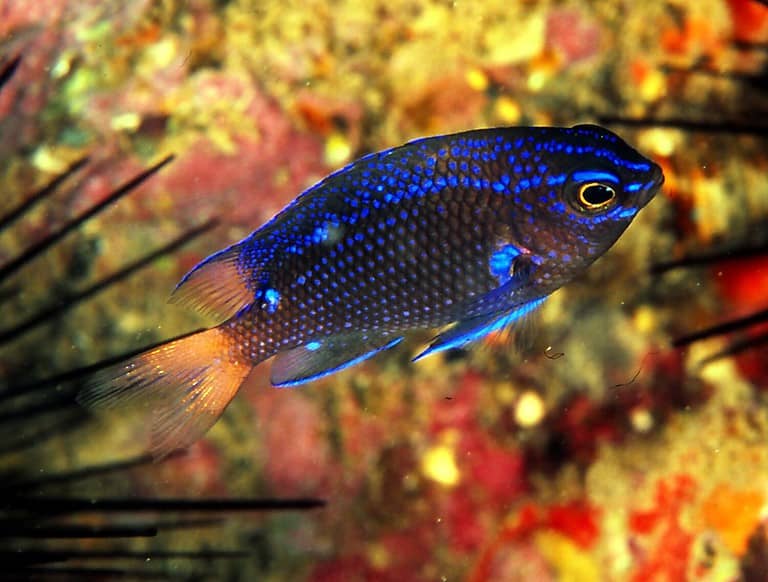
If you have ever hovered too close to a patch of brain coral, you may have been aggressively charged by a tiny fish no larger than your palm. This is the territorial damselfish. These miniature guardians cultivate and protect patches of marine algae, which serve as their primary food source.
To defend their underwater gardens, damselfish do not just rely on physical posturing; they launch a full auditory assault. By rapidly clicking their jaw bones and grinding their pharyngeal teeth together—a physiological trait detailed in our guide on the purpose of teeth in reef fish—they emit rapid-fire pops, chirps, and clicks. These acoustic warnings translate to a very clear message: "Back off, this garden is mine."
Mating and Courtship: Low-Frequency Love Songs
When the sun begins to set, the reef's acoustic profile shifts from defensive bickering to romantic serenades. Many fish species rely on sound to coordinate spawning events.
- Groupers: During spawning aggregations, male groupers vibrate their swim bladders using specialized muscles to produce deep, booming, low-frequency hums. These sub-bass rumbles travel long distances, signaling their physical fitness and readiness to mate to distant females.
- Toadfish: Nestled in rocky crevices, male toadfish produce a rhythmic, boat-whistle-like drumming sound that can last for hours. It is an exhausting energetic investment designed to lure passing females into their nesting sites.
Distress and Alarm: Collective Defense
When a predator like a reef shark or a barracuda cruises into a zone, the local fish population does not stay silent. Many species of squirrelfish and soldierfish emit sudden, sharp, metallic-sounding clicks when they detect danger. These distress signals act as an immediate alarm system, triggering collective defense behaviors that cause nearby schools of fish to instantly dart into the safety of the coral branches.
| Marine Species | Sound Type | Primary Frequency | Meaning / Purpose |
|---|---|---|---|
| Damselfish | Rapid pops & chirps | 500 Hz - 1 kHz |
Territorial defense of algae gardens |
| Grouper | Deep, booming hums | 50 Hz - 100 Hz |
Courtship and spawning coordination |
| Toadfish | Rhythmic drumming | 100 Hz - 300 Hz |
Mate attraction to nesting sites |
| Snapping Shrimp | High-velocity snaps | 2 kHz - 20 kHz+ |
Hunting, defense, and habitat mapping |
The Acoustic Beacon: How Sound Acts as an Ocean GPS
For many marine species, life begins far away from the safety of the reef. As tiny, microscopic larvae, many fish and invertebrate species drift out into the vast, featureless open ocean. This pelagic phase protects them from reef predators while they grow, but it presents a massive challenge: once they are strong enough to settle, how do they find their way back home?
The answer lies in nature's how marine life navigates system. While chemical cues (smell) and magnetic fields help with long-distance orientation, sound acts as the ultimate close-range homing beacon.
The collective, high-frequency "crackle" of billions of snapping shrimp, combined with the low-frequency rumbles of resident fish, creates an acoustic lighthouse. This unique sonic signature can be detected by larval fish several kilometers away. Drifting larvae use their specialized otoliths (ear stones) to detect the direction of this acoustic signature, swimming purposefully toward the sound of a bustling, healthy reef.
The Reef's Health Report Card: What a Loud Reef Tells Us
For marine biologists, listening to the reef is equivalent to a doctor listening to a patient's heartbeat. By deploying underwater microphones called hydrophones, scientists can record the "soundscape" of a reef to assess its overall health and biodiversity.
A healthy reef is a noisy reef. When we look at how coral reefs function like cities, the acoustic profile reflects the density of its citizens. A thriving reef features a complex, multi-layered soundscape: the high-pitched static of snapping shrimp, the scraping sounds of parrotfish as the reef's architects munching on limestone, and the grunts of territorial fish.

Conversely, a degraded, overfished, or bleached reef falls eerily silent. Without the structural complexity of live coral