Loading...
marine-life#Beyond the Pretty Colors: Understanding the Vital Role of Sharks in Marine Life Ecosystems#marine-life#a scuba diving and underwater adventure website
Beyond the Pretty Colors: Understanding the Vital Role of Sharks in Marine Life Ecosystems
Pro Dive Vibes
August 25, 20266 min read
Welcome to Pro Dive Vibes, a scuba diving and underwater adventure website dedicated to exploring the deep blue.
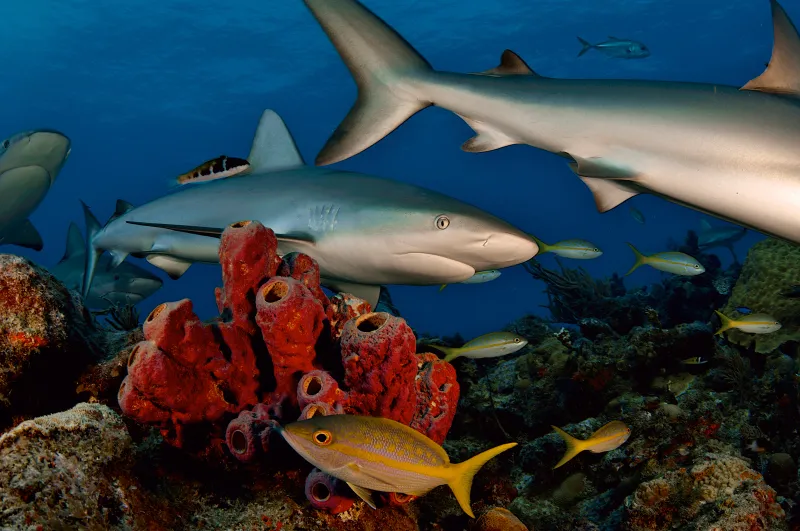
When you descend into a tropical dive site, your eyes are immediately drawn to the explosive palette of the coral reef. The electric orange of anthias, the deep blues of surgeonfish, and the neon yellows of butterflyfish create a dazzling, kinetic mosaic. It is easy to get swept up in this beautiful, sun-lit spectacle. Yet, if you look past the busy schools of reef fish and peer into the deeper, shadowy blue, you might spot a sleek, silent silhouette patrolling the drop-off.
Too often, divers focus exclusively on the brilliant coral gardens while fearing or ignoring the apex predators roaming the edges. Today, we are looking Beyond the Pretty Colors: Understanding the Vital Role of Sharks in Marine Life Ecosystems. Sharks are not the mindless, bloodthirsty monsters portrayed by Hollywood. Instead, they are the essential biological architects keeping our oceans healthy, balanced, and alive. Without them, the vibrant colors we love to photograph would quickly fade into a monoculture of decay.
Beyond the Pretty Colors: Understanding the Vital Role of Sharks in Marine Life Ecosystems
To understand the health of our oceans, we must look past superficial beauty. Every creature on a reef has a job, but none hold a more critical position than sharks. As apex predators, sharks have spent more than 400 million years shaping the evolution of marine-life. They are the guardians of the balance, ensuring that no single species dominates the ecosystem to the detriment of others.
When we protect sharks, we are not just saving a single predatory species; we are preserving the intricate web of life that supports everything from microscopic plankton to the massive manta rays we love to dive with. To truly appreciate what we see on our dives, we must understand how these predators maintain the structural integrity of the underwater world.
The Trophic Cascade: How Sharks Keep the Food Web in Check
In ecology, a trophic cascade is a powerful indirect interaction that can control entire ecosystems. When an apex predator is present, it regulates the populations of mid-sized predators (known as mesopredators), which in turn protects the herbivorous species lower down the food chain.
On a coral reef, sharks sit at the very top of this pyramid. They hunt mid-sized predators like groupers, snappers, and large jacks.
- Without sharks: The populations of these mid-sized hunters explode.
- The consequence: Overpopulated mesopredators consume massive quantities of smaller, herbivorous fish.
- The final impact: The reef loses its vital algae-eating workforce.
This is where our colorful friends, the parrotfish, come into play. As detailed in our guide, The Sand Makers: Why Parrotfish Are the Reef’s Most Important Architects, these herbivorous fish act as the reef's cleanup crew, scraping away suffocating algae. If sharks are removed from the equation, the resulting boom in groupers and snappers decimates parrotfish populations.
Without parrotfish to graze the reef, fast-growing macroalgae quickly smothers the living coral. This shift is disastrous. As explored in Marine Algae: The Unsung Heroes of Reefs & Why Divers Should Care, while algae is a crucial component of a healthy reef in small amounts, unchecked algal overgrowth blocks sunlight, starves coral of nutrients, and eventually turns a thriving reef into a desolate, grey wasteland. By keeping mesopredators in check, sharks indirectly ensure that corals can breathe, grow, and maintain their brilliant colors.
Survival of the Fittest: Sharks as Ocean Doctors
Beyond controlling population sizes, sharks act as the primary health inspectors of the ocean. In the wild, hunting is an energy-intensive task. To conserve energy, sharks naturally target the easiest prey: the sick, the weak, the old, and the genetically inferior.
By culling these compromised individuals, sharks perform two vital ecological services:
- Disease Control: They halt the spread of infectious diseases and parasites through fish populations before an outbreak can devastate an entire school.
- Genetic Strength: They ensure that only the healthiest, fastest, and most resilient individuals survive to reproduce, driving the evolutionary strength of prey species.
To accomplish this, sharks rely on a highly specialized biological toolkit. While they have excellent vision and an acute sense of smell, it is their ability to detect electrical fields that makes them such efficient "doctors."

Using specialized sensory organs called the Ampullae of Lorenzini, sharks can detect the tiny bioelectric fields generated by the muscle contractions of living creatures. A sick or injured fish emits a distressed, irregular electrical signature, acting like a beacon for a patrolling shark. You can dive deeper into this fascinating biological superpower in our article, The Shark's Sixth Sense: Understanding Electroreception and the Ampullae of Lorenzini.
Expert Diver Tip: Understanding that sharks target weak and distressed signals is key to safe diving. When diving with sharks, avoid thrashing, rapid ascending, or making erratic movements that could mimic the bioelectric or acoustic signature of injured prey.
Nutrient Cycling: Connecting the Deep Blue to the Shallow Reefs
We often think of sharks as resident reef dwellers or distant deep-sea wanderers, but many species constantly move between these two worlds. Through their vertical and horizontal migrations, sharks serve as vital nutrient conduits across the ocean.
Many pelagic and reef shark species spend their days resting or patrolling shallow reefs and their nights hunting in deep, offshore waters. When they feed in the nutrient-rich depths and return to the relatively nutrient-poor shallow reefs, they transport vital organic matter.
Through their excretion (defecation and urination), sharks distribute essential nutrients like nitrogen and phosphorus directly onto coral reefs and seagrass beds. This localized fertilization boosts the productivity of phytoplankton and marine plants, which form the base of the entire marine-life food web. In nutrient-poor tropical waters, this constant influx of "deep-sea fertilizer" is a primary driver of reef resilience and growth.
The Diver's Perspective: Sharing the Water with Reef Guardians
For decades, sensationalized media has taught us to fear sharks. But as divers, we have the privilege of seeing the truth firsthand. Sharks are dangerous man-eaters waiting to attack—in reality, sharks are generally cautious, respectful, and highly indifferent to scuba