Loading...
marine-life#Venomous Marine Life Safety: Identifying Risks Without the Panic#marine-life#a scuba diving and underwater adventure website
Venomous Marine Life Safety: Identifying Risks Without the Panic
Pro Dive Vibes
November 1, 20265 min read

Welcome to the fascinating realm of marine biology, where defense mechanisms are sculpted by millions of years of evolution. For many scuba divers, encountering creatures armed with sharp spines, invisible tentacles, or lethal neurotoxins can trigger an automatic spike in heart rate. However, mastering Venomous Marine Life Safety: Identifying Risks Without the Panic begins with a crucial mindset shift: ocean inhabitants use venom purely for survival and self-defense, never out of unprovoked malice toward humans.
Venomous ocean creatures are aggressive monsters lurking to attack divers — in reality, almost every envenomation incident occurs when a diver accidentally steps on, touches, or corners an animal.
To dive safely and confidently, it is essential to distinguish between venomous and poisonous organisms:
- Venomous animals actively deliver toxins into another organism using a specialized apparatus, such as spines, barbs, stingers, or beak-like jaws (e.g., stingrays, lionfish, blue-ringed octopuses).
- Poisonous animals contain toxins within their tissues that cause harm passively when ingested or absorbed (e.g., pufferfish, certain sea cucumbers).
Reframing fear into biological appreciation allows you to admire the breathtaking complexity of underwater ecosystems. When you understand how these creatures behave and defend themselves, anxiety fades, replaced by heightened awareness. A calm, observant diver is ultimately the safest diver on any scuba diving and underwater adventure.
Spotting the Hidden Marvels: Identifying Key Venomous Species
Recognizing hazardous marine life in their natural habitats is the first line of defense. Venomous animals generally rely on one of two survival strategies: blending seamlessly into the environment or displaying vibrant, contrasting colors to warn potential predators away.
Stonefish and Scorpionfish
Stonefish (Synanceia) and scorpionfish (Scorpaenidae) are the undisputed kings of biological camouflage. Resting quietly on rocky reefs, coral rubble, or sandy bottoms, their skin mimics algae-covered rocks and encrusting sponges.
- The Risk: Stonefish possess
13stout dorsal spines capable of piercing boot soles and delivering a potent cytotoxic venom. - Identification Tip: Look for immobile "rocks" with subtle gill movements, downturned mouths, or tiny, highly detailed eyes.

Lionfish
With their dramatic fins and bold vertical stripes, lionfish display classical warning coloration (aposematism).
- The Risk: Lionfish feature
13sharp dorsal spines,3anal spines, and2pelvic spines loaded with protein-based venom. - Identification Tip: Watch for slow-swimming fish with fan-like pectoral fins hovering near overhangs or artificial reefs. If you are exploring Atlantic or Caribbean waters where these invasive predators thrive, check out our detailed guide on lionfish look-alikes to accurately separate them from native species.
Blue-Ringed Octopus
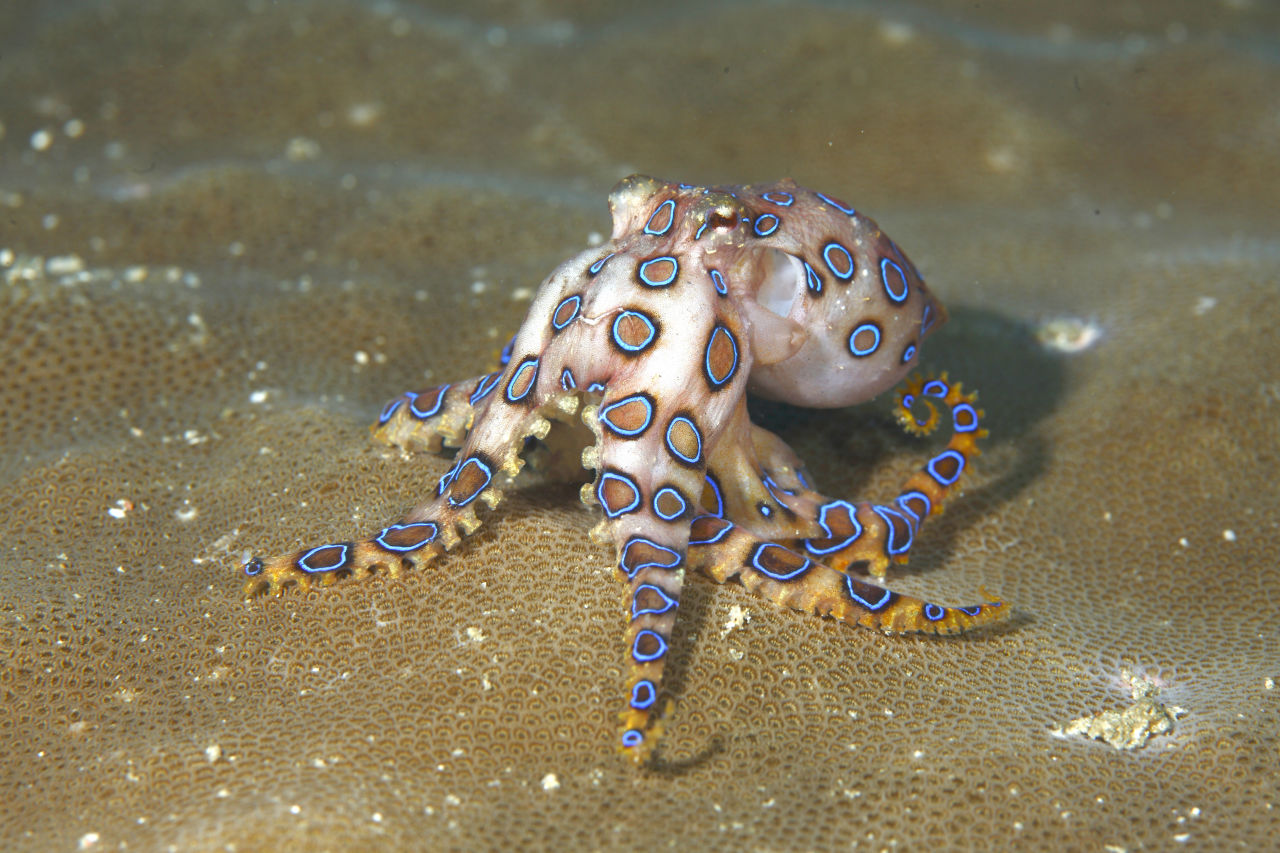
Measuring just 12 to 20 centimeters, the tiny blue-ringed octopus (Hapalochlaena) carries tetrodotoxin—a neurotoxin powerful enough to block nerve signaling and cause muscular paralysis.
- The Risk: Bites are typically painless but life-threatening if unmanaged.
- Identification Tip: While normally a muted yellow or brown, when harassed or stepped on, its body flashes dynamic, iridescent electric-blue rings across its skin.
Sea Wasps and Box Jellyfish
Floating gracefully through the water column, box jellyfish (such as Chironex fleckeri) use stinging cells called nematocysts to capture prey.
- The Risk: Tentacles can extend up to
3 meterslong and inflict excruciating, potentially fatal stings within minutes. - Identification Tip: Look for transparent, cube-shaped bells propelling themselves through shallow coastal waters, particularly during known seasonal blooms in tropical regions.
Stingrays
Stingrays are docile bottom-dwellers that spend much of their day partially buried in soft sediment.
- The Risk: A serrated, venomous barb located along the upper tail structure, used strictly as a whip-like defense when stepped on.
- Identification Tip: Look for raised mounds in the sand, visible tail tips, or spiracles blowing small clouds of dust on sandy flats.
| Marine Species | Primary Habitat | Visual Warning Signs | Venom Delivery Apparatus |
|---|---|---|---|
| Stonefish | Shallow rocky/coral rubble reefs | Mottled, encrusted body; downturned mouth | 13 heavy dorsal spines |
| Lionfish | Coral heads, shipwrecks, wall crevices | Vibrant stripes, flared fan fins | 18 needle-sharp fin spines |
| Blue-Ringed Octopus | Tide pools, shallow coral rubble | Flashing iridescent blue rings | Beak-delivered salivary toxin |
| Box Jellyfish | Shallow coastal waters, mangroves | Transparent cube bell, trailing tentacles | Nematocysts along tentacles |
| Stingray | Sandy bottoms, seagrass beds | Buried outline, exposed tail in sand | Serrated tail barb |
The Psychology of Calm: Managing Underwater Anxiety Around Venomous Wildlife
When an encounter with a venomous creature takes a diver by surprise, fear can instantly trigger a physiological fight-or-flight response. Underwater, panic is a diver's true enemy.
Panic leads to rapid, shallow breathing, which accelerates air depletion, causes hyperventilation, and disrupts buoyancy control. A diver who panics risks uncontrolled ascents or accidental contact with the very reef structure they are trying to avoid.

If you unexpectedly find yourself hovering directly above a well-hidden stonefish or swimming near a lionfish, execute the Stop, Think, Breathe, Act safety protocol:
- Stop: Freeze your movement immediately to avoid kicking or making sudden contact.
- Think: Assess your position,