Loading...
marine-life#Open Water vs. Ocean Floor: Exploring Pelagic and Benthic Marine Life#marine-life#a scuba diving and underwater adventure website
Open Water vs. Ocean Floor: Exploring Pelagic and Benthic Marine Life
Pro Dive Vibes
October 31, 20267 min read

Descend beneath the waves, and you instantly enter a world governed by liquid physics, light refraction, and shifting currents. But as any experienced diver knows, not all dive sites feel the same. Descending into the bottomless blue off a volcanic drop-off feels worlds apart from sifting through the silt beneath a wooden harbor pier. When evaluating Open Water vs. Ocean Floor: Exploring Pelagic and Benthic Marine Life, you quickly realize you are exploring two entirely different ecological planets within a single body of water.
Here at Pro Dive Vibes—a scuba diving and underwater adventure website dedicated to deepening your appreciation of the underwater world—understanding marine zoning transforms every dive. Marine biologists divide the ocean into distinct ecological layers, primarily distinguished by whether organisms inhabit the open water column or live in direct contact with the seafloor.
The physical rules of survival shift dramatically between these zones. Depth dictates light penetration, temperature drops rapidly across thermoclines, and hydrostatic pressure increases by 1 atm every 10m (33ft) of depth. Whether a marine species swims perpetually through blue void or clings to a rock face determines its anatomy, camouflage, feeding behavior, and how you as a diver must approach it.
Two Oceans in One: Pelagic vs. Benthic Realms Explained
To navigate these ecosystems, we must first map the ocean’s architecture. Oceanographers broadly separate the marine environment into two primary realms: the pelagic realm (the open water column) and the benthic realm (the ocean floor and underlying substrate).
The pelagic realm is vast, accounting for over 330 million cubic miles of water. It is further stratified by light penetration:
- Epipelagic Zone (Sunlit Zone): Extending from the surface to
200m(656ft), where sunlight powers photosynthesis and fuels vast marine food webs. - Mesopelagic Zone (Twilight Zone): Stretching from
200mto1,000m(3,280ft), where faint light lingers, but plant life cannot survive. - Bathypelagic & Abyssopelagic Zones: Pitch-black, high-pressure environments reaching to the deepest trenches.
Conversely, the benthic zone encompasses every submerged surface, from shallow tidal sandbars and vibrant coral reefs to abyssal plains and hydrothermal vents.
Pro Tip: Don't confuse benthic with "deep." A shallow tide pool, a coral head at
5m, and a shipwreck at30mare all benthic environments because they rely on solid substrate.
The Wanderers of the Deep Blue: Exploring Pelagic Marine Life
Step off the dive deck into open ocean, look down, and you might see hundreds of feet of cobalt blue stretching into infinity. This is the realm of pelagic marine life—organisms that spend their existence swimming, drifting, or hunting without ever resting on the seafloor.
+------------------------------------------------------------------+
|                      EPIPELAGIC ZONE (0 - 200m)                  |
|  Sunlight Sunlight Sunlight Sunlight Sunlight Sunlight Sunlight  |
|                                                                  |
|   [Tuna]           [Manta Ray]          [Bait Ball]             |
|                                                                  |
|  --------------------------------------------------------------  |
|                      MESOPELAGIC ZONE (200m - 1000m)             |
|  Faint Twilight Light                                            |
+------------------------------------------------------------------+
Adaptations for the Void
Without rocks to hide beneath or algae to blend into, pelagic species rely on evolutionary engineering to survive open water:
- Hydrodynamic Streamlining: Pelagic predators like oceanic whitetip sharks, yellowfin tuna, and billfish feature torpedo-shaped (fusiform) bodies designed for low drag and high-speed endurance.
- Countershading: A classic pelagic camouflage. Animals feature dark backs (dorsal sides) to blend into the dark depths when viewed from above, and pale bellies (ventral sides) to blend into bright sunlit surface water when viewed from below.
- Schooling Dynamics: Smaller pelagic species form massive, tightly coordinated bait balls to confuse predators through visual overload.
Pelagic species are just aimless wanderers—in reality, pelagic animals navigate using geomagnetic cues, ocean temperatures, and bathymetric highways to travel thousands of miles across open basins.

Iconic Pelagic Encounters
For divers, pelagic encounters deliver adrenaline-pumping highlights. You might drift alongside majestic pelagic filter-feeders like whale sharks and oceanic manta rays, or encounter large pelagic apex predators cruising the pelagic blue. Even gentle drifters play a crucial ecosystem role; learn more by reading our guide on beyond the sting: the hidden ecology of jellyfish in the open ocean.
Diving in open, bottomless water requires specialized buoyancy skills and situational awareness. Before attempting a deep ocean drift, review our essential tips on into the deep blue: the blue water protocol and safety tips for pelagic diving.
Masters of the Seabed: Decoding Benthic Marine Life
If the pelagic realm is defined by constant motion and vast empty spaces, the benthic realm is defined by structure, micro-habitats, and patience. Benthic marine life lives on, in, or directly adjacent to the seafloor.
Substrates vary dramatically across benthic sites:
- Soft Substrates: Fine silt, volcanic black sand, and shell hash.
- Hard Substrates: Granitic boulders, limestone drops, and coral structures.
- Artificial Substrates: Wrecks, concrete breakwaters, and jetty pillars.
Survival Strategies on the Substrate
To thrive on the seabed, benthic organisms have developed some of the most bizarre and specialized adaptations in the animal kingdom:
- Masterful Camouflage: Specialized chromatophores allow octopuses, cuttlefish, and scorpionfish to alter their skin color and texture in milliseconds, perfectly mimicking surrounding coral or algae.
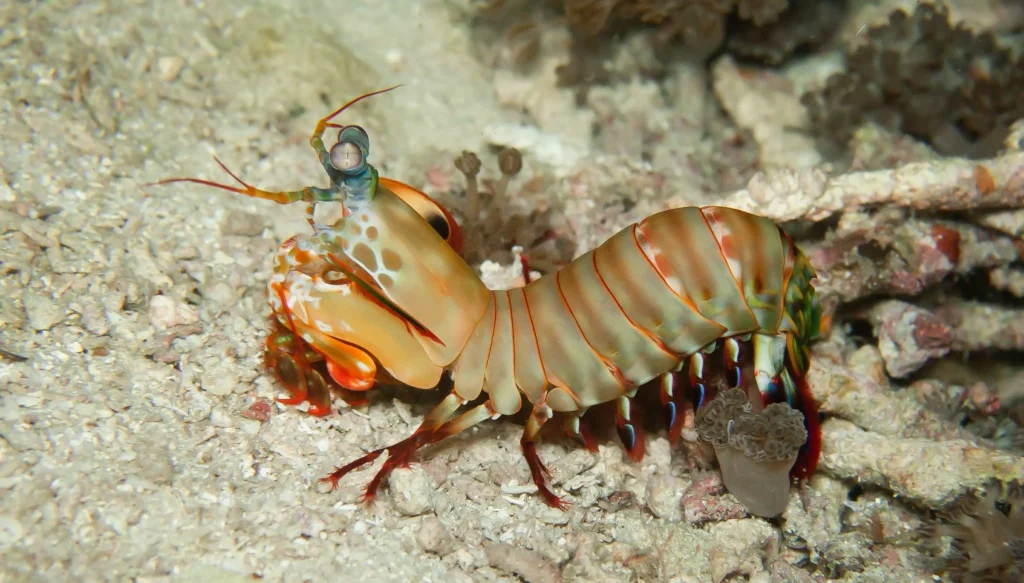
- Substrate Burrowing: Animals like jawfish, mantis shrimp, and garden eels construct complex burrows in sandy flats for shelter and ambush hunting.
- Specialized Feeding Mechanisms: Heavy jaw structures, crushing plates, and protrusible mouths allow benthic feeders to crack hard-shelled mollusks or siphon detritus out of sediment.
- Heavy Exoskeletons and Armor: Crustaceans, sea urchins, and starfish rely on structural defense rather than high-speed flight.
Iconic Seabed Dwellers
Benthic diving exposes divers to incredible macro life, from colorful nudibranchs and frogfish to bottom-dwelling elasmobranchs. When navigating sand flats, identifying bottom-bound elasmobranchs can be challenging; sharpen your identification skills with our practical guide to mastering the sand: how to tell skates, stingrays, and angelsharks apart.