Loading...
marine-life#coral bleaching vs disease#citizen science diving#coral reef health
Coral Bleaching vs. Disease: A Diver’s Guide to Identifying Reef Health
Pro Dive Vibes
March 10, 20269 min read
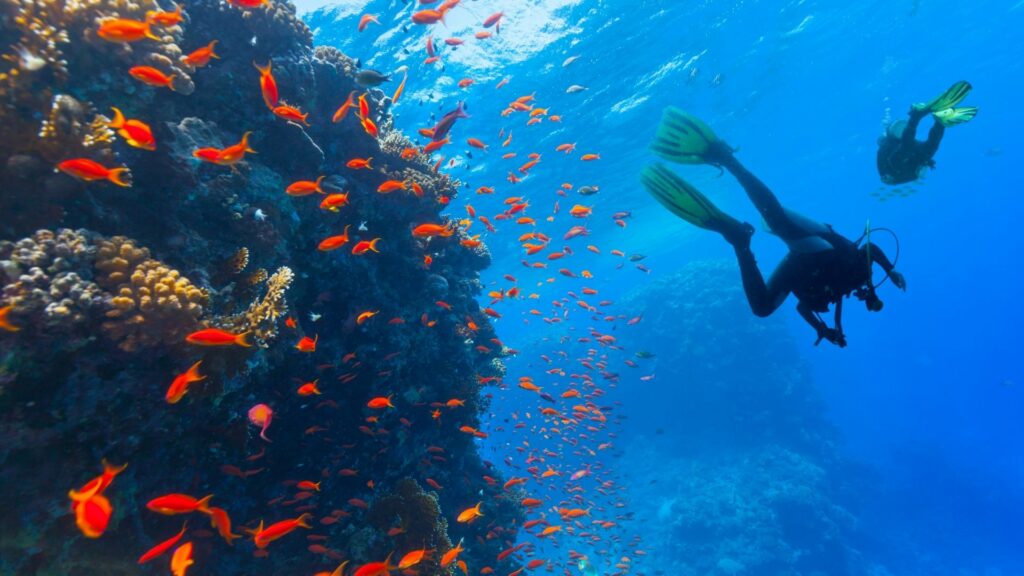
As you descend through the crystal-clear water, the first thing that usually grabs your attention is the explosion of color. Vibrant purples, neon greens, and deep oranges create an underwater mosaic that rivals any terrestrial rainforest. But as divers, we are more than just tourists in this liquid world; we are the eyes of the ocean. Because we visit these remote ecosystems regularly, we are often the first to notice when something is wrong.
Why Your Eyes Matter: The Power of the Citizen Scientist
For a marine biologist, monitoring a reef is a massive undertaking. They can’t be everywhere at once. This is where the citizen scientist—that’s you—comes in. By learning to distinguish between a healthy reef, a stressed one, and a diseased one, you bridge a critical data gap. Your observations provide real-time snapshots of reef health that help conservationists track the spread of threats and implement protection strategies.
Beyond the data, there is a deep emotional connection. Seeing a reef you love lose its luster is heartbreaking, but shifting from a passive observer to an active monitor transforms that feeling into agency. Monitoring our "underwater rainforests" isn't just about science; it's about protecting the very places that give us the sport we love. Much like learning to identify invasive species, recognizing coral health issues is a fundamental skill for the modern, eco-conscious diver.
Coral 101: The Symbiotic Relationship at Risk
To understand why reefs "turn white" or get sick, we have to understand what a coral actually is. It’s a common misconception that corals are just colorful rocks or underwater plants. In reality, a coral is a living animal—a colonial organism made up of thousands of tiny individuals called polyps.
These polyps have a fascinating "roommate agreement" with microscopic algae called zooxanthellae. This is a symbiotic relationship:
- The Coral provides the algae with a protected environment and the compounds they need for photosynthesis.
- The Zooxanthellae provide the coral with up to 90% of its nutrients (food) and give the coral its brilliant colors.
When you see a vibrant reef, you aren't just seeing the coral's tissue; you are seeing the pigment of billions of algae living inside that tissue. This partnership is the engine of the reef, allowing massive structures to grow in nutrient-poor tropical waters.
What is Coral Bleaching? The 'Ghost' of the Reef
Coral bleaching is a stress response. Imagine being stuck in a room that is five degrees too hot with no way to turn down the thermostat. Eventually, you’d get frustrated. Corals do the same thing, but their reaction is much more dramatic: they evict their roommates.
When water temperatures rise even slightly (sometimes as little as 1°C or 2°F above the seasonal maximum) or when UV radiation becomes too intense, the zooxanthellae begin to produce toxic oxygen compounds. To survive, the coral polyp expels the algae.
Visual Cues of Bleaching
When the algae are gone, the coral's tissue becomes translucent. What you are actually seeing is the white calcium carbonate skeleton shining through the clear flesh of the animal.
- The coral looks like a "ghost" or a skeletal version of itself.
- The tissue is still there, but the color (the pigment) is gone.
- Bleaching usually happens across entire colonies or even entire reef systems simultaneously.
The 'Fluorescent' Warning
In a desperate attempt to protect themselves from the sun, some corals produce colorful pigments that act as a sort of "internal sunscreen." This can cause the reef to glow in eerie, neon shades of purple, yellow, or blue before they turn completely white. This is a form of fluorescence, and while it looks beautiful in photos, it is actually a final cry for help.
Pro Tip:
Bleached coral is dead coral.This is a common myth! A bleached coral is "starving" and vulnerable, but it is still alive. If the water temperature returns to normal quickly enough, the coral can re-absorb zooxanthellae and recover.
Identifying Coral Disease: More Than Just a Color Change
While bleaching is a widespread stress response to environmental conditions, coral disease is an attack by pathogens—bacteria, fungi, or viruses. Disease is often more aggressive and localized than bleaching, and unlike bleaching, the coral tissue is often destroyed in the process.
Spotting the 'Front'
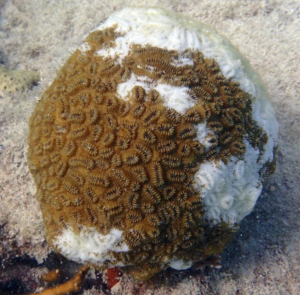
The hallmark of most coral diseases is a distinct disease front. This is a visible line or lesion that moves across the coral colony. On one side of the line, you have healthy, colorful tissue. On the other side, you have bare, dead skeleton.
Common Diseases to Watch For
- Stony Coral Tissue Loss Disease (SCTLD): One of the deadliest threats in the Caribbean. It spreads rapidly and can kill a centuries-old colony in weeks. It often appears as white patches that expand outward.
- Black Band Disease: A dark, cyanobacterial mat that moves like a slow-moving wave across the coral, consuming the tissue and leaving a dead skeleton behind.
- White Band Disease: Typically affects branching corals like Elkhorn and Staghorn, moving from the base of the branch toward the tip.
Visual Cues of Disease
- Sloughing Tissue: You might see bits of coral flesh peeling away or appearing "rotten."
- Exposed Skeleton: Unlike the translucent look of bleaching, diseased areas show the hard, white skeleton immediately, which often quickly becomes covered in brown or green algae.
- Rapid Progression: Disease can move across a colony in days, whereas bleaching may persist for weeks.
Bleaching vs. Disease: The Ultimate Comparison Guide
Distinguishing between the two underwater can be tricky, especially when a reef is experiencing both. Use this table as a mental reference for your next dive.
| Feature | Coral Bleaching | Coral Disease |
|---|---|---|
| Primary Cause | Heat / UV Stress | Pathogens (Bacteria/Fungi) |
| Pattern | Uniform/Widespread | Focal/Irregular |
| Tissue Status | Intact but clear | Missing or necrotic (dead) |
| Visual Border | Blurry/Faded | Sharp/Distinct line |
| Recovery | Possible if stress ends | Rare without intervention |
| Algal Growth | Slow to colonize | Rapidly covers dead area |
The Diver’s Mid-Dive 'Cheat Sheet'
If you see white on the reef, ask yourself these three questions:
- Is the white area fuzzy or "clear" (Bleaching) or is it sharp and "bony" (Disease)?
- Is the white color spread evenly across the top of the coral (Bleaching) or is it a line moving from one side (Disease)?
- Are multiple different species of coral turning white at once (likely Bleaching)?
Tools of the Trade: Enhancing Your Underwater Observations
To be an effective citizen scientist, you need the right gear and the right technique. Your ability to spot the subtle difference between translucent tissue and a disease lesion depends heavily on your visual clarity.
Mask Choice and Visibility
If you are serious about reef monitoring, your mask is your most important tool. Many divers prefer clear vs. black silicone masks depending on their environment. A clear silicone skirt allows more ambient light in, which can help you spot subtle color changes in the shadows of a reef. However, a black silicone skirt can reduce glare, making it easier to focus on a specific diseased "front" without distraction.
Equipment & Ethics
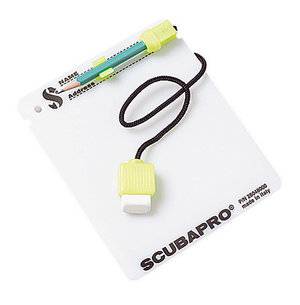
- Underwater Slates: Use a slate to record the species, depth, and type of damage you see.
- GPS-Enabled Cameras: Taking a photo is great, but knowing exactly where you took it is better for researchers.
- Look but Don't Touch: This is the golden rule. Disease can be spread by your fins, hands, or even your gear. If you swim through a site with known disease, make sure to decontaminate your BCD and regulator after the dive. Just as you perform regulator maintenance for your safety, cleaning your gear is essential for the reef's safety.
How to Report Your Findings and Save the Reef
Your data is only useful if it reaches the people who can use it. Several global networks rely on diver input to map reef health.
1. Coral Watch (University of Queensland)
This is one of the easiest ways to get involved. They provide a Coral Health Chart—a waterproof card with color gradients. You simply hold the card next to the coral, find the matching color code, and record it. This standardizes data so scientists can compare a reef in Cozumel to a reef in the Maldives.
2. AGRRA (Atlantic and Gulf Reef Assessment)
AGRRA focuses on the health of the wider Caribbean. They have extensive resources for identifying specific diseases like SCTLD.
How to Take 'Science-Grade' Photos
A "pretty" photo isn't always a "useful" photo for a biologist. To help researchers:
- Include a Scale: Place a dive knife or a ruler (without touching the coral!) near the site so they know the size of the lesion.
- Take Three Angles: One wide shot of the whole colony, one top-down shot of the affected area, and one close-up macro shot of the "front."
- Note the Depth: Use your dive computer to record the exact depth of the observation.
Conclusion: Diving with Purpose
The ocean is changing, but we aren't helpless. By shifting our perspective from "sightseer" to "steward," we add a layer of purpose to every dive. Much like mastering eel identification or understanding the nuances of octopus body language, learning to read the health of a reef is a mark of an experienced and responsible diver.
Next time you head out, don't just look for the big stuff like turtles and sharks. Look closer. Check the "skin" of the reef. If you see something, say something. Reporting your findings to organizations like Coral Watch or your local marine park authority can make a tangible difference in the survival of these ecosystems.
Ready to take the next step? Sign up for a PADI Coral Reef Conservation specialty course or join a local reef clean-up. Every data point counts, and every diver can be a hero for the reef.