Loading...
marine-life#moray eel#eel identification#marine life
Eel-egantly Different: A Diver's Guide to Moray Eel Identification
Pro Dive Vibes
February 21, 20269 min read

Eel-egantly Different: A Diver's Guide to Moray Eel Identification
It was a seemingly ordinary dive in Cozumel, Mexico. The vibrant coral reef teemed with life – parrotfish nibbling, angelfish flitting, and the gentle sway of sea fans. As I peered into a small crevice, a pair of beady eyes stared back. Then, the unmistakable form of a moray eel emerged, its mottled skin blending seamlessly with the surrounding reef. It wasn't aggressive, just curious, and we shared a moment of mutual respect before it retreated back into its lair. That encounter sparked a fascination that has lasted to this day.
Moray eels often get a bad rap. Many perceive them as aggressive, menacing creatures lurking in the shadows, ready to strike at any moment. This couldn't be further from the truth. While they possess a formidable appearance and powerful jaws, moray eels are generally shy and reclusive animals. They prefer to avoid confrontation and will only bite if they feel threatened or provoked. Sharks are dangerous to divers Actually, moray eels are far less likely to attack a diver than a shark.
Pro Dive Vibes Tip: Never reach into holes or crevices on a reef without looking first. This is a good rule of thumb for avoiding unwanted encounters with any marine life, including moray eels.
These fascinating creatures play a vital role in the delicate balance of reef ecosystems. As apex predators, they help control populations of fish, crustaceans, and other invertebrates, preventing any single species from dominating. Without moray eels, reef ecosystems could become unstable and less biodiverse.
With over 200 known species of moray eels inhabiting oceans around the world, identifying them can be a challenge. Their diverse appearances, ranging from brightly colored and patterned to subtly camouflaged, add to the complexity. This guide aims to equip you with the knowledge to identify some of the most commonly encountered moray eel species by focusing on their unique markings. So, grab your fins, let's dive in!
Understanding Moray Eel Anatomy and Markings
Moray eels are easily recognizable by their elongated, snake-like bodies. Unlike most fish, they lack pectoral and pelvic fins, which contributes to their serpentine movement through the water. This body plan allows them to squeeze into tight spaces and navigate complex reef structures with ease.
Pro Dive Vibes Tip: Moray eels have small gills and rely on opening and closing their mouths to pump water over their gills for respiration. This behavior is often misinterpreted as aggression, but it's simply how they breathe!
The skin of a moray eel is its most distinctive feature. It lacks scales and is covered in a layer of mucus, which protects it from parasites and abrasion. The patterns and coloration of their skin are crucial for camouflage, allowing them to blend seamlessly with their surroundings and ambush prey. These markings also play a role in species recognition, enabling morays to identify members of their own kind.
Common types of markings found on moray eels include:
- Spots: Discrete, rounded markings of varying sizes and colors.
- Blotches: Irregular, larger patches of color that often merge together.
- Stripes: Linear bands of color that run along the length or width of the body.
- Reticulations: Net-like patterns formed by interconnected lines, creating a webbed appearance.
The habitat and geographic location of a moray eel can significantly influence its coloration and patterns. Eels living in brightly lit coral reefs may exhibit more vibrant colors and complex patterns for camouflage, while those in darker, more turbid environments may have duller, more uniform coloration.
It's also important to note that variations can occur within a species. Juvenile moray eels may have different coloration or patterns than adults. For example, some species may exhibit brighter colors or more distinct markings when young, which fade as they mature.
Spotlight on Spotted Morays
Let's start by exploring moray eels that are characterized by having spots as their dominant pattern.
Honeycomb Moray (Gymnothorax favagineus)
- Description: The Honeycomb Moray is a large eel with a distinctive honeycomb-like pattern of dark spots on a light background. The spots are typically black or dark brown and are separated by thin, light-colored lines, creating the appearance of a honeycomb.
- Habitat: This species is found in the Indo-Pacific region, often inhabiting coral reefs and lagoons. They prefer areas with plenty of hiding places, such as caves and crevices.
Whitemouth Moray (Gymnothorax meleagris)
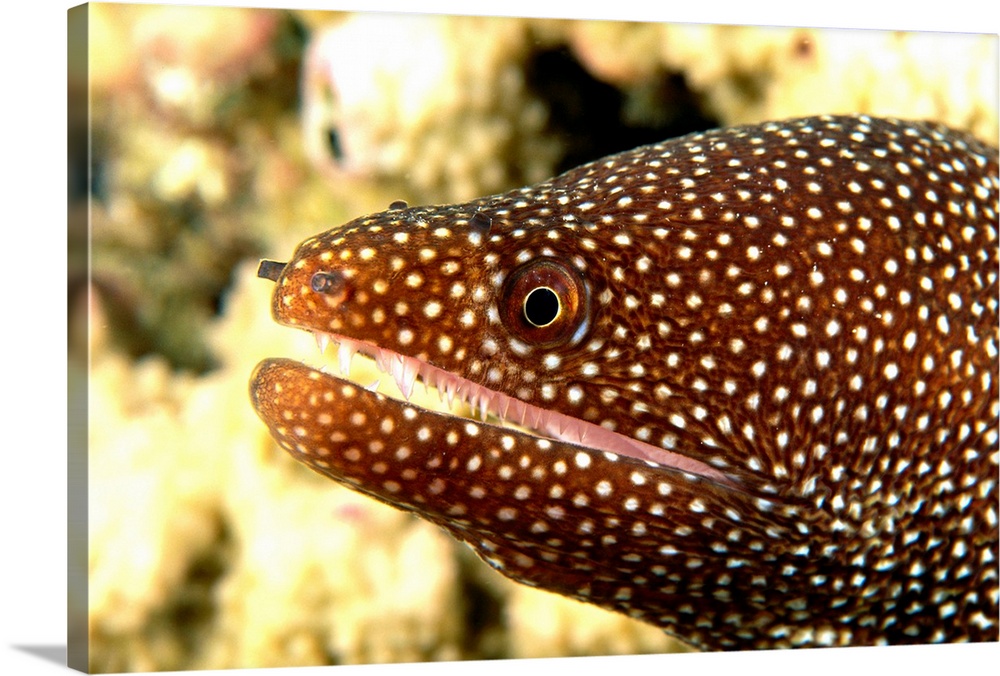
- Description: The Whitemouth Moray is easily identified by its body covered in small white spots. As its name suggests, it also has a distinctive white coloration around its mouth.
- Habitat: This species is also found in the Indo-Pacific region, favoring coral reefs and rocky areas.
Snowflake Moray (Echidna nebulosa)

- Description: The Snowflake Moray has irregular dark blotches with yellow borders, resembling snowflakes scattered across its body. This striking pattern makes it a popular subject for underwater photography.
- Habitat: This species is found in the Indo-Pacific, typically in shallow reefs and tide pools.
Spotted Moray (Gymnothorax moringa)

- Description: The Spotted Moray has dark spots on a yellowish-brown background. The size and density of the spots can vary depending on the individual and its location.
- Habitat: This species is common in the Western Atlantic, including the Caribbean Sea.
Lines and Stripes: Identifying Striped Morays
Now, let's shift our focus to moray eels that feature prominent striped patterns.
Zebra Moray (Gymnomuraena zebra)

- Description: The Zebra Moray is unmistakable with its distinctive black and white vertical stripes, resembling the pattern of a zebra.
- Habitat: This species is found in the Indo-Pacific, inhabiting coral reefs and rocky areas.
Barred Moray (Echidna polyzona)
[[IMAGE: Barred Moray eel reef]
- Description: The Barred Moray has dark bars or bands across a lighter body, giving it a banded appearance. The width and spacing of the bars can vary.
- Habitat: This species is found in the Indo-Pacific, typically in shallow reefs.
Ribbon Eel (Rhinomuraena quaesita)

- Description: The Ribbon Eel is a truly unique species with a fascinating life cycle. Juveniles are black with a yellow dorsal fin, males are bright blue, and females are yellow. They also have an elongated body with a high dorsal fin that resembles a ribbon.
- Habitat: This species is found in the Indo-Pacific, often residing in reef crevices.
The Plain Janes: Unicolored Moray Eels
Not all moray eels sport elaborate patterns. Some species exhibit relatively uniform coloration.
Green Moray (Gymnothorax funebris)
[[IMAGE: Green Moray eel open mouth]
- Description: The Green Moray is uniformly dark green or greenish-brown. Interestingly, its color comes from a yellow mucus coating on a dark blue skin.
- Habitat: This species is found in the Western Atlantic, including the Caribbean, often inhabiting mangroves and reefs.
Giant Moray (Gymnothorax javanicus)
[[IMAGE: Giant Moray eel large]
- Description: The Giant Moray is the largest moray eel species and can be uniformly dark brown or have faint mottled patterns.
- Habitat: This species is found in the Indo-Pacific, inhabiting coral reefs.
Viper Moray (Enchelynassa canina)
[[IMAGE: Viper Moray eel teeth]
- Description: The Viper Moray is generally dark brown with a pointed snout and visible teeth, giving it a somewhat menacing appearance.
- Habitat: This species is found in the Indo-Pacific, inhabiting rocky reefs and rubble areas.
Reticulated and Unique Patterns
Finally, let's explore moray eels with more complex or unusual markings.
Dragon Moray (Enchelycore pardalis)
[[IMAGE: Dragon Moray eel vibrant]
- Description: The Dragon Moray boasts elaborate patterns of red, orange, and yellow on a dark background. It also has elongated tubular nostrils, resembling the whiskers of a dragon.
- Habitat: This species is found in the Indo-Pacific, inhabiting rocky reefs.
Fimbriated Moray (Gymnothorax fimbriatus)
[[IMAGE: Fimbriated Moray eel face]
- Description: The Fimbriated Moray is light brown with darker brown reticulations and spots. It also has fleshy fringes around its nostrils.
- Habitat: This species is found in the Indo-Pacific, inhabiting coral reefs.
Tips for Ethical Moray Eel Encounters
When diving in areas where moray eels are present, it's crucial to respect these animals and their habitat. Here are some guidelines for ethical moray eel encounters:
- Never feed moray eels. Feeding them can alter their natural behavior, making them dependent on humans and potentially aggressive towards divers.
- Maintain a safe distance and avoid cornering or harassing eels. Give them plenty of space to retreat if they feel threatened.
- Be mindful of your buoyancy to avoid damaging the reef environment. Contact with coral can harm both the reef and the eel.
- Avoid reaching into holes or crevices where moray eels may be hiding.
- Report sightings and contribute to citizen science initiatives (e.g., iNaturalist). Your observations can help scientists track populations and better understand these fascinating creatures.
Pro Dive Vibes Tip: If a moray eel opens its mouth repeatedly, it's not necessarily a sign of aggression. It's likely just breathing! However, it's always best to maintain a safe distance and avoid any sudden movements that could startle the eel.
Conclusion: Becoming a Moray Eel Aficionado
Moray eels are truly remarkable creatures, showcasing a stunning array of colors, patterns, and adaptations. By understanding their unique markings and behavior, we can appreciate their beauty and diversity even more.
I encourage you to use the identification tips you've learned in this post during your next dive. Observe these fascinating creatures with respect and admiration, and share your knowledge with others.
Let's work together to protect these amazing animals and their underwater homes, ensuring that future generations can experience the wonder of encountering a moray eel on a vibrant coral reef.