Loading...
marine-life#Beyond the Sting: The Hidden Ecology of Jellyfish in the Open Ocean#marine-life#a scuba diving and underwater adventure website
Beyond the Sting: The Hidden Ecology of Jellyfish in the Open Ocean
Pro Dive Vibes
August 31, 20268 min read

For most beachgoers and casual snorkelers, the sight of a pulsing, translucent bell in the water triggers an immediate instinct to retreat. We have been conditioned to view jellyfish as ocean villains—nuisances that ruin tropical vacations with painful, burning stings. But when you step off the dive boat and plunge into the vast, open ocean, a completely different story unfolds.
Here at Pro Dive Vibes, a scuba diving and underwater adventure website dedicated to revealing the unseen wonders of the world's oceans, we believe in looking closer at the creatures most people avoid. When you look past the initial fear of the sting, you discover that these gelatinous drifters are not brainless pests. Instead, they are highly dynamic, ancient organisms that have quietly shaped our oceans for over 500 million years.
To understand the open ocean is to understand the jellyfish. Far from being ecological dead ends, these elegant drifters serve as the architects of pelagic biodiversity, drivers of the global carbon cycle, and a vital food source for some of the sea's most iconic species. Let us dive deep into the fascinating, forgotten, and highly complex world of gelatinous marine life.
Beyond the Sting: The Hidden Ecology of Jellyfish in the Open Ocean
To appreciate the ecological genius of jellyfish, we must first look at the open ocean—the pelagic zone—through the eyes of its smallest inhabitants. Unlike the bustling, structure-rich environments of shallow coral reefs or coastal kelp forests, the open ocean is a vast, blue desert. It is a featureless, three-dimensional void where there are no rocks to hide behind, no crevices to sleep in, and no solid substrates to call home.
In this endless blue expanse, pelagic jellyfish act as floating micro-habitats—essentially serving as mobile, living reefs.
Living Shields and Gelatinous Homes
For juvenile fish, tiny crabs, and delicate brittle stars, a drifting jellyfish is an oasis of survival. If you observe a large jellyfish, such as a lion's mane (Cyanea capillata) or a barrel jellyfish (Rhizostoma pulmo), during a safety stop in the blue, you will often notice dozens of tiny fish darting in and out of its venomous tentacles.
How do these small creatures survive such close proximity to deadly stingers?
- Immunity and Mucus: Many juvenile fish, particularly young jacks, trevallies, and cod, develop a specialized mucus layer that prevents the jellyfish's stinging cells (nematocysts) from firing.
- Micro-maneuverability: Because of their tiny size, these fish can navigate the microscopic gaps between the stinging dactylozooids with incredible precision, using the venomous curtain as a highly effective shield against larger predators like tuna or mahi-mahi.
- Hitchhiking Scavengers: Tiny invertebrates, such as pelagic amphipods and juvenile crabs, actually ride on top of the jellyfish’s bell, feeding on the host's scraps or even gently nibbling on parasitic parasites that plague the jelly.
This dynamic of seeking shelter among stinging tentacles is not unique to the open ocean. It mirrors the fascinating evolutionary strategies we see in shallow waters, which we explore in detail in our guide, Beyond Clownfish: Unveiling the Secret Lives of Anemone Dwellers. Just as anemone crabs and damselfish find sanctuary in coastal waters, these pelagic hitchhikers rely on jellyfish to survive their vulnerable youth in the open sea.
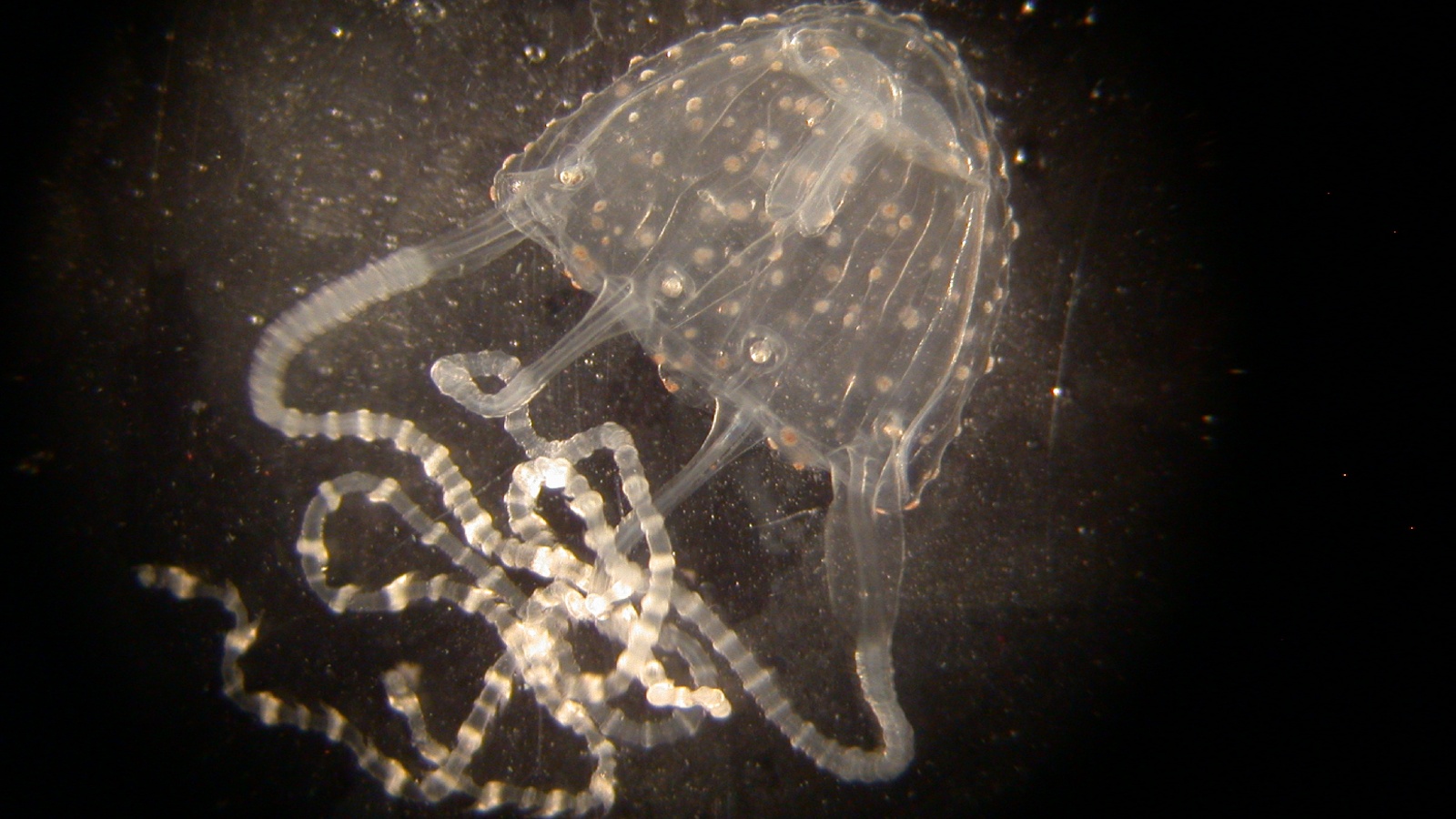
The Biological Carbon Pump: How 'Jelly Falls' Feed the Abyss
While jellyfish play a vital role at the surface, their ecological contribution to the deep ocean is nothing short of monumental. This process is driven by a phenomenon known as the biological carbon pump, and jellyfish are its unsung heavy lifters.
During the spring and summer, nutrient-rich upwellings trigger massive explosions in jellyfish populations, known as "blooms." Millions of these gelatinous creatures feed, grow, and reproduce at rapid rates. But because jellyfish have relatively short lifespans, these blooms eventually die off in massive numbers.
When they die, they sink. This event is known to marine biologists as a jelly fall.
[Jellyfish Bloom at Surface] ──> [Natural Die-off] ──> [Rapid Sinking (1000m+/day)] ──> [Deep-Sea Jelly Fall] ──> [Benthic Feast]
Historically, scientists believed that dead jellyfish dissolved long before reaching the ocean floor. However, modern deep-sea submersibles have revealed that because jellyfish are highly dense compared to the surrounding water, their carcasses sink rapidly—often descending at speeds exceeding 1000 to 1500 meters per day.
Nourishing the Desert of the Seafloor
When these massive quantities of organic matter hit the benthic zone (the deep seafloor), they deliver a sudden, concentrated payload of organic carbon, nitrogen, and phosphorus to an otherwise nutrient-depleted wasteland.
- The Immediate Feast: Deep-sea scavengers like hagfish, crabs, sea cucumbers, and giant isopods descend upon the jelly falls, consuming the nutrient-rich tissues within hours.
- Microbial Breakdown: What the scavengers leave behind is quickly broken down by deep-sea bacteria, enriching the surrounding sediment and fueling the local food web for months.
- Carbon Sequestration: By carrying carbon rapidly to the deep ocean floor, jelly falls effectively lock carbon away from the atmosphere for centuries, playing a quiet but crucial role in regulating our planet's climate.
This rapid transfer of energy is vital for the survival of the bizarre, alien creatures that inhabit the abyss. To understand how these deep-sea organisms have evolved to survive on such sporadic, deep-sea feasts, check out our deep dive into evolutionary adaptations: Why Do They Look Like That? The Bizarre Evolutionary Traits of Deep-Sea Marine Life.
A Surprising Feast: Jellyfish in the Pelagic Food Web
For decades, classic marine biology textbooks labeled jellyfish as trophic dead ends—organisms that consume vast amounts of energy but provide virtually no nutritional value to higher predators because they are composed of roughly 95% water.
Modern science has thoroughly debunked this myth.
While a single jellyfish might not have the caloric density of a greasy sardine, they are incredibly easy to catch, digest rapidly, and are packed with essential fatty acids, structural proteins, and collagen. For many marine species, hunting jellyfish is the ultimate low-effort, high-reward strategy.
| Predator | Favorite Jelly Prey | Ecological Impact of Consumption |
|---|---|---|
| Leatherback Sea Turtle | Lions Mane & Moon Jellies | Keeps jellyfish populations from overwhelming plankton stocks |
| Ocean Sunfish (Mola mola) | Siphonophores & True Jellies | Controls jelly blooms; transfers energy to deep-water predators |
| Chinstrap Penguins | Small Hydromedusae | Provides quick, easily digestible hydration and nutrients during nesting |
| Spiny Lobsters (Larvae) | Large Scyphozoans | Rides and feeds on jellies during their pelagic larval stages |

The leatherback sea turtle, the largest reptile on Earth, fuels its massive 1000-pound body almost exclusively on a diet of jellyfish, consuming up to its own body weight in gelatinous prey every single day. Similarly, the bizarre and gigantic ocean sunfish (Mola mola) consumes thousands of pounds of jellies to maintain its massive bulk.
When jellyfish populations are healthy and balanced, they keep the entire marine food web in check. They consume vast quantities of zooplankton and larval fish, preventing any single species from dominating the ecosystem. In turn, they feed the giants of the sea. This delicate predatory balance perfectly mirrors how apex predators manage reef systems, a concept we explore in Beyond the Pretty Colors: Understanding the Vital Role of Sharks in Marine Life Ecosystems.
Diving with the Drifters: Safety and Etiquette in the Blue Water
For scuba divers, encountering jellyfish in the open ocean is one of the most mesmerizing experiences imaginable. Watching a translucent, bioluminescent creature pulse rhythmically through the deep blue is like watching a living work of art.
However, pelagic diving—often called "blue water diving"—presents unique challenges. Because you are diving in the open ocean with no bottom visual reference, proper preparation and strict safety protocols are essential.
Expert Tip: When diving in the open ocean around jellyfish, always wear a full-length exposure suit (even in warm water), along with a hood and gloves. This protects you from accidental contact with drifting tentacles, which can sometimes stretch several meters away from the jellyfish’s main body.

Your Pelagic Jellyfish Diving Checklist
Before you jump into the deep blue to observe these magnificent drifters, ensure you have ticked off these essential steps:
Further Reading
- Stung!: On Jellyfish Blooms and the Future of the Ocean, Gershwin, Earle
- Beyond the Sting: How 21st-Century Science is Unlocking the Complex Social Networks of Jellyfish
- Frontiers | Management of jellyfish outbreaks to achieve good environmental status
- Behind the Sting: Jellyfish Behavior in the Red Sea - Scuba Hank NYC