Loading...
marine-life#Why Do They Look Like That? The Bizarre Evolutionary Traits of Deep-Sea Marine Life#marine-life#a scuba diving and underwater adventure website
Why Do They Look Like That? The Bizarre Evolutionary Traits of Deep-Sea Marine Life
Pro Dive Vibes
August 28, 20263 min read
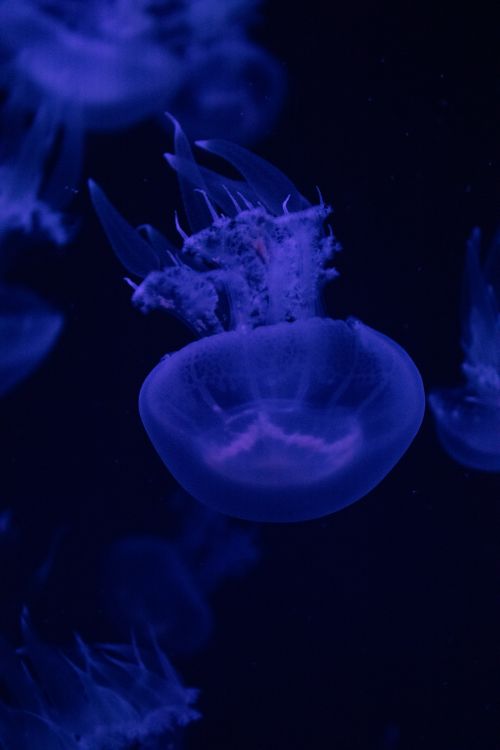
Imagine descending past the sunlit coral reefs, leaving behind the familiar school of colorful parrotfish and the sandy flats where stingrays hide. As you sink deeper, the warm turquoise water fades into a deep, velvety indigo, then to a cold, absolute black.
This is the abyss—a realm of crushing pressure, near-freezing temperatures, and perpetual darkness. Yet, even in this hostile environment, life thrives. The creatures that call these depths home look like they crawled straight out of a science fiction movie.
Why do they look like that? The bizarre evolutionary traits of deep-sea marine life are not random biological accidents; they are highly specialized, brilliant responses to surviving in some of Earth's most extreme environments.
Here at Pro Dive Vibes, a scuba diving and underwater adventure website, we love bridging the gap between recreational diving limits and the mysteries of the deep ocean. While most of us are limited to exploring the top 40 meters (130 feet) of the water column, understanding the radical evolutionary pathways of deep-sea marine-life gives us a deeper appreciation for the resilience of our blue planet.
Why Do They Look Like That? The Bizarre Evolutionary Traits of Deep-Sea Marine Life
To understand the alien appearance of deep-sea creatures, we must first understand the physics of their home. The deep ocean is a world of extremes, and surviving there requires throwing the standard rules of biology out the window.
The Pressure Cooker: Surviving the Crushing Depths
For every 10 meters (33 feet) you descend in the ocean, the pressure increases by 1 atmosphere (atm). At the average depth of the ocean floor—around 4,000 meters (13,123 feet)—the pressure is a staggering 400 atm. That is equivalent to having an elephant standing on your thumb.
How do deep-sea creatures survive this crushing weight without being flattened?
The secret lies in their cellular structure and the complete absence of air-filled spaces. Unlike shallow-water fish, most deep-sea residents do not have air-filled swim bladders. If they did, the immense pressure would cause these organs to implode instantly. Instead, deep-sea animals have evolved gelatinous bodies, water-permeable tissues, and highly flexible bones.
On a molecular level, these animals utilize a cellular stabilizer called trimethylamine N-oxide (TMAO). This compound prevents cellular proteins and membranes from collapsing under pressure.
| Biological Feature | Shallow-Water Species | Deep-Sea Species |
|---|---|---|
| Buoyancy Control | Gas-filled swim bladder | Gelatinous tissues and light lipids |
| Skeletal Structure |