Loading...
marine-life#blue water protocol#pelagic diving#open ocean safety
Into the Deep Blue: The Blue Water Protocol and Safety Tips for Pelagic Diving
Pro Dive Vibes
July 31, 20265 min read

Imagine stepping off the dive boat's swim platform and dropping not onto a colorful coral reef, but into a boundless, shimmering liquid sky. There is no sandy bottom below, no towering rock walls to your sides, and no surface ripples visible if you look down. You are suspended in a three-dimensional universe of pure, saturated blue.
This is pelagic diving—the ultimate frontier of scuba diving. It is a realm where the rules of scale are rewritten, where you are simultaneously a microscopic speck in a vast wilderness and a privileged witness to some of the most spectacular wildlife encounters on Earth. But diving in this vast, bottomless void requires specialized skills, a deep understanding of ocean physics, and a strict adherence to safety protocols.
The Allure of the Open Ocean: What is Pelagic Diving?
To truly appreciate pelagic diving, you must first understand the geography of the open ocean. The pelagic zone refers to the ecological region of the water column that is far from both the coast and the seafloor. In practical diving terms, it means you are floating in water that may be hundreds or even thousands of meters deep, with no physical structure in sight.
For many divers, the draw of the pelagic zone is the sheer unpredictability of what might emerge from the deep. This is the highway of the ocean’s giants. In this endless blue, you stand a chance of lock-eye encounters with:
- Oceanic whitetip sharks cruising the currents
- Schools of hammerheads rising from the depths
- Majestic manta rays and whale sharks feeding on plankton
- Sleek billfish, like sailfish and marlin, hunting at lightning speed
- Pods of curious cetaceans, including pilot whales and dolphins
Sharks are mindless man-eating monsters — actually, pelagic sharks are highly cautious, majestic predators that are vital to ocean health, and observing them in their natural habitat is a peaceful, awe-inspiring experience.
This vast expanse is also the stage for one of the planet's most incredible ecological phenomena. Every single day, billions of marine organisms journey from the dark depths of the mesopelagic zone up to the sunlit surface waters to feed under the cover of darkness. To understand how divers can witness this massive movement of life firsthand, check out our guide on The Deep Sea's Daily Commute.
The Blue Room Effect: Overcoming Spatial Disorientation
In a standard reef environment, your brain constantly processes visual data to maintain orientation. You know which way is up because the sun is above you, the reef rises to your side, and the sandy bottom lies beneath your fins.
In the open ocean, these visual references vanish. This brings about the Blue Room Effect, a state of sensory deprivation that can quickly lead to spatial disorientation and vertigo.
Without a physical point of reference, it is incredibly easy to lose track of your depth and orientation. You might feel like you are hovering perfectly still, only to look at your depth gauge and realize you have drifted down to 30 meters or floated up near the surface.

This is where exceptional buoyancy control becomes your lifeline. Because you cannot rely on the seafloor to gauge your depth, you must learn to rely on your internal sensations, your breathing cadence, and, most importantly, your instruments.
Your visual comfort in this environment also depends heavily on your gear. A fogged or poorly fitting mask can amplify the feeling of isolation and disorientation, making it harder to focus on your buddy or your dive computer. To ensure you have the best window into the blue, take a look at our comprehensive guide on Decoding Dive Mask Features.
Pro Tip: If you begin to experience spatial disorientation or vertigo in the blue, do not panic. Focus your eyes on your dive buddy, your computer, or the physical line of the dive boat's rigging. Take slow, deliberate breaths, and use these close-up visual anchors to ground your senses.
Decoding the Blue Water Protocol: Setup and Rigging
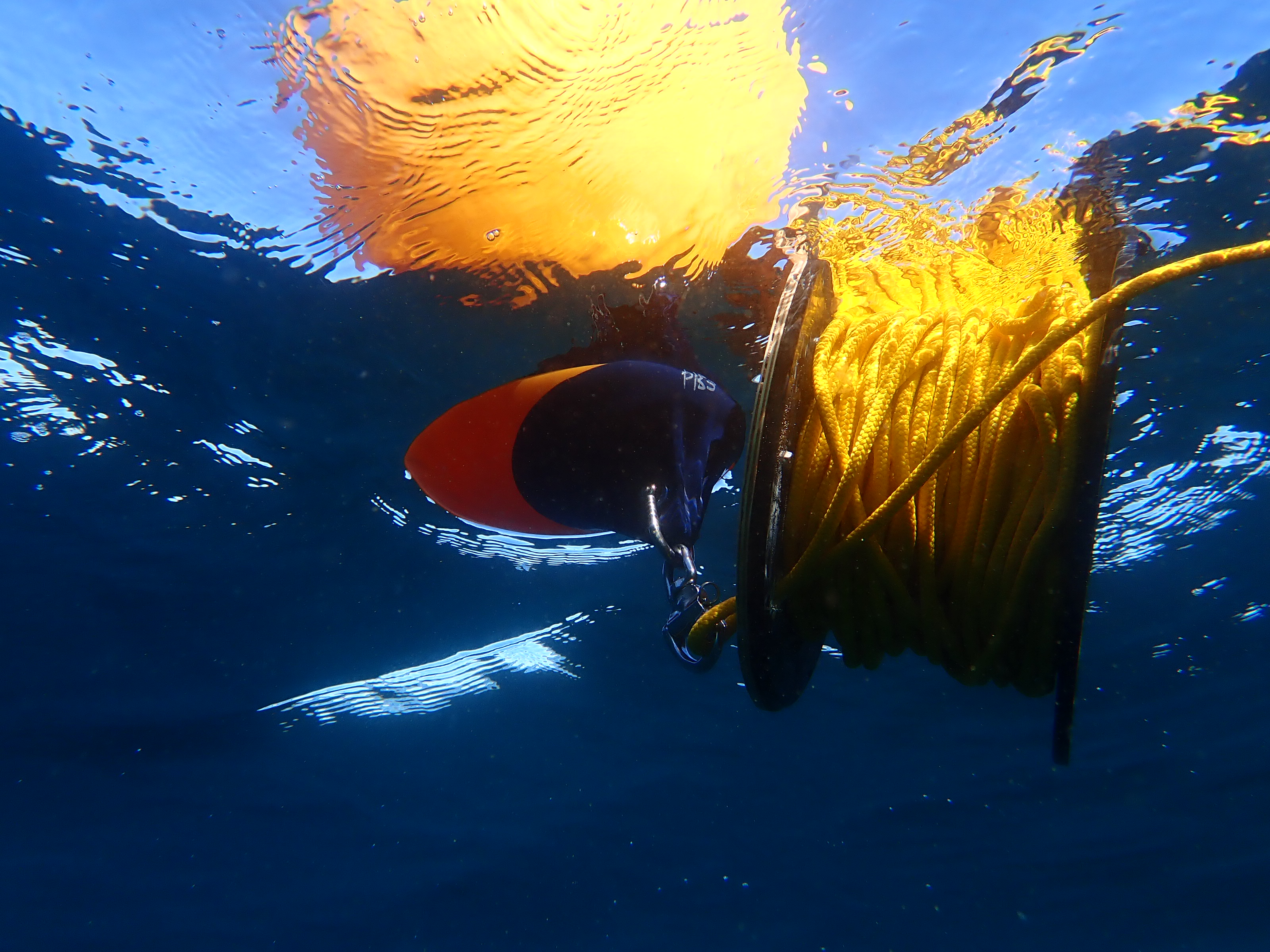
To mitigate the risks of diving in a bottomless void, scientific and technical divers developed the Blue Water Protocol. This standardized rigging system is designed to keep a group of divers safely connected to a central reference point, preventing them from sinking into the abyss or drifting away in opposing currents.
The Anatomy of a Blue Water Rig
The system relies on a specialized tether and trapeze setup deployed from a drifting dive vessel:
- The Downline: A heavy, weighted line is suspended from a large surface buoy or directly from the boat. This line typically descends to a depth of
10 to 15 meters. - The Hub (or Trapeze): At the bottom of the downline, a metal ring or weighted hub serves as the central anchor point.
- The Tethers: Each diver is connected to the central hub via a dynamic rope tether, usually
5 to 10 metersin length. These tethers are equipped with quick-release clips at both ends, allowing divers to move freely within a safe radius without the risk of drifting away.
The Role of the Safety Diver
The linchpin of the Blue Water Protocol is the Safety Diver. While the rest of the dive team is looking outward into the blue searching for wildlife,