Loading...
marine-life#triggerfish behavior#titan triggerfish aggression#scuba diving safety
Beyond the Bite: Why Triggerfish Are Actually More Territorial Than Sharks
Pro Dive Vibes
June 7, 20269 min read

Ask any new diver what they are most afraid of encountering during their first open water session, and the answer is almost always the same: sharks. We’ve been conditioned by decades of cinema to view these apex predators as the ultimate underwater threat. However, seasoned dive guides in the Indo-Pacific will tell you a very different story. While you might spend your entire dive searching for the graceful silhouette of a reef shark, there is another resident of the reef that can turn a peaceful drift dive into a frantic retreat in seconds.
The Diver’s Paradox: Why We Fear Sharks but Should Watch for Fins
It is a classic case of mistaken identity. Sharks, with their rows of serrated teeth and silent, prowling gait, fit the "villain" archetype perfectly. Yet, as we’ve explored in our guide to shark body language, their behavior toward humans is almost exclusively rooted in curiosity or caution rather than aggression. Sharks are mindless man-eaters—in reality, they are highly calculated hunters who generally find the loud, bubble-blowing presence of a diver more annoying than appetizing.
Enter the Triggerfish. With their vibrant colors, goofy "human-like" lips, and somewhat clumsy swimming style, they look like the comic relief of the reef. But don't let the aesthetics fool you. While a shark’s "aggression" is usually a misunderstood defensive display or a case of mistaken identity, a triggerfish’s aggression is deliberate, calculated, and intensely territorial.
The primary subject of diver caution is the Titan Triggerfish (Balistoides viridescens). Reaching up to 75 centimeters (30 inches) in length, they are the heavyweights of the family. Unlike the shark, which occupies a massive home range and rarely "defends" a specific patch of sand, the Titan Triggerfish is a homeowner with zero tolerance for trespassers.
Predation vs. Protection: The Psychology of the Reef
To understand why a triggerfish is more likely to nibble on your fins than a shark is to bite your arm, we have to look at their psychological drivers.
A shark is an opportunistic predator. Its primary goal is the efficient acquisition of calories. Engaging with a diver—a large, unfamiliar organism—is a high-risk, low-reward activity. Unless a shark feels cornered or detects the bioelectric signals of a distressed fish (which you can learn more about in our post on electroreception), it will likely keep its distance.
The triggerfish, however, is driven by the most powerful instinct in nature: procreation and protection. During nesting season, female triggerfish lay their eggs in sandy depressions on the reef floor. From that moment until the eggs hatch, the female (and often the male) becomes a sentinel. Their "aggression" isn't about hunger; it’s about a 100% commitment to a "no-fly zone."
| Feature | Reef Shark Intent | Triggerfish Intent |
|---|---|---|
| Primary Goal | Hunting / Scavenging | Nest Protection |
| Territory | Large / Fluid | Fixed / Concentric |
| Human Interaction | Curiosity / Avoidance | Active Deterrence |
| Bite Motivation | Mistaken Identity | Defensive Strike |
The Geometry of Aggression: Understanding the Nesting Cone
One of the most dangerous mistakes a diver can make when encountering a defensive triggerfish is a vertical ascent. To humans, moving "up" feels like moving "away." To a triggerfish, the world is shaped like an inverted cone.
The triggerfish’s territory begins at the nest on the sea floor and extends upward and outward in a funnel shape toward the surface. If you see a triggerfish hovering over a patch of sand and you swim directly upward, you are not leaving its territory—you are actually staying deep within the widest part of its "danger zone."
How to Navigate the Cone
- Identify the Center: The nest is usually a cleared-out pit in the sand or rubble.
- Swim Horizontally: The only way to exit the territory is to swim parallel to the reef.
- Stay Low: By staying closer to the bottom (while maintaining a safe distance from the nest), you minimize the radius of the cone you have to cross.
Expert Advice: If you see a Titan Triggerfish "hovering" vertically with its snout pointed toward a sandy patch, you are looking at a nesting site. Do not approach for a photo; this is the underwater equivalent of a "Keep Out" sign.

Built for the Battle: The Anatomy of a Triggerfish
Triggerfish aren't just angry; they are physically equipped to back up their attitude. Their name comes from a unique biological "trigger" mechanism in their dorsal fins. The first dorsal spine is long and stout; when it is raised, a second, smaller spine locks it into place.
This mechanism serves two purposes:
- Defense: It makes them nearly impossible for a predator to swallow or pull out of a crevice.
- Sleeping: They can wedge themselves into a hole at night and "lock" themselves in, ensuring they don't drift away or get pulled out by a nocturnal predator.
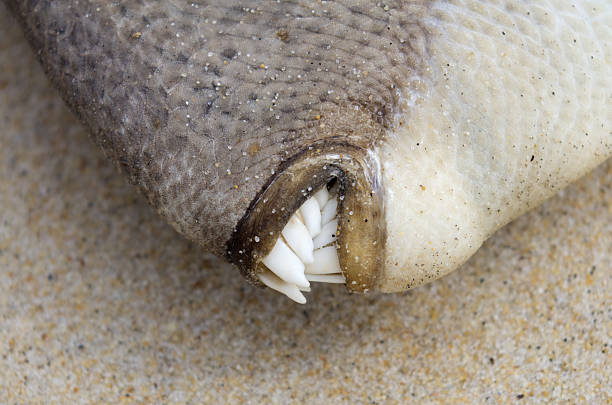
Beyond the spine, their most formidable weapon is their mouth. As we noted in our exploration of reef fish teeth, triggerfish have incredibly powerful jaws and heavy, independent teeth designed to crush sea urchins, crustaceans, and even hard coral. Those same teeth can easily puncture a 5mm neoprene wetsuit or a rubber fin blade.
Furthermore, their eyes move independently. Like a chameleon, a triggerfish can keep one eye on its nest and the other eye fixed squarely on you. This 360-degree awareness makes it nearly impossible to "sneak" past an alert parent.
A Pattern of Feistiness: The 'Small Fish' Syndrome
The Titan Triggerfish isn't an anomaly; it’s just the largest version of a personality trait common among reef residents. In fact, many divers find that the smaller the fish, the bigger the attitude.
We see this clearly with the damselfish. As discussed in Small Fish, Big Attitude, these tiny gardeners will fearlessly nip at a diver’s mask if they get too close to their algae patch. The triggerfish is essentially a 10-pound damselfish with a much more powerful bite.
This "grumpy" behavior is an evolutionary advantage. On a crowded reef where space and resources are at a premium, being a "pacifist" means losing your home or your offspring. The triggerfish has evolved to be the ultimate reef bouncer because it works. Even large groupers and some sharks will give a nesting Titan Triggerfish a wide berth.
Reading the Signs: Triggerfish Body Language
Just like sharks have a specific "hunch" or pectoral fin drop that signals distress, triggerfish have a clear escalation ladder. If you know what to look for, you can usually avoid a full-on charge.
1. The Raised Trigger
The first sign of annoyance is the raising of the first dorsal spine. If you see that "antenna" pop up, the fish is aware of your presence and is signaling its readiness to defend.
2. The Side-Eye and Tilt
If the triggerfish turns onto its side while looking at you, it is preparing to charge. This posture allows them to keep a better visual lock on you while preparing to use their powerful tail for a burst of speed.
3. Auditory Warnings
In our guide to identifying marine life by sound, we mentioned that the reef is a noisy place. Triggerfish contribute to this by making a "thrumming" or clicking sound using their swim bladder and teeth. If you hear a low-frequency vibration while near a sandy patch, it’s time to move.
The Escape Plan: How to Handle a Triggerfish Charge
If you’ve missed the warning signs and find yourself being targeted by a charging Titan, don't panic. Unlike a shark, which usually breaks off an approach if it realizes you aren't prey, a triggerfish is on a mission to escort you out of its territory.
- Check your position: Are you swimming up? If so, level out immediately.
- Deploy your fins: If the fish charges, tuck your legs and keep your fins between your body and the fish. It’s much better to have a hole in a fin than a hole in your leg.
- Maintain eye contact: Never turn your back and swim away blindly. Keeping your eyes on the fish allows you to reposition your fins as it circles.
- Swim horizontally and fast: Do not stop until you are well away from the nesting area. Once you are outside the "cone," the fish will abruptly stop its pursuit and return to its nest.
Warning: Never try to hit or poke the fish with a dive knife or camera rig. This will only escalate the aggression and could lead to more persistent attacks in the future.
Conclusion: Respecting the Reef’s Most Dedicated Parents
It is easy to label the triggerfish as the "villain" of the reef, but that does them a great disservice. They aren't mean; they are dedicated. In an environment where almost everything is trying to eat your children, the triggerfish’s fierce territoriality is the only reason their species survives.
Furthermore, triggerfish are vital to the health of the reef. By preying on sea urchins, they prevent "urchin barrens" where overpopulated urchins strip the reef of all algae and coral. They are the architects and the protectors of the underwater landscape.
The next time you’re on a dive and see a Titan Triggerfish, don't be afraid—be respectful. Give them the space they’ve earned, keep an eye on that dorsal spine, and remember: in the world of scuba diving, it’s often the "pretty" ones you have to watch out for.
Ready to learn more about reef behavior? Check out our latest post on why juvenile fish look nothing like their parents to spot the next generation of reef bouncers!