Loading...
marine-life#parrotfish sleep sac#parrotfish cocoon#sleeping parrotfish
Parrotfish Sleep Sacs: The Science Behind the Reef's Weirdest Pajamas
Pro Dive Vibes
July 22, 20264 min read
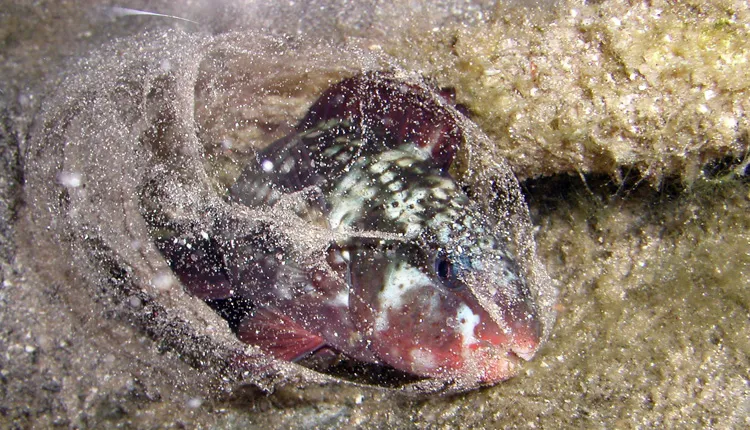
Imagine settling down for bed by blowing a giant, slimy bubble of mucus around your entire body. To us, it sounds like a scene straight out of a sci-fi horror film. But for one of the ocean's most charismatic and colorful reef dwellers, this is just a standard Tuesday night.
If you have ever been on a night dive, you may have shone your light into a coral crevice only to find a parrotfish suspended in what looks like a glowing, translucent sleeping bag. These bizarre "sleep sacs" are one of the most fascinating evolutionary adaptations in the marine world. During the day, parrotfish are famous for their vibrant colors and their tireless work as essential reef architects, grinding up dead coral to produce the soft white sand of our favorite beaches. But when the sun sets, their behavior shifts from industrious grazers to masters of biological engineering.
Understanding how and why these fish produce their nightly pajamas reveals a complex web of predator-prey dynamics, parasitic warfare, and energy conservation. For scuba divers, witnessing a sleeping parrotfish is a true bucket-list experience—but it comes with a strict set of rules to ensure we do not disrupt this delicate biological process. Let's dive deep into the science behind the reef’s weirdest bedtime routine.
What Exactly is a Parrotfish Sleep Sac?
At first glance, a sleeping parrotfish looks like it has been vacuum-sealed in plastic wrap. In reality, this protective envelope is a highly sophisticated, organic structure made entirely of mucus.
The Recipe for a Sleeping Bag
The "pajamas" are not just standard fish slime. They are secreted from specialized opercular glands located inside the gill cavity, just behind the fish’s mouth. This mucus is a complex cocktail of glycoproteins, lipids, and water-insoluble molecules. When released, it does not dissolve into the surrounding seawater. Instead, it reacts with the water to expand and solidify into a tough, elastic, and semi-permeable membrane.
The Construction Process
Building a sleep sac is not an instantaneous trick. It requires a dedicated, coordinated effort from the parrotfish. Once the fish finds a suitable resting spot—usually a sheltered crevice or a quiet patch of coral—it begins the construction process.
- Secretion: The opercular glands begin pumping out thick streams of mucus.
- Distribution: The parrotfish uses its pectoral fins and synchronized gill movements to gently push and mold the mucus envelope around its body.
- Encapsulation: The fish slowly backs into the forming bubble, ensuring it is completely enclosed from snout to tail.
This entire process takes anywhere from 30 to 45 minutes of continuous labor. The fish must remain relatively still while actively pumping its gills to inflate the bubble without tearing the delicate, setting material.
The Energy Cost
For a wild animal, energy is currency. Spending energy on something disposable is a massive evolutionary gamble. Studies have shown that parrotfish invest up to 2.5% of their daily energy budget just to manufacture their nightly sleep sacs.
To put that in perspective, that is the metabolic equivalent of a human running a light 5K trail run just to set up a tent every single evening. If the fish is disturbed and forced to abandon its cocoon middle-of-the-night, it cannot simply "remake" it; the metabolic cost is too high, leaving the fish exhausted and defenseless.
The Morning Routine
When the first rays of morning light pierce the water, the parrotfish’s internal clock wakes it up. To break out, the fish simply bites through the front of the cocoon or uses its body weight to rupture the membrane. It swims away, leaving the discarded, slimy residue behind.
But this waste does not go to waste. The nutrient-rich mucus is quickly consumed by opportunistic reef scavengers, including crabs, hermit crabs, and bristle worms, recycling the energy back into the reef ecosystem.
| Sleep Sac Specification | Metric / Detail | Ecological Purpose |
|---|---|---|
| Material | Glycoprotein-rich mucus | Creates a semi-permeable physical barrier |
| Source | Opercular glands (near gills) | Allows controlled distribution via respiration |
| Build Time | 30 to 45 minutes |
Ensures complete, gap-free coverage |
| Metabolic Cost | ~2.5% of daily energy |
High- |
Further Reading
- Parrotfish sleep in a mosquito net made of mucus | National Geographic
- Why Parrotfish Sleep in Slime Bubbles - Strange Sleeping Ritual & Predator-proof Pajamas. MUST see! - YouTube
- Researchers watched a ton of parrotfish in their sleep to uncover sleeping patterns and nighttime habitat use – oceanbites
- The Fish That Sleeps in a Mucus Bubble Every Night | Earth