The Physics of Streamlining: Calculating Drag and Its Impact on RMV
Introduction: Beyond the Aesthetic of the 'Pro' Look
In the world of technical and advanced recreational diving, there is a specific look often associated with "the pros." It is a clean, minimalist silhouette—hoses tucked tightly against the body, no dangling gauges, and a perfectly horizontal orientation. While many novices mistake this for a mere fashion statement or "gear ego," the reality is rooted in rigorous fluid dynamics. Streamlining is not an aesthetic; it is an engineering solution to a biological problem. 2
For the intermediate diver, a common frustration arises: the plateau of gas consumption. You have mastered basic buoyancy, you no longer flail your arms, and you have transitioned to high-quality fins, yet your Respiratory Minute Volume (RMV) remains stubbornly high. This plateau occurs because many divers overlook the direct correlation between hydrodynamic resistance and metabolic demand. 1 Water is approximately 800 times denser than air, meaning every square centimeter of unoptimized surface area and every degree of poor trim acts as a brake, forcing your muscles to work harder, consume more oxygen, and produce more carbon dioxide. 4
By understanding the physics of drag, we can move beyond "guessing" at our configuration and begin calculating the energy cost of our equipment and posture.
The Drag Equation: The Mathematics of Resistance
To master streamlining, one must first understand the force we are fighting. In fluid dynamics, the drag force ($F_d$) acting on an object moving through a fluid is expressed by the equation:
Fd = ½ρv²CdA
Breaking this down allows us to see exactly where we can optimize:
- $\rho$ (Rho): The density of the fluid. For divers, this is a constant challenge. Seawater has a density of approximately
64.0 lbs/ft³, while freshwater is62.4 lbs/ft³. 4 Because water is so much denser than air, the energy required to move through it is exponentially higher than terrestrial movement. - $v$ (Velocity): The speed of the diver. Note that this variable is squared ($v^2$). This is the most critical takeaway for gas management: doubling your swimming speed does not double the resistance; it quadruples it.
- $C_d$ (Drag Coefficient): A dimensionless number that represents the "slippiness" of an object based on its shape and surface texture.
- $A$ (Frontal Area): The cross-sectional area you present to the direction of travel.
For the diver, $\rho$ is dictated by the environment, and $v$ is a choice of pace. Therefore, our primary tools for efficiency are the reduction of Area (A) and the optimization of the Drag Coefficient ($C_d$).
Frontal Area (A): The Geometric Cost of Poor Trim
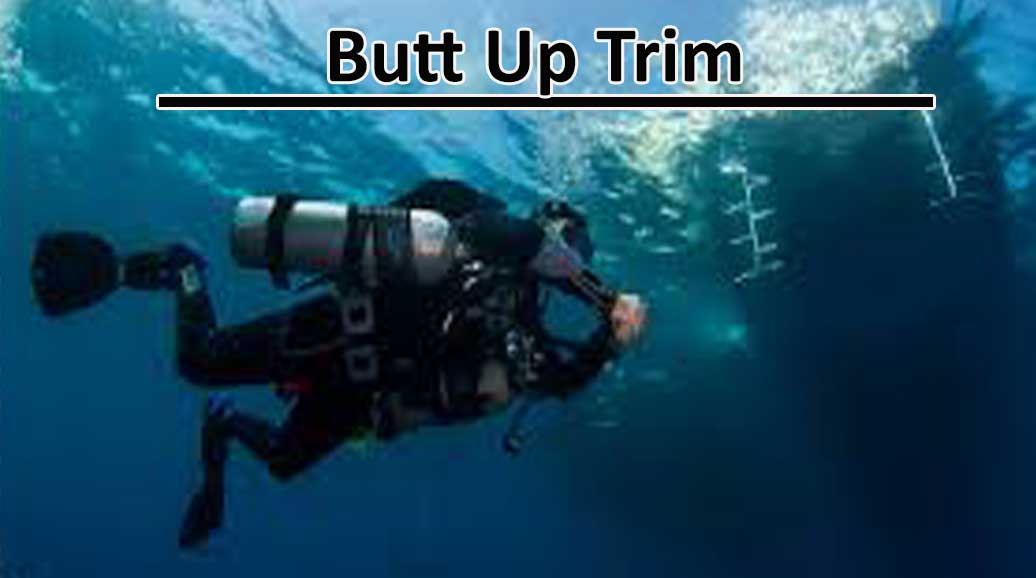
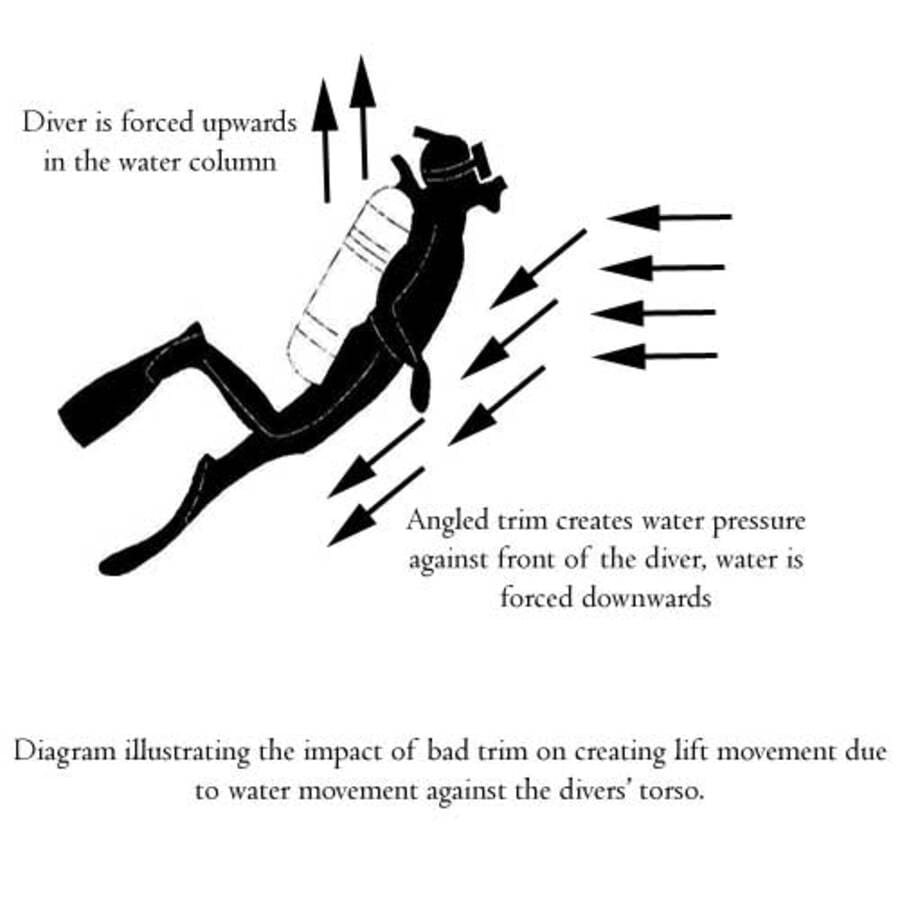
The variable $A$ in the drag equation is largely a function of your trim. If you are swimming in a "seahorse" posture—head up, fins down at a 15 to 30-degree angle—you are significantly increasing your frontal area.
Imagine a diver as a rectangular box. In a perfectly horizontal position, the "Area" presented to the water flow is merely the top of the head, the shoulders, and the profile of the tank. In a 15-degree incline, that area expands to include the entire chest, the thighs, and the underside of the BCD.
The Mathematical Penalty of Poor Trim
| Posture | Estimated Frontal Area (sq. ft) | Relative Drag Increase |
|---|---|---|
| Horizontal (0°) | 2.5 | Baseline (1.0x) |
| Slight Incline (15°) | 3.8 | ~1.5x |
| "Seahorse" (45°) | 6.2 | ~2.5x |
| Vertical (90°) | 8.5 | ~3.4x |
Achieving a small $A$ requires a deep understanding of the Center of Gravity vs. Center of Buoyancy. If these two points are not aligned, you will constantly use your fins to "push" your torso up or down, which inherently increases your frontal area and, consequently, your drag. 4 Furthermore, your choice of rig matters; a bulky jacket BCD often has a larger "A" than a streamlined back-mount wing because the air is distributed around the torso rather than behind the diver.
The Drag Coefficient (Cd): Surface Texture and Form Drag
While $A$ is about your silhouette, $C_d$ is about how "clean" that silhouette is. In fluid dynamics, we distinguish between Laminar Flow (smooth, parallel layers of fluid) and Turbulent Flow (chaotic eddies and swirls).
When water flows over a smooth surface, it stays attached to the object (laminar). When it hits a dangling SPG, an unclipped backup light, or an open thigh pocket, the flow "separates," creating a low-pressure wake behind the object. This wake literally sucks the diver backward—a phenomenon known as Form Drag.
Interference Drag: The Sum is Greater than the Parts
One of the most overlooked aspects of diving physics is interference drag. This occurs when the turbulence from one piece of gear (like a shoulder-mounted snorkel) interacts with the turbulence of another (like a bulky BCD strap). The resulting drag is often greater than the sum of the two individual components.
Pro Tip: To minimize your $C_d$, apply the "Rule of Flushness." Every accessory should be clipped off such that it sits flush against the body or the harness. If it can swing, it can create turbulence.
The Metabolic Cost: Translating Newtons to Liters per Minute
Why does a few Newtons of drag force matter? It comes down to bio-energetics. To overcome drag, your muscles must perform mechanical work. This work requires Adenosine Triphosphate (ATP), which is produced through the oxidation of glucose. In simpler terms: more drag equals higher oxygen consumption. 1
The US Navy Diving Manual notes that a diver's oxygen consumption is a direct measure of energy expenditure. 1 As you work harder to push a high-drag profile through the water, your body produces more $CO_2$. Because the human respiratory drive is primarily triggered by $CO_2$ levels rather than $O_2$ levels, this buildup causes an involuntary increase in your breathing rate.
The Feedback Loop of High Drag:
- Increased Resistance: Poor trim or dangling gear increases $F_d$.
- Increased Exertion: Muscles work harder to maintain velocity ($v$).
- $CO_2$ Accumulation: Metabolic byproduct increases in the bloodstream.
- Elevated RMV: The brain signals for more frequent, deeper breaths to "flush" the $CO_2$. 1
- Gas Depletion: Your cylinder pressure drops faster, shortening your bottom time.
By reducing drag, you aren't just "looking pro"—you are physically lowering the $CO_2$ threshold that dictates your breathing rate.
Propulsion vs. Resistance: The Efficiency Balance
It is a common misconception that powerful fins can "overpower" a high-drag profile. While high-thrust fins are essential for managing currents, they cannot compensate for poor streamlining without a massive metabolic cost.
As explored in The Bio-Mechanics of Fin Efficiency, the goal of propulsion is to maximize the thrust-to-drag ratio. If your drag is high, a larger percentage of your kick's energy is wasted simply overcoming the water's resistance rather than moving you forward.
The 'Glide Phase'
The most efficient divers utilize the "Glide Phase." After a powerful kick, a streamlined diver maintains a rigid, horizontal posture to coast through the water. A high-drag diver, however, loses momentum almost immediately after the kick ends.
- Check: Does your momentum stop the moment you stop kicking?
- Check: Are your knees dropping during the glide?
- Check: Is your SPG swinging like a pendulum?
If you answered yes to any of these, your $C_d$ and $A$ variables are likely working against you.
Practical Optimization: Engineering the Streamlined Diver
To reduce the variables in the drag equation, we must look at gear configuration as an engineering task.
1. Hose Routing
Standard recreational "sport" routing often involves hoses that flare out from the first stage. Technical routing (Long hose/short hose) keeps hoses tucked tight against the neck and torso. From a fluid dynamics perspective, this significantly reduces the "interference drag" between the diver's head and the tank valve.
2. Wing vs. Jacket BCD
A wing system allows for a smaller frontal area ($A$) because the buoyancy is located behind the diver, in line with the tank. This makes it easier to maintain the horizontal trim required to keep $A$ at its minimum. Additionally, many wings are designed with a "360-degree" shape to prevent air from trapping in pockets that would create asymmetrical drag.
3. Weighting and Trim
You cannot be streamlined if you are overweighted. Overweighting requires you to put more air in your BCD to achieve neutral buoyancy. This extra air increases the volume of the BCD, which increases both $A$ and $C_d$. Mastering The Science of Specific Gravity is the first step in ensuring you carry only the lead you need, allowing for the smallest possible profile underwater. 4
Conclusion: The 1% Gains in Diving Theory
In professional diving, we often talk about "marginal gains." A 5% reduction in frontal area and a 3% improvement in your drag coefficient might seem negligible on a single dive. However, over the course of a 60-minute bottom time, these physics-based adjustments result in hundreds of liters of saved gas.
Streamlining is about looking like a "cool" diver. Streamlining is about being a more efficient biological machine.
When you minimize the $F_d = \frac{1}{2} \rho v^2 C_d A$ equation, you reduce your metabolic load, lower your $CO_2$ production, and ultimately lower your RMV. 1 This leads to a psychological state of "effortless" diving, where you are no longer fighting the medium, but moving through it with mathematical precision.
Next time you gear up, don't just check if your equipment is functional—check if it is hydrodynamic. Your gas needle will thank you.