The Bio-Mechanics of Fin Efficiency: How Thrust Vectors and Blade Geometry Drive Propulsion

To the uninitiated, scuba diving propulsion seems as simple as "kicking your legs." However, for the technical diver or the advanced recreationalist, moving through a fluid medium that is approximately 800 times denser than air is an exercise in complex physics and bio-mechanical engineering 4. Every flick of the ankle represents a conversion of metabolic energy into kinetic displacement. When this conversion is inefficient, the result is more than just slow progress; it leads to increased air consumption, elevated $CO_2$ levels, and premature fatigue 6.
The Physics of Propulsion: Beyond the Kick
Propulsion in water is governed fundamentally by Newton’s Third Law of Motion: for every action, there is an equal and opposite reaction. When a diver pushes water backward with a fin, the water pushes the diver forward. However, because water is a non-compressible fluid with significant density, the resistance encountered is far greater than in terrestrial movement 4.
Propulsive efficiency is the ratio of useful work performed to the total energy expended. In diving, we define this as the ability to convert the chemical energy stored in our muscles into forward thrust while minimizing "parasitic drag." Unlike walking, where the ground provides a solid anchor, the fluid medium of water allows for "slip." If your fin blade is too flexible or your technique is sloppy, you spend energy moving water in directions that do not contribute to forward progress.
Deconstructing the Thrust Vector
In physics, a vector is a quantity having both magnitude and direction. When you kick, the force you generate is rarely 100% horizontal.
Useful Thrust vs. Wasted Lift
A perfect kick would result in a purely horizontal thrust vector. In reality, most divers generate a significant amount of vertical lift. This occurs when the fin blade is angled such that it pushes water up or down rather than strictly backward. This wasted energy forces the diver to use their BCD or lung volume to compensate for the unintended depth change, further complicating their Center of Gravity vs. Center of Buoyancy.
The Role of Ankle Flexion
The angle of your ankle dictates the orientation of the thrust vector. If the foot is not fully plantar-flexed (pointed), the fin blade will meet the water at an inefficient angle, sending the vector "off-axis." This is why ankle flexibility is often a greater predictor of diving efficiency than raw leg strength.
The 'Dead Zone'
Every kick cycle has a "Dead Zone"—the specific points at the top and bottom of a stroke where the fin blade is parallel to the direction of travel. At these moments, propulsive thrust drops to zero. Advanced divers minimize the duration of the dead zone by using specialized kick styles like the frog kick, which maximizes the "power phase" of the stroke.
Blade Geometry: The Engineering of Displacement
The design of a fin is not merely aesthetic; it is a calculated attempt to manipulate fluid dynamics. Different geometries solve the problem of resistance in different ways 1.
| Fin Type | Primary Physics Principle | Best For |
|---|---|---|
| Paddle | Total Displacement | Maximum power and torque |
| Split | Lift (Bernoulli Principle) | Reducing muscle strain |
| Vented | Drag Reduction | Efficient recovery strokes |
| Channel | Focused Vectoring | Directing water backward |
Paddle Fins and Power
Paddle fins rely on maximum surface area to move a large volume of water. They are the "low gear" of the diving world, providing high torque for divers encumbered by heavy equipment 1. However, a large blade requires significant leg strength to manage the resistance 2.
Split Fins and the Bernoulli Principle
Split fins operate like a wing rather than a paddle. As the two halves of the blade move through the water, they create a pressure differential. This generates lift that is oriented forward. While they require less effort, they often struggle in high-current environments where "raw displacement" is required.
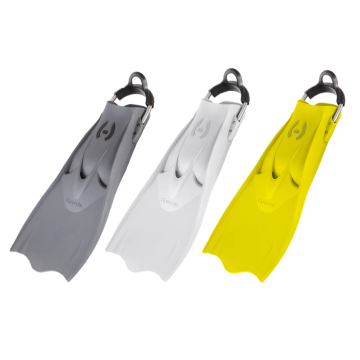
Vented Designs and Longitudinal Rails
Vents are strategically placed openings that allow water to pass through the fin during the non-propulsive "recovery" stroke. This reduces the drag coefficient, making it easier to reset the leg for the next power stroke. Meanwhile, longitudinal rails act as "fences" that prevent water from spilling over the sides of the fin, effectively focusing the thrust vector directly behind the diver.
Bio-Mechanical Leverage: The Human Engine
The fin is merely a lever; the engine is the human musculoskeletal system. Propulsion primarily recruits the iliopsoas (hip flexors) and the gluteus maximus 2.
Muscle Fiber Recruitment
The stiffness of your fin blade dictates which muscle fibers are recruited:
- Stiff Blades: Favor fast-twitch (Type II) fibers. These produce high force but consume oxygen rapidly and produce high amounts of $CO_2$.
- Soft Blades: Favor slow-twitch (Type I) fibers. These are more efficient for long-duration, low-intensity swimming.
Excessive $CO_2$ production from over-exertion is a leading contributor to nitrogen narcosis and gas density issues at depth 6. Therefore, matching fin stiffness to your physical conditioning is a safety requirement, not just a comfort choice.
Joint Stress and Tribonucleation
We must also consider the impact of stiff blades on the joints. Sudden, high-torque movements in the ankles and knees can trigger the phenomenon of tribonucleation. As discussed in our guide on Tribonucleation and Diving: Why Sudden Joint Movements Trigger Bubble Formation, the rapid separation of joint surfaces can create microscopic bubble nuclei, which may theoretically influence decompression stress.
The Geometrical Calculus of Trim and Thrust
Your fins do more than move you forward; they act as your primary control surfaces for trim.
- Heavy Fins (Negative Buoyancy): Often made of compression-molded rubber, these fins act as "ankle weights." They are ideal for divers in drysuits who struggle with "floaty feet" but can create a tail-down pitch in divers wearing thin wetsuits.
- Neutral Fins: These allow for a more balanced longitudinal pitch, making it easier to maintain a horizontal profile.
If a diver's Center of Gravity (COG) is not aligned with their Center of Buoyancy (COB), they will experience a rotational moment. You can use asymmetric thrust—kicking slightly harder with one fin or adjusting the angle of a single blade—to counteract this rotation without using your hands or inflating your BCD.
Kick Styles and Vector Optimization
Choosing the right kick is about matching the physics of the environment to the geometry of your fin.
The Flutter Kick
The standard flutter kick involves high-frequency oscillation. While effective for speed, it creates significant laminar flow disruption. The constant movement can lead to rapid fatigue and is generally avoided in overhead environments like caves or wrecks where "silting" is a risk.
The Frog Kick
The frog kick is the gold standard for efficiency. It utilizes a powerful "thrust phase" followed by a "glide phase."
- Thrust: The bottoms of the fins are pushed together, directing a massive vector of water directly backward.
- Glide: The diver holds a rigid, streamlined position, utilizing the momentum generated. This significantly reduces gas consumption.
Modified Kicks for Precision
In silty or confined spaces, divers use the Modified Flutter or Modified Frog. These involve keeping the knees bent and the fins high, directing the thrust vector slightly upward and backward. This prevents the "downwash" of water from disturbing the bottom sediment.
Expert Tip: The "Silt-Check"
Before entering a sensitive environment, perform a single frog kick and look behind you. If you see a "cloud" rising from the floor, your thrust vector is angled too far downward. Adjust your hip hinge to level the vector.

Efficiency Metrics: Strouhal Number and Propulsive Flow
In fluid dynamics, the Strouhal Number (St) is a dimensionless value used to describe oscillating flow mechanisms. In the context of diving, it relates the frequency of your kick, the amplitude (width) of the stroke, and your forward speed.
Research into biomimetic propulsion (studying how fish swim) suggests that peak efficiency occurs within a very narrow Strouhal range (typically between 0.25 and 0.35).
More effort always equals more speed— False.- Beyond a certain point, increasing your kick frequency creates "vortex shedding" that is so chaotic it actually increases drag rather than thrust. This is the point of diminishing returns where you are working harder but moving slower.
Conclusion: Selecting the Right Tool for Your Bio-Mechanical Profile
Selecting the right fin is a balance of physics and physiology 1. A diver with powerful legs and a high-volume twinset requires a stiff, high-displacement paddle fin to overcome inertia. Conversely, a smaller-framed diver or someone focusing on long-distance reef surveys may find a split fin or a lightweight composite blade more sustainable 2.
Bio-Mechanical Pre-Dive Checklist:
- Check Fin Stiffness: Does the blade match your leg strength and the weight of your gear?
- Verify Trim Balance: Are your fins pulling your feet down or pushing them up?
- Evaluate Ankle Range: Can you achieve full plantar flexion to optimize the thrust vector?
- Match Kick to Environment: Are you prepared to switch to a modified frog kick to avoid silting?
The future of fin design lies in biomimicry—using variable-geometry materials that change stiffness based on the force applied. Until those become standard, your best tool for efficiency is a deep understanding of the physics behind every stroke. By refining your thrust vectors and understanding the bio-mechanical leverage of your "human engine," you can move through the water with the effortless grace of the apex predators we share the ocean with. For more on how movement and physiology intersect, explore our analysis of Shark Body Language to see how nature has already perfected the science of the thrust vector.
Further Reading
- Effect of variable stiffness characteristics on the propulsion performance of biomimetic caudal fin flexible plates - ScienceDirect
- Fin Design and Hydrodynamics: Engineering for optimal propulsion and maneuverability
- Efficiency & Geometry — Truefin
- Impact of Caudal Fin Shape on Thrust Production of a Thunniform Swimmer | Journal of Bionic Engineering | Springer Nature Link