Center of Gravity vs. Center of Buoyancy: The Geometrical Calculus of Perfect Trim
Introduction: The Zen of the Horizontal Diver
In the world of high-level scuba diving, "perfect trim" is often discussed with a sense of reverence usually reserved for ancient martial arts. We see the photos of GUE or technical divers suspended in a void, perfectly horizontal, as still as if they were resting on a glass table. To the uninitiated, this looks like a stylistic choice—a way to look "pro." However, for the experienced diver, trim is not an aesthetic; it is the fundamental intersection of efficiency, gas management, and safety 1.
The struggle most divers face is the "see-saw" effect. You kick to stay level, but as soon as you stop, your fins drop or your head pitches forward. You fight your gear, using your core muscles and constant sculling to maintain a position that should be effortless. This constant battle is more than just annoying; it is a drain on your energy and your gas supply.
To master trim, we must move beyond the intuitive "feel" and look at the geometric precision of our underwater existence. By understanding the relationship between two competing forces—gravity and buoyancy—we can transform our diving from a physical struggle into a calculated state of equilibrium 3. This article explores the physics of the Center of Gravity (CoG) and the Center of Buoyancy (CoB), and how their alignment dictates your every move in the water.
The Downward Vector: Understanding Center of Gravity (CoG)
The Center of Gravity (CoG) is the point where the total weight of the diver and their equipment is concentrated. In physics terms, it is the average location of the weight of an object. In a vacuum, if you supported a diver at their CoG, they would remain perfectly balanced in any orientation.
For a diver, the CoG is determined by several heavy components:
- The Diver’s Body: Bone density and muscle mass distribution.
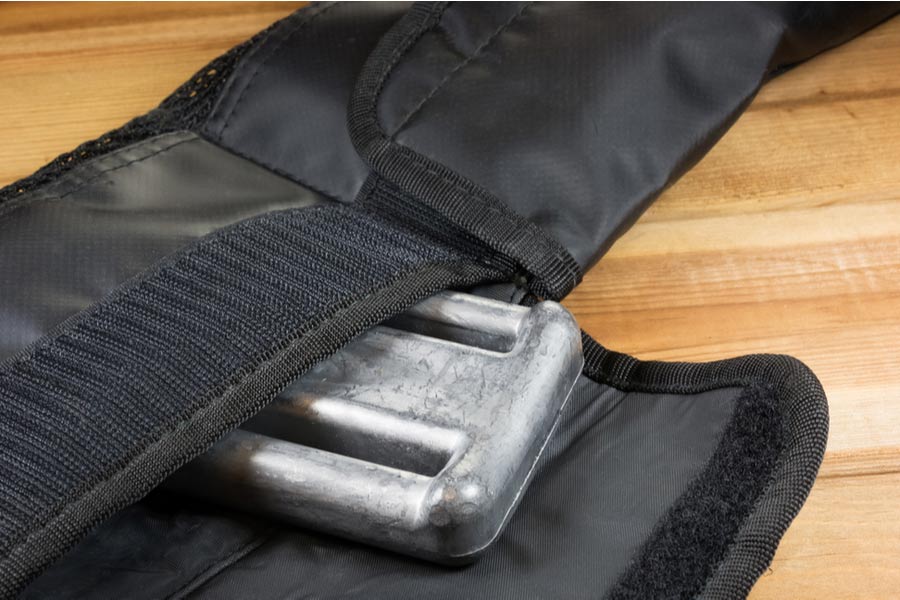
- Ballast: Lead weights on a belt, in integrated pockets, or in trim pockets.
- The Cylinder: A heavy steel tank has a much lower (more posterior) CoG than a neutral or positive aluminum tank.
- Fins: Heavy rubber "jet" style fins can significantly pull the CoG toward the feet.
One of the most important aspects of the CoG is that it remains relatively static throughout the dive. While you do lose some weight as you breathe down the gas in your tank (a standard Al80 tank loses about 5-6 lbs of weight), the physical location of your lead and your tank does not change 2. This means the "downward vector" is the anchor of your trim equation. If your CoG is too far toward your feet, you will struggle with "heavy feet" for the duration of the dive, regardless of how much air you put in your BCD.
The Upward Vector: Understanding Center of Buoyancy (CoB)
While gravity pulls down, buoyancy pushes up. The Center of Buoyancy (CoB) is the geometric center of the displaced volume of water 4. According to Archimedes' Principle, the buoyant force exerted on a body immersed in a fluid is equal to the weight of the fluid that the body displaces 4.
Unlike the CoG, the Center of Buoyancy is highly volatile. It shifts based on where air is distributed within your gear and body:
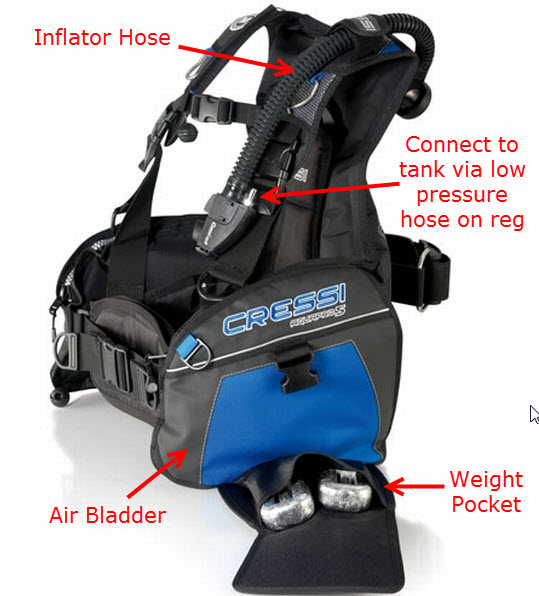
- The BCD Bubble: In a Jacket vs. Back-Inflate BCD, the CoB is located in very different places. A jacket BCD wraps volume around your torso, while a back-inflate model concentrates the volume behind you, pushing the CoB further away from your spine.
- Lung Volume: Your lungs are two massive, variable air sacs. A deep inhalation increases your volume in the upper chest, shifting the CoB "north" toward your head.
- Exposure Suits: A drysuit allows air to move freely. If air migrates to the boots, the CoB shifts toward the feet, creating a dangerous "feet-up" situation.
The goal of a stable diver is to understand that the CoB is the "lever" they can manipulate to counter the static pull of the CoG.
The Geometrical Calculus: Torque and the Pivot Point
The "Calculus" of trim comes down to the alignment of these two centers. When your Center of Gravity and Center of Buoyancy are not vertically aligned, they create Torque (a rotational force).
Imagine a vertical line drawn through your body while you are horizontal.
- If the CoB (upward force) is directly above the CoG (downward force), you are in a state of stable equilibrium. You will stay horizontal without effort.
- If the CoG is "aft" (closer to the feet) of the CoB, the downward force pulls the legs down while the upward force lifts the torso. This creates a clockwise rotation (if viewed from the right), resulting in the classic "turtling" or vertical "seahorse" position.
- If the CoG is "forward" (closer to the head) of the CoB, you will find yourself constantly face-planting into the silt.
| Alignment Scenario | Resulting Trim | Physical Sensation |
|---|---|---|
| CoG = CoB (Vertical) | Perfect Horizontal | Weightless, "flying" |
| CoG Aft of CoB | Feet Heavy | Constant "bicycle kicking" to stay level |
| CoG Forward of CoB | Head Heavy | Feeling of tipping forward; lower back strain |
| CoB Far from Spine | Rolling | Feeling of "toggling" left or right |
The distance between these two centers determines the magnitude of the tipping force. Even a few centimeters of misalignment can create enough torque to force a diver to kick constantly just to stay level, which significantly increases CO2 production 3.
The Variable Constant: Lung Volume and Dynamic Trim
Advanced divers use their lungs as a primary buoyancy and trim tool. Because the lungs are located in the upper torso, they act as a "fine-tuning" weight for the CoB.
By taking a slightly deeper breath and holding it (within safe limits and never while ascending), you shift your CoB anteriorly. This can be used to temporarily counter heavy fins or a heavy manifold. Conversely, a long, controlled exhalation shifts the CoB posteriorly.
Mastering this "dynamic trim" means you aren't just using your lungs to go up and down; you are using them as a longitudinal adjustment tool. If you feel your feet starting to sink, a slight shift in your breathing pattern can move the pivot point of your body, bringing your heels back up into the slipstream.
Equipment Configuration: Engineering Your Stability
If you find yourself fighting your trim, the solution is rarely "more practice." It is usually an engineering problem. You must move your CoG or CoB to eliminate the torque.
Tank Positioning
The position of your cylinder in the cam bands is the most powerful adjustment you have.
- Feet sinking? Move the tank up in the bands (toward your head). This moves the heavy mass of the tank valves and the first stage closer to your head, shifting the CoG forward.
- Head heavy? Move the tank down toward your tailbone.
Weight Distribution
The waist belt is the only place for lead. This is a common myth that ruins trim for many. Distributing weight along the tank's longitudinal axis using trim pockets allows you to fine-tune the CoG without affecting your ability to ditch weight in an emergency.
- Check if fins are "floaty" or "heavy" (e.g., Jet Fins vs. Monoprene).
- Ensure weight is balanced left-to-right to prevent "rolling" torque.
- Test the height of your BCD on your torso; a BCD that rides too high moves the CoB toward the head.
Practical Application: Finding the 'Sweet Spot' in Challenging Environments
In overhead environments, such as Diving The Pit Cenote in Tulum, perfect trim is a safety requirement. In The Pit, you encounter a profound halocline—a layer where fresh water meets salt water. Because salt water is denser than fresh water, your buoyancy changes instantly as you cross the boundary 1.
This density change affects your CoB. As you enter the denser salt water, the buoyant force increases 4. If your trim isn't dialed in, the sudden change in buoyancy can cause a rapid "pitch" in your orientation.
The Hover Test
To identify whether your imbalance is a weight issue or a geometry issue, perform the "Hover Test":
- Find a depth with no current (approx. 15-20 feet) 2.
- Get into a horizontal position and stop all movement.
- Cross your arms and look straight ahead.
- Observe: Do your feet sink? Does your head dip? Do you roll to one side?
- If you sink but stay horizontal, you are over-weighted. If you stay at depth but your feet sink, your CoG is too far aft.
The Safety Implications of Perfect Trim
Perfect trim is more than just a convenience; it is a pillar of decompression safety. When a diver is out of trim (e.g., head-up, feet-down), they must kick to maintain depth. This physical exertion increases the work of breathing and CO2 production. High levels of CO2 are a primary vasodilator and can increase the risk of CNS oxygen toxicity, as discussed in our guide on The Paul Bert vs. Lorrain Smith Effect.
Furthermore, posture affects how your body processes nitrogen. Proper horizontal trim ensures that the hydrostatic pressure is exerted relatively evenly across the body 1. When vertical, the pressure difference between your head and feet can reach 2-3 psi, which influences the "thoracic blood shift." This shift is a key driver of Immersion Diuresis, which can lead to dehydration and increased DCS risk.
Efficient off-gassing also relies on optimal circulation. By maintaining a relaxed, horizontal posture, you minimize "Kinetic Asymmetry"—the phenomenon where Nitrogen Leaves Your Body Slower Than It Enters. When your muscles are relaxed and your heart doesn't have to pump against the "uphill" gradient of a vertical body, your tissues can more effectively clear inert gas toward the "invisible ceiling" of your M-Values.
Expert Tip: If you find yourself constantly "over-breathing" your regulator, check your trim. Most "air hogs" are simply divers who are fighting a losing battle against gravity and buoyancy.
Conclusion: Mastering the Physics of the Deep
Mastering trim is not about having the most expensive gear; it is about understanding the geometrical relationship between your Center of Gravity and your Center of Buoyancy. By treating your configuration as a series of vectors and moments, you can move from a state of constant correction to a state of effortless "Zen."
Remember that trim is a continuous calculation. Changes in suit compression, tank pressure, and water density 1 mean that your "sweet spot" will evolve throughout the dive. Treat every dive as an opportunity to fine-tune your geometry. Perfect trim is the foundation upon which all advanced skills—from precision propulsion to complex decompression—are built. Stop fighting the water, and start letting the physics work for you.