The Science of Specific Gravity: Calculating Precision Weighting for High-Salinity Environments
Introduction: Beyond the 'Rule of Thumb'
For the novice diver, buoyancy is often presented as a "feel" or a "knack." They are taught the ubiquitous rule of thumb: "Add 10% of your body weight plus two pounds if you’re in salt water." While this approximation might suffice for a tropical vacation diver in a 3mm shorty, it fails the advanced diver who demands surgical precision in their profile. For those exploring the limits of Work of Breathing (WOB) or managing complex decompression schedules, weighting is not a guess—it is a calculation.
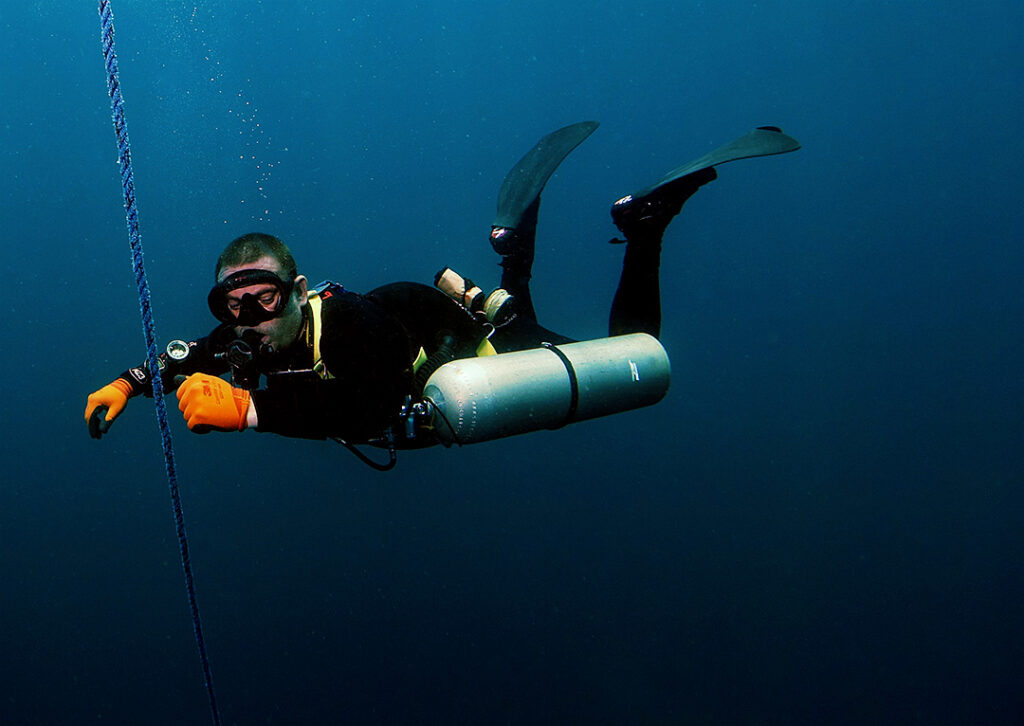
The impact of precision weighting extends far beyond simply staying down. Every extra pound of lead requires a corresponding increase in the volume of gas in your BCD or drysuit to maintain neutrality. This increased volume creates more cross-sectional area, leading to higher hydrodynamic drag and, consequently, increased gas consumption. Furthermore, being overweighted forces a diver into a "tail-heavy" orientation, destroying the horizontal trim necessary for efficient propulsion and safety.
Our objective is to achieve absolute neutral buoyancy at the most buoyant point of the dive: at the safety or decompression stop, with nearly empty cylinders and fully compressed neoprene. To reach this level of mastery, we must move past "ballpark" figures and embrace the physics of specific gravity.
Archimedes’ Principle and the Physics of Displacement
To understand weighting, we must first revisit the fundamental law of the underwater world: Archimedes’ Principle. This principle states that any object, wholly or partially immersed in a fluid, is buoyed up by a force equal to the weight of the fluid displaced by the object 1.
In diving, we are constantly balancing three states of buoyancy:
- Positive Buoyancy: The weight of the displaced water is greater than the weight of the submerged object, causing it to float 1.
- Negative Buoyancy: The weight of the object is greater than the weight of the displaced water, causing it to sink 1.
- Neutral Buoyancy: The weight of the object is exactly equal to the weight of the displaced water, allowing the object to remain suspended 1.
The "weight" we feel on land is a misnomer underwater. We should instead think in terms of net buoyancy. A diver wearing a heavy steel tank might feel heavy on the boat, but if that tank's volume displaces enough water, its net contribution to the diver's buoyancy might be less than a smaller, lighter aluminum tank that displaces less water. The diver, their exposure suit, their cylinders, and their lead are all part of a single displaced volume that must equal the total mass of the system to achieve neutrality.
Understanding Specific Gravity (SG) in Aquatic Environments
Specific Gravity (SG) is the ratio of the density of a substance to the density of a reference substance—usually pure water at 4°C. In pure fresh water, the SG is 1.000. However, as we add dissolved solids (salts), the density increases.
Standard seawater is generally cited as having a density of 64.0 lbs per cubic foot, compared to 62.4 lbs per cubic foot for fresh water 1. This results in a standard SG of 1.025. However, the world’s oceans are not uniform. Evaporation, mineral runoff, and restricted water exchange can create hyper-saline environments that significantly alter your buoyancy requirements.
| Environment | Typical Specific Gravity | Density (lbs/ft³) |
|---|---|---|
| Pure Fresh Water | 1.000 | 62.4 |
| Average Seawater | 1.025 | 64.0 |
| Mediterranean Sea | 1.028 - 1.030 | 64.2 - 64.3 |
| Red Sea | 1.030 - 1.035 | 64.3 - 64.6 |
| Dead Sea (Non-Diving) | 1.240 | 77.4 |
When transitioning from the Great Lakes (SG 1.000) to the Red Sea (SG 1.030), you aren't just "in salt water." You are in a fluid that is 3% denser. While 3% sounds negligible, when applied to a 200lb (90kg) system, it represents a massive shift in upward force.
The Calculus of Lead: Calculating the 'Salt Penalty'
To calculate exactly how much lead you need when changing environments, you must know your total system weight (your body weight + all gear including full cylinders).
The formula for the buoyancy change is: Buoyancy Change = Total System Weight × ((New SG - Old SG) / Old SG)
Example Scenario: The Great Lakes to the Red Sea
Imagine a diver whose total system weight (diver + gear + lead + gas) is 220 lbs (100 kg) and who is perfectly neutral in fresh water (SG 1.000). They are traveling to the Red Sea (SG 1.030).
- Identify the change in SG: 1.030 - 1.000 = 0.030.
- Apply the formula: 220 lbs × (0.030 / 1.000) = 6.6 lbs.
- The Result: The diver will be 6.6 lbs more buoyant in the Red Sea than in the Great Lakes.
However, we cannot simply add 6.6 lbs of lead. Why? Because lead itself has volume. Lead has a density of approximately 11.3 g/cm³. When you add lead to your belt, that lead displaces water, providing a small amount of its own buoyant lift.
Expert Tip: To account for the displacement of the lead weights themselves, you generally need to add about 10% more than the calculated buoyancy change. In the example above, the diver should actually add approximately 7.2 lbs of lead to reach the same level of neutrality.
The Halocline Factor: Buoyancy Shifts in Stratified Water
In certain environments, the specific gravity changes mid-dive. This is most famously observed in the cenotes of the Yucatan Peninsula. As explored in our guide on Diving The Pit Cenote in Tulum, divers encounter a halocline—a physical boundary where fresh water sits on top of much denser salt water.
When you cross a halocline, you are essentially entering a different fluid. If you are weighted to be neutral in the upper fresh-water layer, you will become significantly positive the moment your body enters the salt-water layer.
Strategies for Halocline Weighting:
- Weight for the Salt: If the majority of your dive or your safety stops are in the salt-water layer, weight yourself for that density. You will be slightly overweighted in the freshwater portion, which can be managed with small amounts of BCD inflation.
- The "Density Jump" Awareness: Be prepared for the visual distortion and the physical "push back" of the salt layer. This is not the place to be underweighted, as an uncontrolled ascent through the halocline can be dangerous.

Thermal Effects: Does Water Temperature Influence Lead Requirements?
A common question among technical divers is whether water temperature significantly alters buoyancy. Water is most dense at 4°C (39.2°F)—the "4°C anomaly." As water cools from room temperature toward 4°C, it becomes denser, which theoretically increases your buoyancy.
However, the magnitude of this change is minimal compared to salinity. The density change of water between 25°C (77°F) and 4°C (39°F) is only about 0.3%. For a 200lb diver, this is less than a pound of buoyancy change.
Temperature-driven water density is a major factor in weighting — Fact: Suit compression and gas density are the real thermal variables.
The reason you feel more buoyant in cold water is rarely the water itself; it is the increased thickness of your exposure suit (7mm neoprene or a thick drysuit undergarment) and the fact that you are likely carrying more gas to stay warm. Neoprene contains nitrogen bubbles that compress significantly with depth, creating massive buoyancy shifts that far outweigh the 0.3% change in water density 1.
Integrating Precision Weighting with Trim and Stability
Precision weighting is useless if it destroys your trim. Adding 8 lbs of lead to a waist belt in a high-salinity environment often pulls the diver's hips down, forcing them to kick constantly to stay level. This increases CO2 production and negatively impacts your Work of Breathing (WOB).
To maintain the "Geometrical Calculus of Perfect Trim," you must distribute the added mass of high-salinity environments relative to your Center of Gravity (CG) and Center of Buoyancy (CB) Center of Gravity vs. Center of Buoyancy.
Distribution Tactics:
- V-Weights and Tail Weights: For double-tank configurations, placing weight between the cylinders or at the bottom of the tanks can offset the buoyancy of a drysuit's legs.
- Trim Pockets: Moving some of that "salt penalty" lead to tank-band pockets helps shift the CG forward, countering the natural floatiness of the upper torso.
- Balanced Rig Principle: Ideally, if you had to ditch your weights, you should still be able to make a controlled ascent. In high-salinity water, this becomes harder, making the use of "fixed" vs. "droppable" weight a critical safety consideration.
Practical Application: Field Testing Your Calculations
Even the best math requires empirical validation. The "End of Dive" weight check is the gold standard for refining your calculations.
- Simulate the "Worst Case": Perform this check at the end of a dive when your cylinders are at reserve pressure (approx. 500 psi / 35 bar).
- Vent All Gas: Completely empty your BCD and drysuit at a depth of 10-15 feet (3-5 meters).
- Check Eye Level: You should float at eye level while holding a normal breath. When you exhale, you should begin to sink slowly 1.
- Record the Data: Note the specific environment, the exact amount of lead, the suit worn, and the cylinder type in your logbook.
By recording the specific gravity of the water (often available from local dive centers or tide data) alongside your weight requirements, you build a personal database that eliminates guesswork for future travels. This level of detail is exactly how elite divers maintain a consistent Master Your Ascent profile regardless of where they are in the world.
Conclusion: The Theoretical Diver’s Advantage
Weighting is more than a pre-dive chore; it is a fundamental component of diving physics that dictates the efficiency of your entire system. By understanding the science of specific gravity and Archimedes’ Principle, you move from a diver who "hopes" they have enough lead to a diver who "knows" they are perfectly balanced.
The ripple effects of precision weighting are profound. Lower gas consumption, reduced physical exertion, and more stable decompression stops all stem from that initial calculation. Treat your buoyancy as a mathematical discipline, and you will find that the underwater world becomes significantly more effortless.
Next time you prepare for a trip to the high-salinity waters of the Mediterranean or the Red Sea, leave the "10% rule" behind. Do the math, test the results, and enjoy the silence of a perfectly weighted dive.