Dalton’s Law and Trace Contaminants: Why 'Safe' Air Becomes Toxic at Depth
Introduction: The Hidden Math of Gas Purity
For the recreational diver, "bad air" is often associated with a foul taste or a headache after a shallow reef excursion. However, as we transition into the realm of technical and deep diving, the stakes for gas purity undergo a radical transformation. The fundamental physics of the underwater environment dictates that a gas which is perfectly safe to breathe at the surface can become a potent metabolic poison at depth.
This transformation is governed by Dalton’s Law of Partial Pressures, which states that the total pressure exerted by a gas mixture is the sum of the pressures of each individual gas in that mix 3. While we often apply this law to calculate our oxygen exposure or nitrogen loading, we frequently overlook its application to trace contaminants like carbon monoxide, oil mists, and volatile organic compounds (VOCs).
In diving, there is no such thing as a "negligible" amount of a toxin. Depth acts as a chemical magnifier, taking microscopic fractions of impurities and concentrating them until they reach physiologically significant—and often lethal—thresholds. Understanding this "hidden math" is a prerequisite for any diver venturing beyond the light zone.
The Multiplier Effect: Calculating Equivalent Surface Concentration (ESC)
To understand why a "passable" air test at the surface can fail at depth, we must look at the Equivalent Surface Concentration (ESC), also known in some circles as the Surface Equivalent Value (SEV) 1. This calculation allows us to determine the physiological effect of a gas at depth by comparing it to what its concentration would be at 1 atmosphere (1 ATA).
The formula is straightforward:
ESC = ATA × Percentage of gas (in decimal form) 13
Consider a cylinder contaminated with 10 ppm (parts per million) of carbon monoxide. At the surface (1 ATA), this concentration is generally considered below the threshold for acute symptoms. However, look at what happens as the diver descends:
| Depth (m/fsw) | Pressure (ATA) | ESC of CO (ppm) |
|---|---|---|
| 0m / 0fsw | 1.0 | 10 ppm |
| 10m / 33fsw | 2.0 | 20 ppm |
| 30m / 99fsw | 4.0 | 40 ppm |
| 40m / 132fsw | 5.0 | 50 ppm |
| 60m / 198fsw | 7.0 | 70 ppm |
At 40 meters, that "trace" amount of CO is now five times more concentrated in every breath the diver takes 1. The partial pressure of the contaminant increases proportionally with the ambient pressure, meaning the diver’s tissues are being bombarded by five times as many toxic molecules per breath as they would be at the surface.
Expert Tip: Never assume that a "slight" smell in your tank is manageable. If you can smell or taste an impurity at the surface, Dalton’s Law guarantees it will be a major physiological stressor at your target depth.
Carbon Monoxide (CO): The Silent Predator Under Pressure
Carbon monoxide is the most feared contaminant in diving because it is colorless, odorless, and tasteless. Its toxicity stems from its extreme affinity for hemoglobin—roughly 200 to 250 times that of oxygen. When CO molecules enter the bloodstream, they bind to hemoglobin to form carboxyhemoglobin (COHb), effectively "locking" the oxygen transport sites and preventing the delivery of $O_2$ to vital organs.
Under the influence of Dalton's Law, CO toxicity is accelerated at depth 3. While a diver might feel relatively normal during the initial stages of a dive, the increased partial pressure of CO (ppCO) rapidly saturates the hemoglobin.
The Ascent Paradox
A particularly dangerous phenomenon occurs during ascent. At depth, the high partial pressure of oxygen ($ppO_2$) can sometimes provide enough dissolved oxygen in the plasma to keep the diver conscious despite the CO poisoning. However, as the diver ascends and the ambient pressure drops, the $ppO_2$ decreases. The "crutch" of dissolved oxygen is removed, but the CO remains firmly bound to the hemoglobin. This often leads to a sudden loss of consciousness during the final stages of the ascent, exactly when the diver is most vulnerable.

Hydrocarbons and Oil Mist: Respiratory Irritants and Dalton’s Law
Hydrocarbon contamination usually originates from the compressor itself. If a compressor's filtration system fails or if piston seals are worn, atomized lubricating oil can enter the breathing gas.
At the surface, these oil mists might only cause a mild cough or a "shop air" taste. At depth, the increased partial pressure of these hydrocarbons causes them to act as severe respiratory irritants. They can trigger:
- Pulmonary Edema: Fluid buildup in the lungs as tissue reacts to the irritant.
- Lipid Pneumonia: A serious condition caused by oil droplets being forced into the alveolar spaces.
- Increased Work of Breathing (WOB): Irritated airways constrict, making it harder to move gas.
This risk is compounded by what we call The Thermodynamic Trap. As the gas cools during expansion through the regulator, the solubility and physical state of these hydrocarbons can change, potentially leading to increased deposition in the lungs or even causing regulator second-stage malfunctions.
The Synergy of Toxicity: Contaminants and Oxygen Sensitivity
One of the most critical reasons for advanced divers to demand high gas purity is the synergistic effect between trace contaminants and oxygen toxicity. We know from The Paul Bert vs. Lorrain Smith Effect that high partial pressures of oxygen can eventually lead to Central Nervous System (CNS) convulsions or pulmonary damage.
Trace contaminants, specifically CO and hydrocarbons, act as catalysts for these toxic reactions. They stress the cellular metabolic pathways, lowering the threshold at which a diver might experience a CNS "hit." If you are pushing your $ppO_2$ limits—perhaps following the NOAA Oxygen Tables for a long deco—even a tiny amount of CO can be the "tipping point" that triggers a seizure.
The Role of CO2
Carbon dioxide ($CO_2$) is another critical factor. While often a metabolic byproduct, it can also be a contaminant from poor compressor intake placement. As discussed in our guide on Dead Space and Skip Breathing, hypercapnia (elevated $CO_2$) causes vasodilation in the brain. This increased blood flow delivers more of every other contaminant—and more oxygen—to the brain, drastically increasing the risk of CNS oxygen toxicity and narcosis.
Gas Purity Standards: CGA Grade E vs. EN 12021
Not all "clean air" is created equal. Different regions and diving disciplines follow different standards for what constitutes breathable gas.
| Contaminant | CGA Grade E (US Recreational) | EN 12021 (European Standard) |
|---|---|---|
| Oxygen | 20-22% | 21% ± 1% |
| CO | 10 ppm | 5 ppm |
| CO2 | 1000 ppm | 500 ppm |
| Oil/Mist | 5 mg/m³ | 0.5 mg/m³ |
| Water/H2O | Not specified (Dew point) | < 25 mg/m³ (for 300 bar) |
As you can see, the European EN 12021 standard is significantly more stringent than the American CGA Grade E. For a technical diver planning a 60-meter dive, the "legal" 10 ppm of CO allowed by Grade E becomes an ESC of 70 ppm 1. This is why many technical diving facilities aim for "Oxygen Compatible Air" (OCA) standards, which are even cleaner than standard Grade E to prevent fires during partial pressure blending 4.
The Role of Moisture ($H_2O$): Moisture is often overlooked as a contaminant, but it is the enemy of your equipment. High moisture content in a cylinder can lead to internal corrosion and, more critically, can cause regulator icing. As gas moves from the high pressure of the cylinder to the intermediate pressure of the hose, it undergoes adiabatic cooling. If the gas is "wet," this temperature drop can freeze the moisture, leading to a catastrophic free-flow.
Van der Waals and Real Gas Behavior: When Dalton Needs Refinement
While Dalton’s Law is an excellent tool for most diving applications, advanced gas blenders and ultra-deep divers must recognize its limitations. Dalton’s Law assumes "Ideal Gases"—particles that have no volume and no attraction to one another.
In reality, at the extreme pressures found in a 300-bar cylinder, gases begin to behave differently. As explored in our deep dive into Van der Waals Equation vs. Ideal Gas Law, the actual concentration of a gas in a high-pressure fill may vary slightly from the predicted "Ideal" value 4. For trace contaminants, this means that the actual number of molecules you are getting in a "topped off" tank might be slightly higher than a simple pressure-based calculation would suggest.
Mitigation and Detection: Protecting the Advanced Diver
The "smell test" is a reliable way to check for all contaminants. This is a dangerous myth. While some oil mists have an odor, carbon monoxide and many VOCs do not. To ensure your safety, you must be proactive.
Pre-Dive Checklist for Gas Safety:
- Verify the Source: Does the shop display a current air quality test certificate (usually required every 3-6 months)?
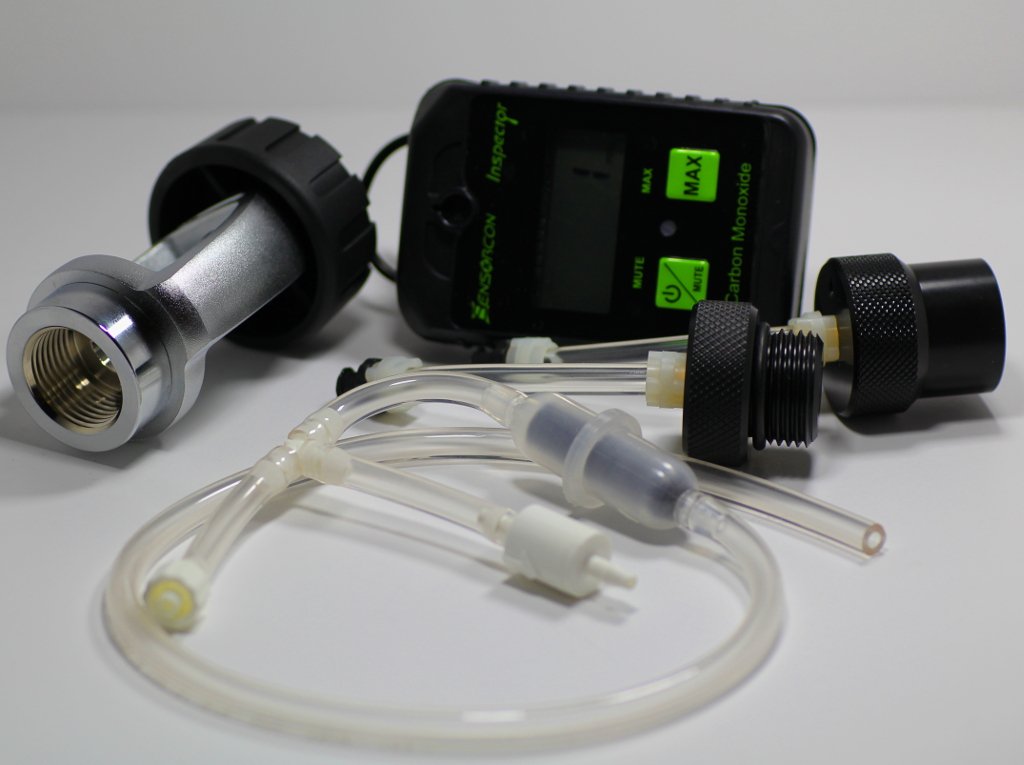
- Personal CO Detector: Use a handheld carbon monoxide analyzer on every tank, just as you would an oxygen analyzer for Nitrox.
- Compressor Maintenance: Ask the shop about their filter change intervals. A reputable shop will be happy to show you their logs.
- In-line Monitoring: For remote expeditions, consider using personal in-line CO monitors that sit between your first stage and your hose.
Warning: If you experience an unexplained headache, dizziness, or "metallic" taste during a dive, terminate the dive immediately. Do not attempt to "push through" it.
Conclusion: Respecting the Law of Partial Pressures
In the world of high-pressure physics, "trace" is a deceptive term. Dalton’s Law teaches us that depth is a force multiplier for every molecule we inhale. A contaminant level that is benign at the surface can quickly become a life-threatening toxin when compressed to 5 or 10 atmospheres.
As you progress in your diving career, your attention to gas quality must scale with your depth. Gas purity is not just a matter of "tasting good"—it is a fundamental pillar of decompression theory and physiological safety. Just as you meticulously calculate your Gradient Factors and oxygen limits, you must also vet the quality of the air that fuels your journey. Respect the math, respect the law of partial pressures, and never settle for anything less than "four-nines" (99.99%) purity in your life support.