Stokes' Law and Silt: The Physics of Particle Suspension in Caves
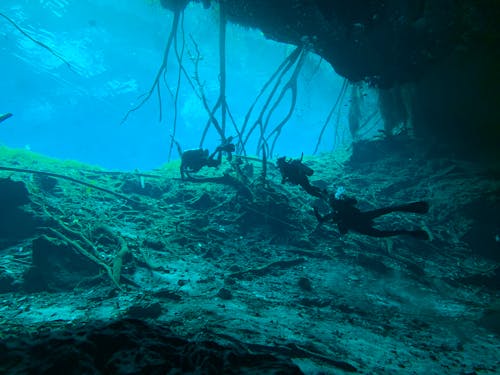
Introduction: The Fragile Clarity of the Subterranean World
For the uninitiated, an underwater cave is often perceived as a static environment of rock and water. But for the technical diver, the cave is a dynamic system in a state of delicate equilibrium. The most immediate threat to this equilibrium is not the overhead ceiling or the darkness, but the ground beneath. A total silt-out—where visibility is reduced to absolute zero—is one of the most psychologically and physiologically demanding scenarios a diver can face. It triggers an immediate spike in gas consumption, an elevation in heart rate, and a profound sense of spatial disorientation as the brain struggles to process a sudden loss of visual reference 2.
Moving beyond the entry-level mantra of "don't touch the bottom," the advanced diver must understand the underlying physics of particle suspension. Why does some silt settle in minutes, while other disturbances render a cave impassable for weeks? The answer lies in fluid dynamics and particle mechanics. By mastering the science of Stokes' Law, we can predict the behavior of our environment and move through restricted passages not just with skill, but with scientific precision. This exploration is the natural progression from understanding the optical complexities of the halocline and the mechanical risks of entanglement.
Decoding Stokes’ Law: The Math Behind the Mud
At the heart of every silt-out is a mathematical principle known as Stokes’ Law. This law describes the settling velocity of a small spherical particle as it falls through a viscous fluid. While cave silt is rarely a perfect sphere, the equation provides the fundamental framework for understanding why particles stay suspended.
The simplified version of the settling velocity ($v$) equation is:
v = (2/9) * [ (ρp - ρf) * g * R² ] / μ
Where:
- $v$: Settling velocity (how fast the "mud" sinks).
- $ρp$: Density of the particle.
- $ρf$: Density of the fluid (water).
- $g$: Acceleration due to gravity.
- $R$: Radius of the particle.
- $μ$: Dynamic viscosity of the fluid.
The Power of the Squared Radius ($R²$)
For the diver, the most critical variable in this equation is the radius squared ($R²$). Because the radius is squared, even a minor decrease in particle size results in a massive increase in suspension time. If a particle of sand is 10 times smaller than a pebble, it doesn't just stay up 10 times longer—it stays up 100 times longer. This explains why "heavy" silt (sand) clears almost instantly, while "fine" silt (clay) creates a persistent, milky fog that defies gravity for hours or days.
Particle Composition: Why All Silt is Not Created Equal
Understanding the geology of the cave you are diving in allows you to predict the consequences of a mistake. Matter, the building block of our physical world 1, behaves differently based on its specific gravity and molecular structure.
| Particle Type | Composition | Density ($ρp$) | Settling Rate |
|---|---|---|---|
| Sand | Silica/Quartz | High | Rapid (Seconds/Minutes) |
| Detritus | Organic Matter | Low | Moderate (Minutes/Hours) |
| Glacial Flour | Fine Clay | Moderate | Very Slow (Days/Weeks) |
| Limestone Snow | Calcite | Moderate | Slow (Hours) |
The Density Differential
The term (ρp - ρf) in Stokes' Law represents the buoyancy of the particle. If the density of the particle ($ρp$) is very close to the density of the water ($ρf$), the settling velocity approaches zero. Organic detritus, often found in inland "tannic" caves, is frequently near-neutral in buoyancy. A single misplaced fin kick can loft a cloud of organic material that lingers like a ghost in the water column, as there is very little gravitational "pull" to bring it back to the floor.
In contrast, the "limestone snow" found in many Mexican cenotes consists of calcium carbonate crystals. While these are denser than organic matter, their incredibly small radius ($R$) keeps them suspended far longer than the heavy river-fed sediments found in the caves of Northern Florida.

The Halocline Factor: Fluid Density and Viscosity
Fluid density ($ρf$) and viscosity ($μ$) are not constants in the diving world. As we explored in our analysis of haloclines, salinity gradients significantly alter the properties of water.
Salinity and Buoyancy
Saltwater is denser than freshwater 4. According to Stokes' Law, as fluid density ($ρf$) increases, the value of (ρp - ρf) decreases. This means that in the saltier, lower layers of a cenote, silt settles slower than it does in the freshwater upper layer. In the mixing zone of the halocline, particles can actually become trapped in a state of neutral buoyancy, creating a permanent layer of turbidity that obscures the transition between water densities.
The Temperature-Viscosity Correlation
Dynamic viscosity ($μ$) is essentially the "thickness" or internal friction of the water. Viscosity is highly dependent on temperature:
- Cold Water: Higher viscosity (thicker).
- Warm Water: Lower viscosity (thinner).
In a cold-water spring (e.g., 50°F / 10°C), the water is more viscous, providing more resistance to the falling particle. This creates a "thick" medium that holds silt in suspension longer than the warmer waters of the Caribbean. When planning a dive in colder cave systems, your margin for error regarding buoyancy and trim is significantly reduced because the "silt clock" runs much slower.
The Mechanics of Suspension: Propulsion and Percolation
Silt doesn't just "happen"; it is the result of kinetic energy being introduced into a stable system. This occurs through two primary mechanical pathways: propulsion and percolation.
The Physics of the Kick
Every fin stroke creates a thrust vector. As discussed in our guide on fin efficiency, an improper kick (like the flutter kick) directs energy downward. This creates a high-pressure zone above the sediment and a low-pressure zone behind the fin, effectively "vacuuming" the silt into the diver's wake.
Expert Tip: In restricted passages, the transition from laminar flow (smooth) to turbulent flow (chaotic) happens almost instantly. Even a perfectly executed frog kick can cause "prop wash" if the diver is moving too fast for the diameter of the tunnel.
Percolation Dynamics
Percolation is the "hidden" silt-out. As a diver exhales, bubbles rise and trap against the ceiling. These bubbles introduce kinetic energy into the "sediment traps" found in the porous limestone of the ceiling.
- Bubbles dislodge fine particles (percolate).
- The particles fall through the water column.
- Because these particles are often the smallest in the cave (low $R$), they have the slowest settling velocity.
This creates a "delayed" silt-out where the way in is clear, but the way out is obscured by the diver's own previous exhaust bubbles.
Colloidal Suspension and Brownian Motion
In some cases, Stokes’ Law fails to account for the persistence of a silt-out. When particles reach a sub-micron size, they enter the realm of colloidal suspension. At this scale, the particles are so small that the random thermal motion of water molecules—known as Brownian Motion—is enough to keep them from ever settling.
Flocculation and Electrical Charges
Many clay particles carry a negative electrical charge. These charges cause the particles to repel one another, preventing them from clumping together into larger, heavier masses. This is why some cave systems remain murky for weeks after a flood or a diver's mistake.
The water will eventually clear on its own if you wait a few hours—in high-clay environments, this is a dangerous myth. The only thing that will clear a colloidal suspension is the slow process of flocculation, where particles eventually neutralize their charges and bond together, or the physical flushing of the cave by current.

The Silt Clock: Practical Time Management in Low Visibility
Understanding the physics of silt allows for better tactical decision-making during a crisis. If you find yourself in a silt-out, you must immediately assess the "Silt Clock."
Estimating 'Time to Clear'
- Grainy/Sandy Silt: You have a high settling velocity. If you can find a "high spot" and stay still, visibility may improve in 5–10 minutes.
- Milky/White Silt: This is fine calcite or clay. The settling velocity is near zero. Do not wait. Use your line-out protocols immediately.
- Tannic/Organic Silt: This is low-density. It will drift with the current rather than settle.
The Zero-Viz Protocol
If visibility drops to the point where you cannot see your own hand 2, apply physics-based logic to stay calm:
- Stop and Breathe: Control your CO2 to prevent the urge to move sporadically.
- Maintain Contact: Use the "Physics of Entanglement" knowledge to maintain a "C" grip on the line without creating tension that could snap it.
- Feel the Current: Even a slight flow can tell you which way is "downstream" (usually toward the exit in many spring systems).
- Monitor Your Bubbles: If you lose your depth gauge, the direction of your bubbles is your only reliable vector for "up" 1.
Conservation and the Ethics of Disturbance
The physics of silt isn't just about diver safety; it's about the preservation of the subterranean world. Many cave systems host extremophile bacteria and delicate blind fauna that rely on clear water to feed and navigate. Persistent siltation can "smother" these organisms and coat delicate crystalline formations in a layer of mud that can never be removed.
Trim as a Scientific Necessity
In the world of "Pro Dive Vibes," we view good trim not as an aesthetic preference, but as a scientific requirement. By maintaining a horizontal profile, you minimize your cross-sectional area and reduce the turbulence you introduce into the environment.
Remember:
- Density Matters: Know if you're in salt or fresh water.
- Radius is King: The smaller the particle, the longer the danger.
- Viscosity is the Brake: Cold water keeps silt suspended longer.
Respecting the equilibrium of the cave is the hallmark of an advanced diver. By understanding Stokes' Law, we don't just avoid the silt—we master the medium we move through.
Final Thought: Every time you enter a cave, you are a foreign object in a balanced fluid system. Dive like a scientist, move like a ghost, and leave the physics of the cave undisturbed.
For more deep dives into the science of diving, check out our analysis of Micronuclei Theory and the Mystery of M-Values.