Lembeh Strait: A Macro Photographer’s Guide to the World’s Weirdest Critters

Welcome to the Muck: Why Lembeh is the World’s Macro Capital
If you were to describe the perfect dive site to a beginner, you’d likely talk about crystal-clear turquoise water, vibrant coral gardens, and schools of shimmering tropical fish. Lembeh Strait, located in North Sulawesi, Indonesia, is the exact opposite of that dream—and yet, for experienced divers and underwater photographers, it is the ultimate pilgrimage.
Welcome to the world of muck diving. At first glance, the sites in Lembeh look like an underwater wasteland. The seafloor is composed of dark, volcanic black sand, occasionally littered with "rubbish" like old logs, coconut husks, or the odd discarded bottle. But don't let the bleak landscape fool you. This nutrient-rich sediment is the nursery for the strangest, rarest, and most evolutionarily creative creatures on the planet.
Muck diving is boring because there are no reefs—in reality, Lembeh is the undisputed heavyweight champion of biodiversity. Shifting your perspective is key: once you stop looking for the "big picture" and start scanning the sand at a 1:1 macro ratio, the "ugly" environment reveals secrets more beautiful and bizarre than any pristine reef.
The 'Holy Grail' Critters: Lembeh’s Most Famous Residents
In Lembeh, you aren't just diving; you are on a high-stakes scavenger hunt. The strait is home to several "Holy Grail" species that divers travel across the globe to see.
The Hairy Frogfish
The Hairy Frogfish (Antennarius striatus) is perhaps the poster child of the region. Unlike their smoother cousins, these fish are covered in skin filaments that resemble strands of algae or hair, allowing them to disappear against the muck. They don't swim so much as "walk" across the bottom using pectoral fins that look remarkably like hands. Watch closely and you might see their esca—a lure that looks like a small worm—which they wiggle to attract unsuspecting prey.
The Blue-Ringed Octopus
Spotting a Blue-Ringed Octopus is a highlight for any logbook. This tiny cephalopod is famous for its glowing iridescent rings that pulse when it feels threatened. While they are breathtakingly beautiful, they are also one of the most venomous animals in the ocean. As we’ve discussed when exploring the weird world of cephalopods, these creatures carry tetrodotoxin, a potent neurotoxin for which there is no known antivenom. Observe from a distance!
The Mimic Octopus
The Mimic Octopus is the ocean's greatest impressionist. Rather than just changing color to match the sand, it actually alters its physical shape and movement to impersonate other animals. By tucking its arms in specific ways, it can look like a toxic flatfish, a lionfish, or even a sea snake. Understanding how they do this involves decoding cephalopod color changes, where specialized cells called chromatophores allow for near-instantaneous camouflage.
The Flamboyant Cuttlefish
While most cuttlefish are masters of disguise, the Flamboyant Cuttlefish is the rebel of the family. It is small, brightly colored in shades of purple, yellow, and red, and it is the only cuttlefish known to "walk" along the seafloor rather than swim. Its vivid colors are a warning to predators: "I am highly toxic."

The Tiny and the Translucent: Pygmy Seahorses and Shrimps
If the octopuses are the stars of the show, the crustaceans and syngnathids are the supporting cast that makes Lembeh truly magical.
Pygmy Seahorses
In the deeper sections of the strait, you’ll find gorgonian sea fans that host the Bargibanti and Denise pygmy seahorses. These creatures are rarely larger than a grain of rice. Finding them requires a keen eye and a patient guide, as they perfectly match the polyps of their host fan. If you are new to these tiny wonders, check out our Seahorses 101 guide to understand the biology of these delicate fish.
Symbiotic Relationships
The black sand is a bustling neighborhood of "roommates." You will frequently see the Goby and Pistol Shrimp duo. The shrimp acts as the "bulldozer," constantly clearing sand from their shared burrow, while the goby acts as the "lookout." This is a classic example of mutualism, which we cover in depth in our guide to the reef’s unlikely roommates.
Vibrant Jewels
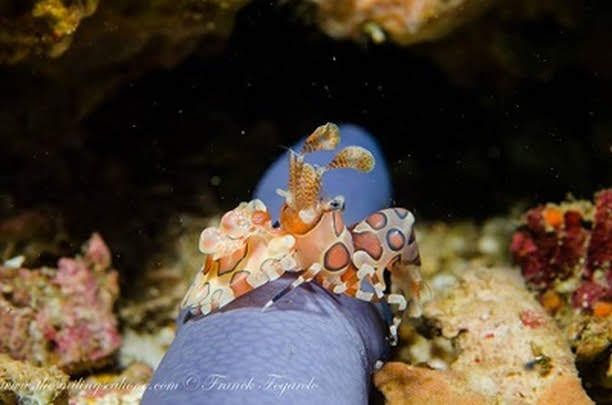
Keep your eyes peeled for the Coleman Shrimp, which lives exclusively on the venomous Fire Urchin, and the Harlequin Shrimp, a stunning white and pink predator that feeds exclusively on sea stars.
Pro Photography Tips for the Lembeh Muck
Shooting in Lembeh presents unique challenges. The dark sand absorbs light, and the silty bottom is easily disturbed, leading to the photographer’s worst enemy: backscatter.
- Strobe Positioning: To avoid illuminating the silt between your lens and the subject, push your strobes out wide and angle them slightly outward. This "edge lighting" technique ensures only the subject is lit.
- The Power of the Snoot: A "snoot" is a device that narrows the beam of your strobe to a tiny point. This allows you to create dramatic portraits with pitch-black backgrounds, isolating a tiny nudibranch or shrimp from the messy sand.
- Focusing in the Dark: Many critters in Lembeh are found at night or in low-light conditions. Use a high-quality focus light with a red-light mode, as many critters (like octopuses) are less bothered by red light.
- The 'Don't Touch' Rule: Good buoyancy is non-negotiable. One wrong kick of a fin can create a "silt cloud" that ruins the visibility for you and every other diver for the next 20 minutes.
Pro Tip: Use a "muck stick" (pointing stick) very carefully to stabilize yourself on a patch of empty sand, but never use it to poke or move a critter.
| Equipment Item | Purpose | Recommended Spec |
|---|---|---|
| Macro Lens | Close-up detail | 60mm or 105mm |
| Diopter | Super-macro magnification | +5 to +15 |
| Focus Light | Assist autofocus | 1000+ lumens |
| Snoot | Selective lighting | Fiber optic type |
Expert Review: A Dusk Dive at 'Hairball'
Of all the sites in the Lembeh Strait, 'Hairball' is the one that lives in my memory most vividly. It is a classic muck site—a long, gentle slope of dark sediment with very little coral in sight.
I remember my last descent there just as the sun was dipping below the horizon. The water was a balmy 28°C. Within ten minutes of hitting the bottom at 15 meters, my guide signaled frantically. Nestled in a small patch of debris was a mating pair of Ambon Scorpionfish, their shaggy, leaf-like appendages swaying in the slight current.
Just as I finished shooting them, I turned around to find a giant Hairy Frogfish—the size of a football—perched on a discarded sponge. The density of "weird" at Hairball is simply unmatched. It feels less like a dive and more like visiting an alien planet.
The Verdict: If you only have time for a few sites, put Hairball at the top of your list. It is the gold standard for macro photography.
Logistical Tip: Your local guide is your most important piece of equipment. These "critter spotters" have superhuman vision. They can find a 5mm nudibranch from three meters away while you're still trying to clear your mask.

Planning Your Lembeh Expedition
Ready to pack your bags? Here is what you need to know to make the most of your trip to North Sulawesi.
Seasonality
- July to September: The "dry" season. Water temperatures can drop to
25°Cor26°C, which actually triggers higher critter density. You might need a5mmwetsuit during this time. - January to March: Quieter months with warmer water, though visibility can be slightly lower due to rain runoff.
Packing Checklist
- Macro Lens: A
60mmis great for larger subjects (frogfish), while a105mmis better for shy subjects (shrimps). - Spare O-rings: The fine volcanic sand gets everywhere—be meticulous with camera maintenance.
- Pointer Stick: Essential for stability in the muck.
- Dive Computer: You’ll be doing long, shallow dives; keep an eye on your no-deco limits.
Combining Your Trip
Many divers choose to pair Lembeh with Bunaken Marine Park, which is just a few hours away. While Lembeh is about the "small and weird" on the sand, Bunaken offers massive vertical walls, incredible visibility, and dozens of sea turtles. It’s the perfect "Macro and Walls" double-feature for a 10-day itinerary.
Whether you are a seasoned pro with a high-end rig or a recreational diver with a GoPro and a sense of wonder, Lembeh Strait will change the way you look at the ocean. It teaches you that beauty isn't always found in the grand landscapes—sometimes, it’s hiding in a handful of black sand.
Are you ready to find the weirdest critters in the sea? Book your Lembeh trip and don't forget to share your best shots with the Pro Dive Vibes community!