Diving The Pit Cenote in Tulum: A Journey Through the Halocline and the Cloud

Introduction: The Jungle’s Best Kept Secret
Deep within the sun-drenched Yucatan Peninsula, far from the crashing waves of the Caribbean Sea, lies a world that feels entirely alien. To reach it, you must navigate the winding dirt paths of the Dos Ojos Park, located just north of Tulum. As you trek through the dense Mayan jungle, the air is thick with humidity and the sound of tropical birds. Then, without warning, the canopy opens up to reveal a jagged limestone scar in the earth: The Pit.
Standing on the wooden platform overlooking the entrance, the first thing that strikes you is the color. It isn't the turquoise of the nearby beaches; it is a deep, bruised indigo that hints at the staggering depths below. The Pit is a "sinkhole" cenote, a vertical shaft that drops straight into the aquifer.
While many divers flock to the ocean for marine life, cenote diving offers something different: infinite visibility. In fact, the only place I’ve experienced clarity this profound is halfway across the world. If you’ve read our guide on diving Iceland’s Silfra Fissure, you know that glacial water offers a surreal, "flying" sensation. The Pit provides a similar experience, but instead of freezing tectonic plates, you are surrounded by ancient limestone walls and the warmth of Mexico.
The Descent: Chasing the 'God Rays'
The magic of The Pit begins the moment you break the surface. Because the opening is narrow and the shaft is deep, the sunlight is focused into concentrated pillars of light known as "God Rays."
To see them at their peak, timing is everything. You want to be in the water between 10:00 AM and 1:00 PM, when the sun is directly overhead. As you descend, these beams of light pierce through the crystal-clear fresh water, reaching down like glowing fingers toward the depths. It creates a high-contrast environment that is a dream for underwater photographers.
Expert Tip: The sheer intensity of the light against the dark cavern walls can trick your camera's sensor. If you want to capture these beams, choosing the right dive lens is essential. A wide-angle lens is non-negotiable here to capture the scale of the light pillars against the massive cavern walls.
As you drift downward, the sensation is one of complete weightlessness. Without the surge of the ocean or the distraction of moving fish, you feel less like a diver and more like an astronaut floating through a liquid cathedral.

Crossing the Halocline: A Shimmering Visual Illusion
At around 12 to 15 meters (40 to 50 feet), the environment begins to warp. You are about to hit the halocline.
Because the Yucatan is a limestone shelf, fresh rainwater sits on top of heavier, denser saltwater that has seeped in from the ocean. Where these two layers meet, they don't mix immediately. Instead, they create a shimmering, oily layer that looks like a pane of moving glass or a desert mirage.
As you swim through it, your vision will suddenly go blurry. It feels like someone has smeared Vaseline over your mask.
- The Visuals: Your bubbles will look like liquid mercury trapped between the layers.
- The Temperature: You will feel a sudden "thermocline" jump. The saltwater is typically a degree or two warmer than the fresh water above.
- The Sensation: It is a brief moment of sensory disorientation that makes you feel as though you are crossing into a different dimension.
The blurriness is a sign of mask fog — actually, it’s just the physics of light refracting differently through two water densities. Once you descend fully into the saltwater layer, your vision will snap back into perfect clarity.
The Hydrogen Sulfide Cloud: Diving into the Mist
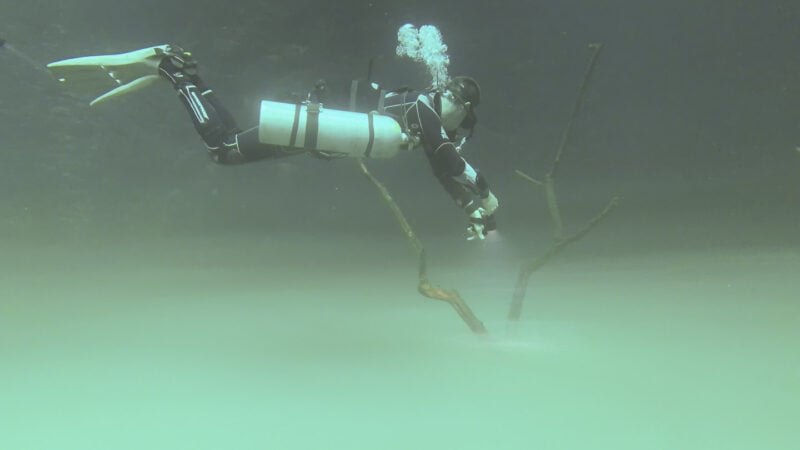
As you continue your descent toward the 30-meter (100-foot) mark, the bright blue water begins to darken, and a ghostly white layer appears below you. This is the hydrogen sulfide cloud.
This "phantom" cloud is formed by decomposing organic matter—leaves and branches that have fallen into the cenote over centuries. As they rot in the anaerobic environment, they produce a layer of sulfurous mist that hangs suspended in the water.
| Feature | Description |
|---|---|
| Depth | Approximately 27m - 30m (90ft - 100ft) |
| Appearance | Thick, white, smoky fog |
| Composition | Hydrogen Sulfide (H2S) |
| Visibility | Near zero once inside the cloud |
Floating just above this cloud is one of the most hauntingly beautiful sights in the diving world. Ancient, leafless trees and spindly branches poke through the mist like skeletal fingers. It looks like a winter forest trapped in time.
There is a significant psychological component to this part of the dive. Looking down into a cloud where you cannot see the bottom triggers a primal "void" response. It requires calm breathing and excellent buoyancy to hover just inches above the mist without disappearing into the darkness below.
The Deep Secrets: Bones and Ancient History
The Pit isn't just a geological wonder; it’s a time capsule. If you look closely at the "talus cone"—the pile of debris at the bottom of the shaft—you can see remnants of the Yucatan’s ancient past.
During the last Ice Age, the water levels were much lower, and these cenotes were dry caves. Animals, and sometimes humans, would wander in or fall into these pits. Because the water at the bottom is low in oxygen, it preserves organic material incredibly well.
- Megafauna: Divers and archaeologists have discovered the remains of giant ground sloths and ancient camels in The Pit.
- Human History: The Maya considered cenotes to be the entrance to Xibalba (the underworld). While The Pit is primarily known for its natural beauty, the nearby cenotes often contain Mayan pottery and artifacts.
- Rock Formations: Look up at the ceiling to see massive stalactites, proving that this entire chamber was once filled with air.
Floating there, observing bones that have been untouched for thousands of years, you feel less like a tourist and more like an underwater archaeologist.
Technical Gear and Skill Requirements
The Pit is a "deep" dive and is not suitable for beginners. To experience the full depth and the cloud, an Advanced Open Water (AOW) certification is the bare minimum requirement.
Gas Management at Depth
At 40 meters (130 feet), you are consuming air four times faster than at the surface. Because you are in an overhead environment (even if the exit is visible), gas management is critical. Most guides will require a "Rule of Thirds" or a very conservative air plan to ensure you have plenty of reserve for the ascent.
High-Performance Regulators
Deep diving in freshwater requires gear you can trust. If you’re looking to upgrade your kit for deeper adventures, check out our Regulator Rumble guide where we rank second stages based on their ease of breathing at depth.
Buoyancy Control
The transition between fresh and salt water changes your displacement. You will feel "heavier" in the fresh water and "lighter" once you hit the saltwater layer. Staying neutral while navigating through the halocline and hovering above the delicate hydrogen sulfide cloud takes practice.

Practical Tips for Your Pit Adventure
To make the most of your trip to The Pit, keep these logistics in mind:
- Location: The Pit is located inside the Dos Ojos Park, about 20 minutes north of Tulum and 45 minutes south of Playa del Carmen.
- The Walk: There is a set of steep stairs leading down to the water. Most shops provide a pulley system for your heavy tanks, but you’ll still need a decent level of fitness to navigate the stairs in a wetsuit.
- The Combo: Most operators pair The Pit (a deep dive) with a shallower second dive at Cenote Dos Ojos (The Bat Cave or Barbie Line). It’s the perfect way to off-gas while seeing stunning cave decorations.
Packing Checklist
- Wetsuit: 5mm is recommended. Even though the air is hot, the water is a constant
25°C(77°F), and you’ll feel the chill on a 45-minute dive. - Dive Light: Essential for peering under ledges and seeing the true colors of the rock.
- GoPro/Camera: With a tray and lights if possible.
- Biodegradable Sunscreen: Regular sunscreen is banned in cenotes to protect the fragile ecosystem.
Conclusion: Why The Pit Belongs on Every Diver's Bucket List
Diving The Pit is a multi-sensory journey that challenges your perception of what "diving" can be. It isn't about the fish or the coral; it's about the interplay of light, the mystery of the mist, and the weight of history.
While reef diving offers vibrant life, cenote diving offers a quiet, spiritual introspection that you simply can't find in the open ocean. It is a reminder of the hidden worlds that exist right beneath our feet.
As you plan your trip, remember that the Mayan aquifer is a fragile resource. Avoid touching the walls, never kick up the silt on the bottom, and always dive with a certified cavern guide. If you respect the cave, The Pit will provide you with a dive experience that remains etched in your memory long after you’ve dried off.
Are you ready to drop into the abyss? Check out our latest gear reviews to make sure you're prepared for the deep!