Diving Between Continents: Why Iceland’s Silfra Fissure is the World’s Most Surreal Cold-Water Experience
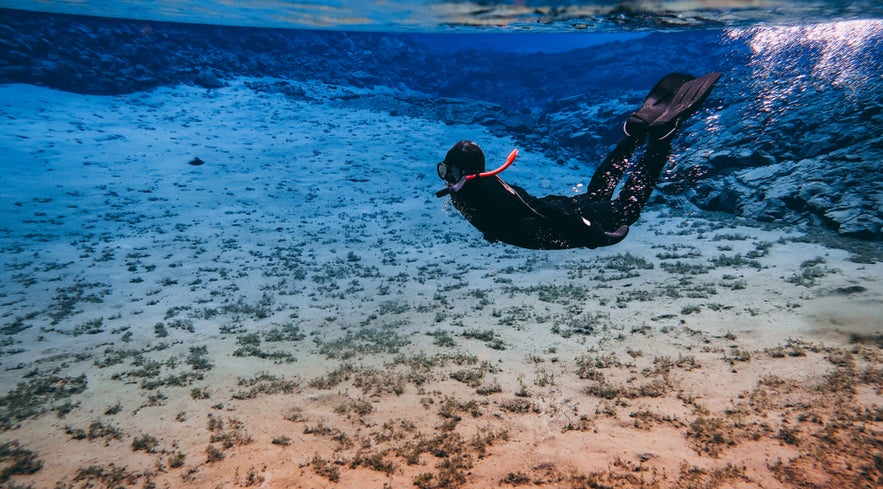
The first thing you notice isn’t the cold; it’s the silence. As I rolled off the metal platform into the 2°C (35°F) waters of the Silfra Fissure, my regulator hissed, and the world simply vanished. Or rather, the world I knew—the one defined by gravity and atmospheric haze—was replaced by something entirely alien. For a split second, my brain refused to accept I was underwater. The water is so impossibly clear that it feels like "liquid air."
Diving in Silfra is often described as a bucket-list experience, but that label feels too small. It is a sensory shock, a geological marvel, and a masterclass in buoyancy all wrapped into one shivering, awe-inspiring hour. Located in Iceland’s Þingvellir National Park, this is the only place on Earth where you can dive directly between the North American and Eurasian tectonic plates. If you are a globe-trotting diver used to the balmy currents of the Indo-Pacific, Silfra will redefine your understanding of what a "great dive" looks like.
Geology in Action: Touching Two Tectonic Plates at Once
Silfra isn’t just a hole in the ground; it’s a living, breathing wound in the Earth’s crust. It sits atop the Mid-Atlantic Ridge, the volcanic seam where the North American and Eurasian tectonic plates are moving apart at a rate of about 2cm per year.
As you descend into the narrowest parts of the fissure, you can literally reach out and touch both continents simultaneously. Your left hand rests on the rugged basalt of North America, while your right brushes against the ancient stone of Europe. This isn't a static monument; it's a site of constant change. Earthquakes are frequent in this region, and every few decades, the fissure shifts, creating new cracks and closing old ones.
Expert Tip: When you reach the narrowest point of "The Big Crack," pause for a photo. It’s the quintessential Silfra shot, but remember to keep your movements slow. In this narrow space, a stray fin kick can easily disturb the silt on the ledges, though the flow of water is usually enough to clear it within seconds.
Visibility Beyond Belief: Why 100 Meters Feels Like Flying
If you’ve spent your diving career navigating the nutrient-rich, sometimes murky waters of the coast, Silfra will ruin you. The visibility here is regularly cited as exceeding 100 meters (328 feet). In fact, the only thing limiting your view is the curvature of the rock walls or the limits of the human eye.
The secret lies in a 100-year journey. The water in Silfra begins as glacial meltwater from the Langjökull glacier, about 50 kilometers away. This water sinks into the ground and spends a century filtering through thick layers of porous volcanic basalt. By the time it emerges from underground springs into the fissure, every impurity has been stripped away. It is so pure, in fact, that you can safely drink it during your safety stop—just pop your regulator out and take a sip of the most refreshing water you’ll ever taste.
Because the water is so transparent, light behaves differently here. At midday, the sun’s rays pierce the depths like laser beams, illuminating every jagged edge of the volcanic rock in high definition. This extreme clarity makes choosing the right equipment essential. For instance, choosing the right dive lens is critical; you want a mask that maximizes your field of vision to truly appreciate the "flying" sensation that comes with 100m+ visibility.
| Feature | Silfra Fissure | Typical Tropical Reef |
|---|---|---|
| Visibility | 100m+ | 20m - 30m |
| Temperature | 2°C - 4°C | 24°C - 30°C |
| Water Type | Glacial Spring | Saltwater |
| Primary Draw | Geology/Clarity | Biodiversity |

The Big Chill: Mastering Thermal Protection in Iceland
You can dive Silfra in a 7mm wetsuit — actually, you absolutely cannot. Unless you are a member of a very specific group of extreme cold-water athletes, a drysuit is mandatory.
Managing the "Big Chill" is the primary challenge of this dive. You aren't just wearing a drysuit; you’re wearing a sophisticated layering system. Most divers opt for a "teddy bear" suit—a thick, fleece-lined thermal onesie—underneath their drysuit. While this keeps you warm, it adds a massive amount of buoyancy.
If you’re used to standard wetsuit thicknesses, the transition to a drysuit can feel clunky. You’ll likely need double the weight you usually carry, and you have to learn to manage air moving inside your suit to prevent it from rushing to your boots and flipping you upside down.
Drysuit Essentials for Silfra:
- Hood and Gloves: Usually
7mmneoprene. Your face and hands will get wet, but the water trapped against your skin will warm up slightly. - Thermal Base Layer: Moisture-wicking wool or synthetic layers are best.
- Drysuit Inflator Hose: Ensure your BCD configuration allows for easy access to the suit's inflation valve.
Navigating the Four Sections: The Silfra Tour
The dive follows a specific route through four distinct areas, each offering a different visual feast.
1. The Big Crack
This is the entrance and the deepest part of the fissure. It is narrow, dramatic, and provides that iconic "touching two continents" moment. The depth here can reach about 18 meters, though the tour usually stays shallower.
2. Silfra Hall
As the fissure opens up, you enter the Hall. Here, the colors begin to shift. While the deep water remains a piercing indigo, the shallower rocks are covered in vibrant neon-green "Troll Hair" (a type of algae).
3. The Cathedral
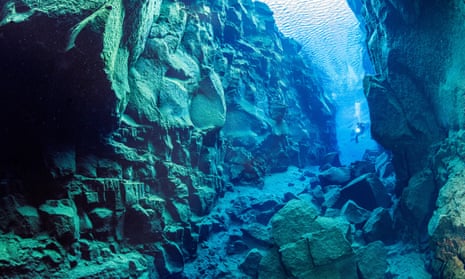
This is the highlight for many. The Cathedral is a 100-meter long fissure that looks like a sunken canyon. The walls are jagged and majestic, and the visibility is at its absolute peak here. It feels like swimming through a cathedral made of glass and stone.
4. Silfra Lagoon
The dive ends in the Lagoon, a shallow, wide-open area. This is where you can take your time exploring the "Troll Hair" and looking for the rare Arctic Char that occasionally wander in from the nearby Þingvallavatn Lake.
A Different Kind of Life: Geology Over Biology
Divers often ask, "What fish will I see?" The honest answer is: almost none. If you are looking for the bustling marine life of the SS Thistlegorm in the Red Sea, you’re in the wrong place.
Silfra is about the beauty of the inanimate. It is a world of rock, light, and water. The "life" here is found in the way the light refracts through the surface, creating "underwater rainbows" on the canyon walls. The only consistent biological presence is the Ulothrix algae, or "Troll Hair," which glows with an almost radioactive green hue against the blue water.
Occasionally, you might spot a small Arctic Char, but they are shy. The focus here is the scale of the planet—the raw, naked power of the Earth pulling itself apart.
Practical Tips for Your Icelandic Dive Adventure
Because of the extreme conditions, Silfra is a regulated dive site. You cannot simply show up with a tank and jump in.
Certification Requirements
To dive Silfra, you must meet one of the following criteria:
- Be a certified Drysuit Diver.
- Have at least 10 logged drysuit dives in the last two years, signed off by an instructor.
If you don't have these, many operators offer a "Drysuit Specialty" course on-site, or you can opt for a snorkeling tour, which is equally stunning and requires no special certification.
When to Go
- Summer (June - August): Long days and "Midnight Sun" mean incredible light. The surrounding park is lush and green.
- Winter (November - March): The air temperature can be brutal (
-10°C), and the walk to the entry point is icy. However, the contrast between the snow-covered landscape and the blue water is magical, and the crowds are much thinner.
Before you head out, make sure you aren't overlooking essential cold-water gear like a high-quality dive computer that can handle sub-freezing air temperatures.
Conclusion: Why Silfra Changes You as a Diver
By the time I climbed out of the water, my lips were numb and my fingers felt like blocks of ice, but I couldn't stop smiling. Silfra does something to your perspective. It strips away the distractions of "critter hunting" and forces you to confront the sheer scale of the Earth.
It is a meditative experience. In that silent, blue world, suspended between two continents, you aren't just a tourist; you are a witness to the slow, relentless movement of our planet. It is cold, yes. It is challenging, certainly. But stepping out of your warm-water comfort zone to hover in the "Big Blue" of the North is an experience that will stay with you long after your drysuit has dried.
If you’re ready to see the world in high definition, Iceland is waiting. Just remember to bring your thickest thermals and an open mind.