Beyond the Blue Hole: A Deep Dive into the Eerie Mist of Cenote Angelita
The 'Little Angel' of the Yucatan: An Introduction to Cenote Angelita
If you have spent any time scrolling through the Instagram feeds of technical divers or cave explorers, you have likely seen it: a diver suspended in mid-air above a swirling, ghostly river, surrounded by skeletal trees. This isn't a scene from a high-budget fantasy film; it is Cenote Angelita. Located about 15 minutes south of Tulum, Angelita—which translates to "Little Angel"—is widely considered the ultimate bucket-list dive for advanced enthusiasts visiting the Riviera Maya.
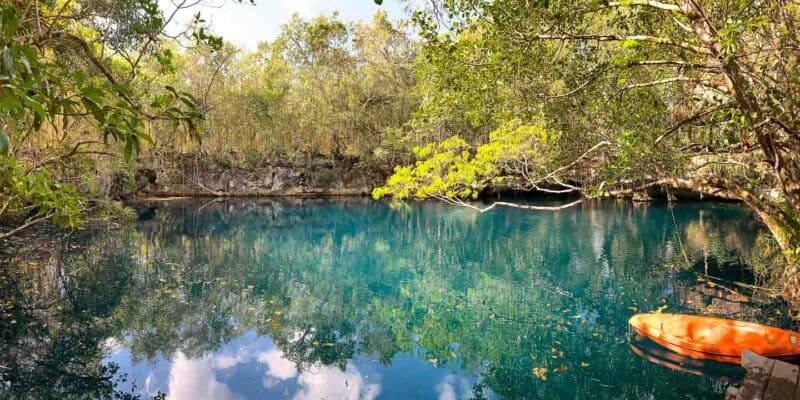
I remember my first time pulling up to the site. Unlike the sprawling tourist hubs of other cenotes, Angelita feels remarkably unassuming. You park in a gravel lot surrounded by dense, humid jungle, gear up on wooden benches, and walk a short path through the trees. When you finally reach the water, it looks like a simple, circular pond. There are no jagged rock formations or sprawling cavern entrances visible from the surface. It’s just a still, dark pool of water.
But as any seasoned diver knows, the surface rarely tells the whole story. While I’ve written about the oceanic vastness and ancient stalactites in my guide to Diving the Great Blue Hole Belize, Angelita offers a completely different kind of "blue hole" experience. It is intimate, vertical, and deeply eerie. It’s not just a dive; it’s a descent into a submerged underworld that feels entirely disconnected from the Caribbean Sea just a few miles away.
Falling Through the Forest: The Vertical Descent
The dive profile of Angelita is deceptively simple: it is a massive vertical cylinder reaching depths of approximately 60 meters (200 feet). As you descend, the first thing that strikes you is the visibility. The upper layer is pure, fresh rainwater, and the clarity is staggering.
In my review of Diving between Continents at Silfra, I raved about the 100-meter visibility of glacial meltwater. Angelita’s upper layer is perhaps the only place in the Americas that rivals that sensation. As you drop, you feel less like you are swimming and more like you are skydiving in slow motion.
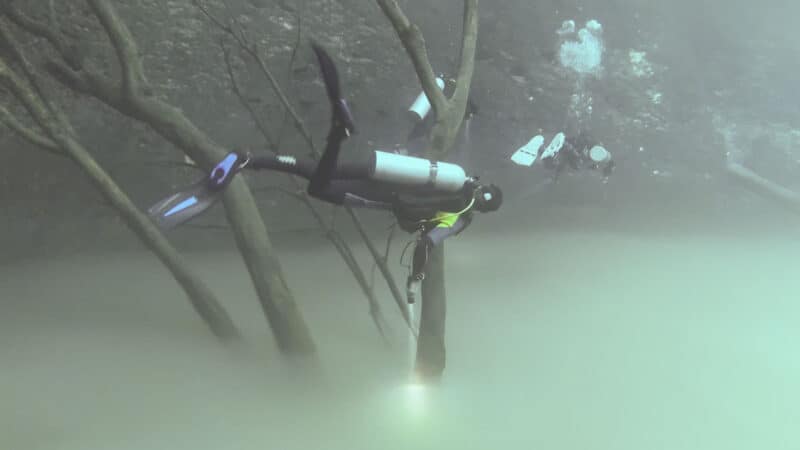
At about 20 meters, the "island" begins to emerge from the depths. Because this cenote is a vertical sinkhole, decades of falling leaves, branches, and even entire trees have tumbled in, creating a massive mound of debris in the center of the shaft. As you look down, these branches reach upward like skeletal fingers through a thick, white mist. It is at this moment that most divers realize Angelita is unlike any other environment on Earth.
The Science of the Fog: Understanding the Hydrogen Sulfide Cloud
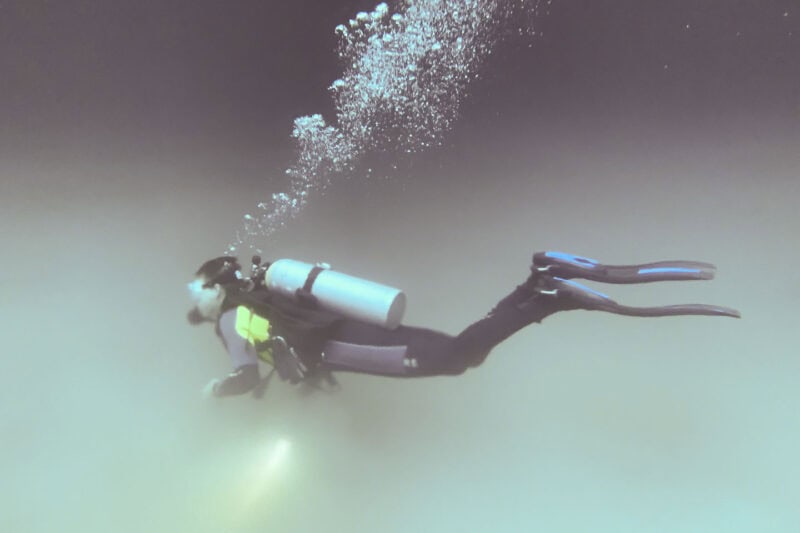
The most iconic feature of Angelita is the thick, smoky layer of "fog" that sits at roughly 30 meters (100 feet). To the uninitiated, it looks like a solid floor or a flowing underwater river.
What is it?
This isn't actually smoke or "thick water." It is a layer of hydrogen sulfide gas. Over centuries, organic matter (those trees and leaves we mentioned) falls into the cenote and decomposes. In the oxygen-poor environment of the deep saltwater layer, bacteria break down this matter, releasing hydrogen sulfide as a byproduct.
The Chemistry of the Layer
While we often talk about the visual distortions caused by salinity in The Science of the Shimmer, the cloud in Angelita is a different beast entirely. It sits right at the junction where the fresh rainwater meets the heavy saltwater (the halocline). The gas becomes trapped in this transition zone, creating a cloud that is opaque, swirling, and roughly 2 to 3 meters thick.
The 'Underwater River' Effect
Because the debris mound in the center is shaped like a hill, the cloud drapes over it, flowing down the sides of the "island" just like a mist rolling down a mountain. When you hover just above it, the fallen trees poking through the fog create the perfect illusion of a haunted forest bordering a mystical river.
Passing Through the Veil: The Experience of the 'Darkness'
Dropping through the cloud is the highlight of the dive, but it’s also the moment that tests a diver’s composure. As your mask enters the layer, the world turns a sickly, sulfurous yellow-green. Visibility drops to zero. For a few seconds, you are blind, relying entirely on your depth gauge and your buddy’s proximity.
Expert Tip: When passing through the cloud, maintain a slow, controlled descent. It is easy to lose your sense of orientation when you can't see your fins or the surface. Keep a hand on your inflator hose and stay close to your guide.
Once you punch through the bottom of the cloud (around 33 meters), the environment changes instantly. You are now in the saltwater layer. Because the cloud blocks out almost all sunlight, it is pitch black. This is where your high-powered dive lights become essential. Looking back up, the bottom of the cloud looks like a glowing, bioluminescent ceiling.
You might also notice a distinct smell or taste—a faint hint of "rotten eggs." Even through a high-quality regulator, the hydrogen sulfide is potent enough to be detected by your senses. It’s not harmful in these concentrations, but it certainly adds to the "nightmare" aesthetic of the dive.
Safety and Buoyancy
Maintaining perfect trim is critical here. If you kick too hard or flail your fins, you will stir up the delicate cloud, ruining the visibility for the divers behind you and potentially obscuring your own exit path.
- Check buoyancy at the surface (freshwater is less buoyant than salt!)
- Use a horizontal "frog kick" to minimize vertical thrust
- Ensure all hoses and gauges are tucked in to avoid snagging on submerged branches
Angelita vs. The Pit: Choosing Your Deep Cenote Adventure
Many divers ask if they should dive Angelita or "The Pit." While both are deep cenotes located near Tulum, they offer vastly different vibes.
| Feature | Cenote Angelita | The Pit |
|---|---|---|
| Primary Vibe | Eerie, swampy, "haunted" | Majestic, bright, "cathedral-like" |
| Max Depth | 60m (Dive limit 40m) |
119m (Dive limit 40m) |
| Cloud Layer | Thick, opaque, sulfurous | Thin, wispy, ethereal |
| Visibility | 100m+ above the cloud | 100m+ throughout |
| Light Effects | Moody, filtered green light | Intense, "laser" sunbeams |
While Diving The Pit Cenote is famous for its shimmering light beams that reach deep into the abyss, Angelita is for those who want a more atmospheric, almost "Gothic" experience. If you have the time, I highly recommend doing both to see the two extremes of Yucatan geology.
Gear, Certification, and Logistics for the Deep Descent
Because the primary attraction of Angelita sits at 30 meters, this is not a dive for beginners.
- Certification: An Advanced Open Water (AOW) certification is the absolute minimum requirement. Most shops will also require a "check dive" at a shallower cenote before taking you here.
- Gas Management: You are at depth in a confined (though overhead-free) space. Monitoring your
PSIorBARis crucial. Many divers choose to dive with Nitrox to extend their no-decompression limits, though you must be mindful of your Maximum Operating Depth (MOD) given the30m+profile. - Lighting: You need a primary light with at least 1000 lumens to appreciate the "dark zone" beneath the cloud.
- Photography: If you’re bringing a camera, turn off your strobes when shooting the cloud itself to avoid "backscatter" (the light reflecting off the sulfur particles). Use ambient light for the descent and save the strobes for the skeletal trees beneath the mist.
Beyond the Abyss: Pairing Angelita with the Tulum Classics
Angelita is a demanding dive, both physically and mentally. The depth and the nitrogen load mean you’ll want a much shallower, more relaxed second dive.
The perfect one-day itinerary involves hitting Angelita early in the morning (to beat the crowds and catch the best light) and then heading over to Diving Dos Ojos Cenote for a shallow, light-filled afternoon. The contrast between the dark, eerie depths of the "Little Angel" and the bright, turquoise tunnels of the "Two Eyes" is the best way to experience the full spectrum of the Yucatan's subterranean beauty.
Cenotes are just holes in the ground—they are complex, living geological wonders that offer some of the most unique diving on the planet. Angelita remains, in my logbook, the most "otherworldly" experience I’ve ever had. It challenges your perceptions of what "underwater" is supposed to look like.
Whether you are a photographer looking for that impossible shot or a thrill-seeker wanting to experience the "underwater river," Cenote Angelita is a dive that will stay with you long after you've washed the sulfur smell off your gear.
Ready to take the plunge? Make sure your buoyancy is dialed in, your lights are charged, and prepare yourself for a journey beyond the blue hole.