Loading...
marine-life#moray eel pharyngeal jaws#eel anatomy#underwater predators
Pharyngeal Jaws: The Alien-Like Secret of the Moray Eel’s Bite
Pro Dive Vibes
April 7, 20269 min read

The Xenomorph of the Reef: A Biological Marvel
If you’ve ever sat through a screening of Ridley Scott’s 1979 masterpiece Alien, you likely remember the bone-chilling moment the Xenomorph reveals its "inner mouth"—a second set of jaws that shoots forward to deliver a lethal blow. For decades, moviegoers assumed this was pure science fiction, a product of H.R. Giger’s dark and twisted imagination. However, as is often the case, nature had already beaten Hollywood to the punch.
Beneath the waves, tucked away in the craggy recesses of the coral reef, lives a creature with a biological mechanism so similar to the Xenomorph that it feels like a glitch in the evolutionary matrix: the moray eel.
For most divers, a moray eel is a common sight—a toothy face peering out from a hole, rhythmically opening and closing its mouth. We often categorize them as "cool to see" or "slightly intimidating," but rarely do we stop to consider the incredible engineering hidden behind those rows of needle-like teeth. To truly appreciate the moray, we have to look past its skin patterns and understand the "why" behind its evolution. These are not just generic predators; they are highly specialized hunters designed to dominate the complex, cramped architecture of the reef.
The Suction Struggle: Why Eels Can’t Eat Like Other Fish
To understand why moray eels evolved a second set of jaws, we first have to look at how a "normal" fish eats. Most of the fish you see on a reef—from the tiny damselfish to the massive grouper—rely on suction feeding.
When a typical fish spots a snack, it rapidly expands its oral cavity (the mouth and throat area). This sudden expansion creates a vacuum, pulling a volume of water—and the unlucky prey—into the fish’s mouth. It is an incredibly effective strategy in open water, but it has a major physical limitation: it requires space.
The Problem with Tight Spaces
Moray eels live in the "negative space" of the reef. They spend their lives squeezed into narrow crevices, volcanic tubes, and deep coral undercuts.
- Expansion Issues: To create suction, a fish needs to expand its head laterally. In a tight hole, there is no room for the head to "puff out."
- Hydrodynamic Drag: Suction feeding works best when the predator can lunge forward. A moray, often anchored in a hole, can’t always generate the forward momentum needed to make suction effective.
- The "Bellows" Effect: In a confined pipe or crevice, trying to suck in a large volume of water can actually create pressure issues that push the prey away rather than drawing it in.
In our post Beyond the Bite: Unveiling the Surprising Purpose of Teeth in Reef Fish, we discussed how different species have adapted their dental structures to their diets. While parrotfish developed "beaks" for scraping algae, the moray eel went in a completely different direction. Instead of relying on the physics of water movement, the moray evolved a mechanical solution.
| Feeding Method | Mechanism | Environment | Limitation |
|---|---|---|---|
| Suction Feeding | Vacuum creation | Open water/Reef edge | Requires head expansion space |
| Ram Feeding | Lunging with open mouth | Open ocean | Requires high speed |
| Pharyngeal Bite | Mechanical transport | Crevices/Holes | Requires complex musculature |
Meet the Pharyngeal Jaws: The Hidden Second Set
So, if you can't suck your food down, how do you get it from your mouth to your stomach? Enter the pharyngeal jaws.
While many fish species actually possess pharyngeal jaws (usually located deep in the throat and used for grinding food, like the "throat teeth" of a parrotfish), the moray eel’s version is unique in the entire animal kingdom. In most fish, these jaws are fused to the skull or gill arches and have very limited movement. In the moray eel, these jaws are highly mobile and equipped with their own set of powerful muscles.
Anatomy 101: The "Inner Mouth"
The pharyngeal jaws are located just behind the eel’s skull, in the pharynx (throat area). When the eel is at rest, these jaws sit tucked away, invisible to the casual observer. However, they are armed with backward-curving, razor-sharp teeth.
The design is intentional:
- The Hook: The curvature of the teeth ensures that once a prey item is grabbed, any struggle only serves to drive the teeth deeper.
- The Rail System: The jaws are mounted on a complex system of muscles that allow them to slide forward and backward along the length of the eel’s throat like a train on a track.

The Mechanics of the Strike: A Two-Stage Process
Witnessing a moray eel hunt is a rare treat for a diver, especially if you are out on The Midnight Shift. The strike happens in the blink of an eye, but it is actually a sophisticated two-stage mechanical process.
Stage One: The Primary Strike
The eel lunges with its primary oral jaws. These jaws are designed for one thing: restraint. The long, needle-like teeth pierce the prey, preventing it from escaping. However, because the eel cannot use suction to pull the prey further back, it is stuck with a mouthful of fish and no way to swallow it—unless it has a second pair of hands.
Stage Two: The Slingshot
This is where the magic happens. Within milliseconds of the primary jaws making contact, the pharyngeal jaws launch forward from the throat. They travel all the way into the oral cavity, bite into the prey, and then—with incredible force—retract.
This "slingshot" motion effectively drags the prey from the front of the mouth down into the esophagus. The eel doesn't need to move its head or use water pressure; the mechanical "inner mouth" does all the heavy lifting.
Expert Insight: Scientists at UC Davis were the first to film this in high-speed X-ray back in 2007. They discovered that the pharyngeal jaws can move almost the entire length of the eel's head, a range of motion unseen in any other vertebrate.
Evolutionary Advantage: The King of the Crevice
Why go through all this evolutionary trouble? The answer lies in the moray’s niche. By decoupling the act of "grabbing" from the act of "swallowing," the moray has turned the reef’s tightest cracks into a buffet line.
- Niche Specialization: Morays can hunt in holes where a grouper or snapper would be physically unable to feed.
- Energy Efficiency: The double-jaw system is incredibly efficient. There is very little "lost" prey; once the primary jaws hit, the success rate of the pharyngeal jaws is nearly 100%.
- Nocturnal Dominance: During the night, when many fish are "sleeping" in coral branches, the moray can slide through the architecture and pluck prey out without needing to move its entire body, maintaining its stealth.
This specialized anatomy makes the moray one of the most successful predators on the reef, a fact you can explore further in our identification guide, Eel-egantly Different.
Diver Observations: Reading Moray Behavior
As a diver, you will most likely see a moray eel in its "gape" posture—mouth open, teeth on display. Many new divers mistake this for a threat display, but it's usually much more mundane.
The 'Gape': Breathing vs. Aggression
Because moray eels have small gill openings, they have to constantly pump water through their mouths and over their gills to breathe. That rhythmic opening and closing of the mouth is simply the eel taking a breath.
How can you tell the difference between a breathing eel and a grumpy one? Look for these signs:
- Breathing: Rhythmic, slow, steady opening/closing. The eel remains deep in its hole.
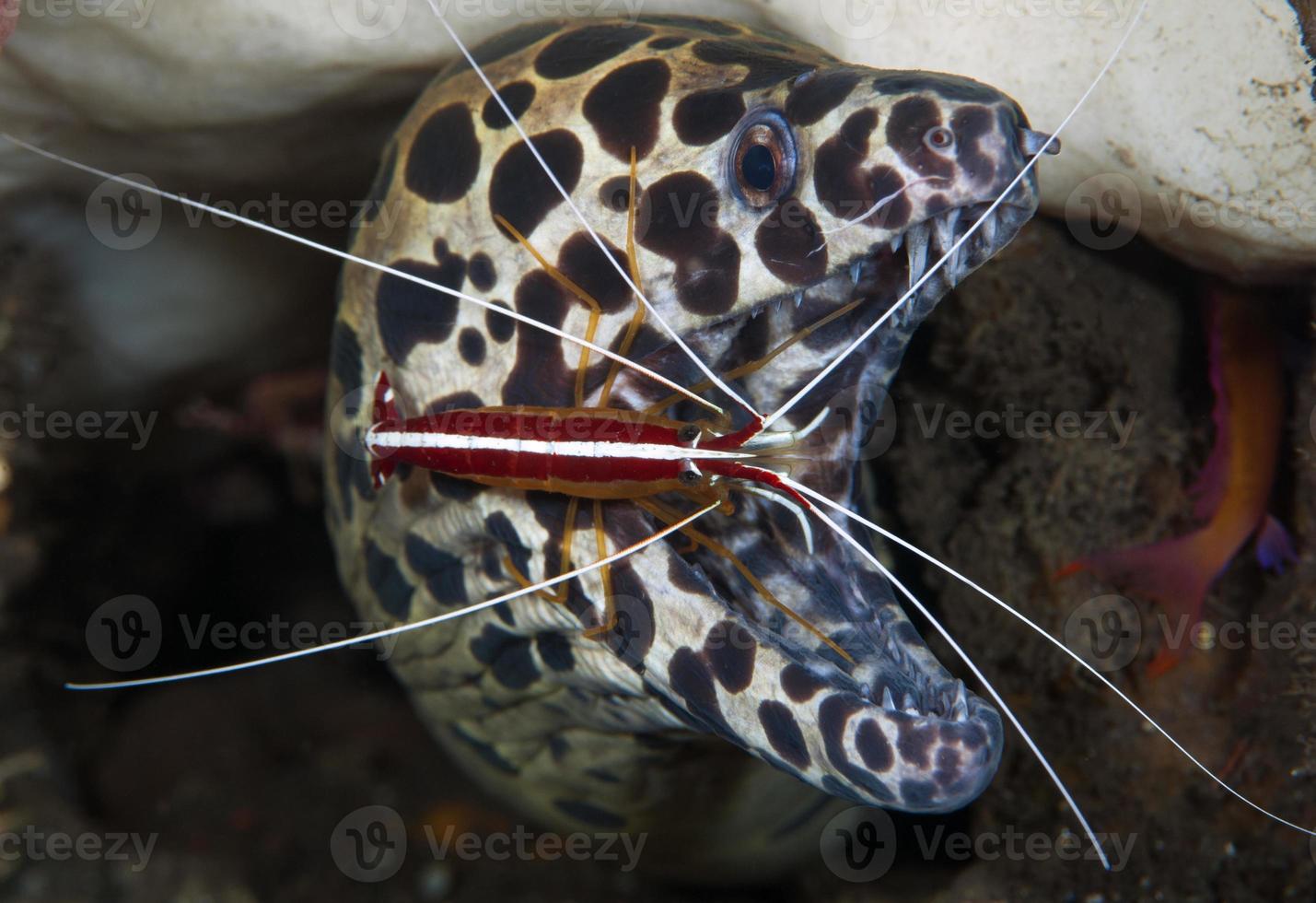
- Cleaning: The eel stays very still with its mouth wide open, often with small shrimp or wrasses darting in and out.
- Aggression: The eel leaves its hole, its body is tensed in an "S" shape, and the mouth movements become rapid or "snappy."
If you see an eel being tended to by small shrimp, you’re witnessing one of the reef’s most famous "social contracts." Check out The Reef’s Spa Day to learn why these predators don't eat their "dentists."
Safety and Ethics: Respecting the Power of the Jaw
Understanding the pharyngeal jaw isn't just a cool biology lesson; it's a vital safety tip.
The Danger of Hand-Feeding
Feeding eels is a harmless way to get a good photo—actually, it is incredibly dangerous and unethical. Because of the two-stage bite, if an eel accidentally bites a diver's finger, the pharyngeal jaws will automatically launch.
Once those secondary jaws have latched on, the eel literally cannot let go easily. The backward-curving teeth are designed to stay locked. Trying to pull your hand away often results in more severe tissue damage as the teeth "hook" deeper. In many cases, the only way to release the bite is to kill the animal or wait for it to relax, which can take a long time.
Safety Warning: Never attempt to hand-feed or touch a moray eel. Their strike is faster than human reaction time, and their unique jaw anatomy makes a "test bite" a permanent injury.
To keep your dives safe and reef-friendly, always follow the protocols in Look But Don't Touch: Essential Safety Tips for Diving Near Venomous Marine Life. Even though morays aren't venomous, their mechanical bite is just as formidable.
Conclusion: Appreciating the Reef’s Most Specialized Hunter
The moray eel is a masterclass in biological engineering. From its lack of pelvic and pectoral fins to its incredible "Alien" jaws, every inch of this animal is optimized for life in the labyrinth of the reef.
The next time you find yourself eye-to-eye with a Giant Moray or a Spotted Moray, take a second to look past the "scary" teeth. Think about the incredible musculature hidden in that throat and the millions of years of evolution it took to perfect the "slingshot" bite. It’s a reminder that the ocean has a solution for every environmental challenge, even if those solutions look like they belong on a spaceship rather than a coral reef.
Ready to spot some eels on your next dive?
- Practice your buoyancy to get close (but not too close!) to the reef.
- Bring a dive light to peek into those dark crevices.
- Keep an eye out for cleaner shrimp—they are the best way to find a stationary eel.
The more we understand about the "monsters" of the deep, the more we realize they aren't monsters at all—just brilliantly designed neighbors in the underwater world. Happy diving!