Loading...
marine-life#skates vs stingrays#angelshark identification#sand-dwelling marine life
Mastering the Sand: How to Tell Skates, Stingrays, and Angelsharks Apart
Pro Dive Vibes
August 1, 20265 min read

To many divers, a vast stretch of sand looks like an underwater wasteland. We are naturally drawn to the high-voltage energy of coral reefs, wall drops, and kelp forests. But if you glide over the sand too quickly, you are missing out on some of the ocean's most spectacular masterclasses in adaptation. Far from being a barren desert, the sandy bottom is a bustling, dynamic habitat populated by cryptic predators and master mimics.
Sandy dive sites are boring deserts — in reality, they are thriving ecosystems where some of the ocean's most fascinating elasmobranchs (the class of cartilaginous fish that includes sharks, rays, and skates) hide in plain sight.
There is a distinct, heart-pounding thrill that comes with spotting a buried sand-dweller. At first, you might only notice a slight, unnatural contour in the sediment, or a pair of glossy, unblinking eyes peering up through the silt. As you hover quietly, the outline of a flat, winged creature slowly materializes. But what exactly are you looking at?
Is it a skate, a stingray, or perhaps the ultimate master of disguise—an angelshark?
While they all share a flattened profile designed for life on the seafloor, these animals belong to entirely different taxonomic groups, possess unique survival strategies, and require different safety protocols from divers. In our previous exploration of pelagic species, Manta or Mobula? The Biological Keys to Identifying Every Ray You See, we learned how to identify the giants of the water column. Now, it is time to drop down to the substrate, slow our breathing, and master the art of identifying the hidden residents of the sandy slope.
The Anatomy of Camouflage: Why Sand-Dwellers Look Alike
To understand why these animals look so similar, we have to look at the concept of evolutionary convergence. When different species inhabit the same ecological niche, they often evolve similar physical traits to solve the same survival challenges. For a bottom-dwelling predator, the goal is simple: blend into the seafloor to avoid being eaten by larger predators, while remaining completely invisible to unsuspecting prey passing overhead.
Over millions of years, this pressure has sculpted skates, stingrays, and angelsharks into highly flattened, disc-like shapes. Their dorsal (top) sides are painted in mottled shades of beige, brown, grey, and cream, perfectly mimicking the texture of sand, gravel, or mud.
But living buried under a layer of sediment presents a major physiological challenge: how do you breathe without inhaling a mouthful of sand?
The answer lies in specialized breathing structures called spiracles. These are modified gill slits located directly behind the eyes on the top of the head.
Instead of drawing water in through their mouths (which are pressed flat against the sand), these animals draw clean, oxygenated water down through their spiracles, pump it over their gills, and expel it out of their gill slits on their underside. When you watch a buried ray closely, you can often see these spiracle valves rhythmically opening and closing like tiny, pulsing bellows.
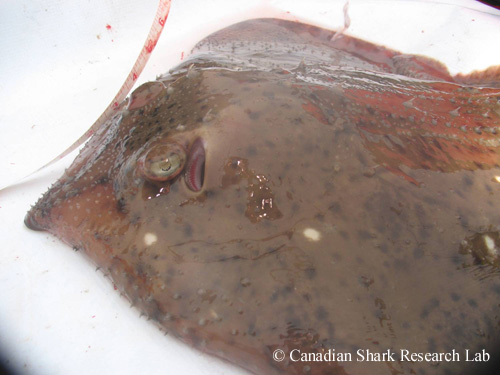
If you want to find these masters of camouflage, you have to train your eyes to look for subtle clues in the right places. Sandy patches adjacent to coral reefs, shallow seagrass beds, and muck diving sites are prime hunting grounds.
Artificial structures are also major biodiversity magnets. If you explore the debris fields and sandy channels beneath piers, you are highly likely to spot them resting in the shadows, as detailed in our guide on Hidden in Plain Sight: Why Pier Piles and Jetty Debris are the Ultimate Marine Life Hotspots.
Skates vs. Stingrays: Unraveling the Flatfish Confusion
For many divers, "skate" and "stingray" are used interchangeably. However, they belong to completely different taxonomic orders and have vastly different life histories.
Taxonomy 101
Skates belong to the order Rajiformes, while stingrays belong to the order Myliobatiformes. While they share a similar flat, cartilaginous blueprint, their evolutionary paths split millions of years ago.
Tail Tales
The easiest way to tell a skate from a stingray in the wild is to look at the tail:
- Stingrays possess a thin, whip-like tail. This tail is typically equipped with one or more venomous, serrated barbs (or stings) located along the mid-to-upper section of the tail, which they use purely for self-defense. Stingrays generally lack dorsal fins on their tails.
- Skates have a much thicker, fleshier tail. They completely lack venomous barbs. Instead, their tails often feature two small dorsal fins near the tip, and they may be lined with small, thorny scales.

Reproductive Differences
If you cannot see the tail clearly, their reproductive strategies offer another massive biological distinction. Skates are oviparous, meaning they lay eggs. They deposit their embryos in tough, leathery, rectangular egg cases often referred to as "mermaid's purses." These cases have curly tendrils at the corners that snag on seaweed or rocks to keep them secure.
Stingrays, on the other hand