The Thermodynamic Trap: How Temperature Dictates Gas Solubility and DCS Risk

For many divers, thermal protection is viewed through the lens of comfort—a thick enough wetsuit to avoid "the shivers" or a drysuit to stay cozy in temperate waters. However, in the world of advanced decompression theory, temperature is far more than a matter of subjective preference. It is a critical thermodynamic variable that dictates the rate of inert gas uptake and elimination. When we ignore the thermal state of our tissues, we fall into the Thermodynamic Trap: a physiological state where our bodies deviate significantly from the mathematical models humming away inside our dive computers.
Beyond Comfort: The Molecular Impact of Temperature
Thermal management is a core pillar of decompression theory because the human body is not a static block of tissue; it is a dynamic system of fluid and gas exchange. While your dive computer assumes you are at a constant, "neutral" physiological state, your body responds to thermal stress by altering its internal "gas map." 1
There is a vital distinction between perceived cold (the sensation of chilly water on the skin) and physiological thermal stress (the systemic response to heat loss). Even before you begin to shiver, your body initiates a series of complex survival mechanisms. As we explored in our guide on Stimulants and Vasoconstriction, the narrowing of blood vessels significantly alters how gas moves through your system. When temperature drops, the body prioritizes core temperature over peripheral perfusion, essentially rewriting the rules of gas transport in real-time.
Henry’s Law and the Solubility Inverse
To understand the thermodynamic trap, we must return to the physics of solubility. Henry’s Law states that the amount of gas dissolved in a liquid is proportional to the partial pressure of that gas. 4 However, there is a secondary factor often overlooked in basic training: temperature.
The solubility of gases in liquids is inversely proportional to temperature. In simpler terms: colder liquids can hold more dissolved gas than warmer liquids.
The Soda Bottle Analogy
Think of a bottle of carbonated soda. If you open a warm bottle, the CO2 escapes violently because the warm liquid cannot hold the gas in solution. If you open a near-freezing bottle, the gas stays dissolved much longer. In a diving context, as your body cools, your blood and tissues become a more efficient "sponge" for inert nitrogen and helium. 4
| Condition | Gas Solubility | Tissue Loading Potential |
|---|---|---|
| Warm | Lower | Reduced |
| Cold | Higher | Increased |
As a diver’s peripheral tissues cool down, their capacity to "soak up" nitrogen increases. This creates a hidden debt that most decompression algorithms—which generally ignore temperature—fail to account for.
The Perfusion Pivot: How Temperature Controls Gas Transport
The body’s primary defense against heat loss is vasoconstriction. By narrowing the blood vessels in the skin and extremities, the body reduces the volume of blood exposed to the cold environment, preserving heat for the vital organs. 1 This is known as the "Diving Reflex" or peripheral shutdown. 3
This physiological shift creates a massive disconnect with your dive computer's kinetic model.
- Stagnant Compartments: When vessels constrict, blood flow to the skin and muscles (the "peripheral" tissues) slows to a crawl.
- Kinetic Mismatch: Gas exchange relies on perfusion. If blood isn't flowing through a tissue, nitrogen cannot be transported out of it.
- The "Ghost" Loading: While your computer thinks your "slow" tissues are off-gassing at a predictable rate, those tissues may actually be sequestering gas because the "delivery trucks" (blood flow) have stopped running due to the cold.
This phenomenon is a primary driver of Kinetic Asymmetry, where the rate of gas entering the body does not match the rate of it leaving.
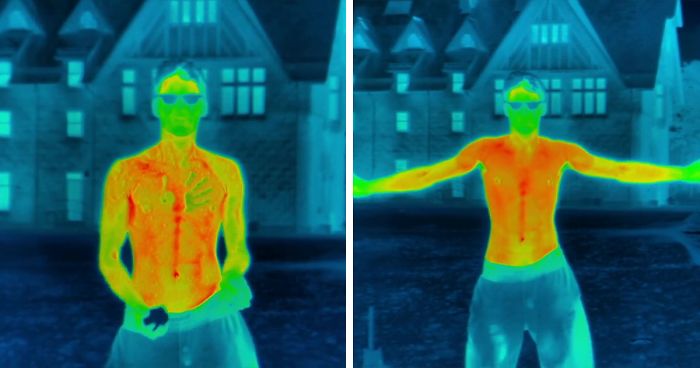
The Thermodynamic Trap: Warm Bottom, Cold Ascent
The most dangerous thermal profile a diver can experience—and the essence of the Thermodynamic Trap—is the Warm Bottom / Cold Ascent profile.
During the working portion of the dive, many divers are active. They may be swimming hard or using active heating systems, keeping their peripheral tissues warm and well-perfused. This maximizes the uptake of inert gas into the tissues. 1 However, as the dive transitions to the decompression phase, activity levels drop, and the diver begins to cool down.
Why This Profile Is Lethal
When you are cold during decompression, two things happen simultaneously:
- Increased Solubility: Your cooling tissues want to hold onto the gas more tightly.
- Decreased Perfusion: Your constricted blood vessels cannot transport the gas to the lungs for exhalation.
This combination traps gas in the tissues just as you are ascending to zones of lower ambient pressure. This is a recipe for the formation of Vascular Gas Bubbles (VGE) and can lead to Subclinical DCS, where you feel fatigued and "beat up" after a dive even without classic "bend" symptoms. 1
Expert Tip: The goal of a safe decompression is to be "cool and calm" during the loading phase and "warm and relaxed" during the off-gassing phase. This promotes minimal uptake and maximal elimination.
The Cold Bottom Paradox: Loading Efficiency vs. Solubility
If being warm on the bottom increases gas uptake, does being cold on the bottom protect you? This is the Cold Bottom Paradox.
While it is true that a cold, vasoconstricted diver will have lower perfusion and thus "load" less gas in their extremities, the trade-off is rarely worth it. Being cold triggers involuntary shivering, which leads to Metabolic Debt. Shivering can increase your metabolic rate and gas consumption by up to 300%, significantly impacting your gas reserves. 3 Furthermore, a chilled diver cannot think clearly or work efficiently, increasing the risk of task loading and accidents. 2
"Cold and miserable" is a valid decompression strategy — In reality, the increased solubility and the eventual need to off-gas from "stagnant" tissues make being cold on the bottom a high-risk gamble, not a safety margin.
Active Heating Systems: A Double-Edged Sword
Active heating (heated vests and drysuit liners) has revolutionized technical diving, but it must be managed with scientific precision. The danger lies in the timing of the heat.
If a diver turns on their heated vest halfway through a long decompression stop, they trigger a sudden "flush" of blood to tissues that are already saturated with gas. This rapid increase in perfusion, combined with a sudden decrease in gas solubility as the tissue warms, can trigger a massive release of bubbles—essentially "boiling" the nitrogen out of solution too quickly for the lungs to handle.
Best Practices for Thermal Stability:
- Maintain Consistency: Keep heating at a low, constant level throughout the dive rather than "spiking" it.
- Pre-warm: Ensure you are thermally neutral before you even enter the water.
- Gradual Reduction: If you must turn heat down, do so gradually to avoid sudden vasoconstriction.
Thermodynamics and Gas Choice: The Helium Factor
Helium is a fantastic gas for deep diving, but it presents a unique thermal challenge. Helium has a thermal conductivity approximately six times greater than air. 2 This means it strips heat from your body—especially through the lungs—at an accelerated rate.
In our article on Thermodynamics of the Deep, we discuss how the "Helium Chill" isn't just uncomfortable; it accelerates the cooling of your core and peripheral tissues. When breathing Trimix, managing your thermal budget is just as important as managing your gas volume. If you lose the thermal battle, your decompression schedule (which assumes standard perfusion) becomes increasingly inaccurate.
Practical Mitigation: Adjusting Your Safety Margin
Since most dive computers do not have a thermometer probe inserted into your muscle tissue, you must manually account for thermal stress.
- Padding the M-Value: If you know you were cold during a dive, you must increase your conservatism. Using Gradient Factors is the most effective way to do this. A "cold" dive should be planned with a lower GF High (e.g., shifting from 85 to 70) to allow for more off-gassing time.
- The "Deep/Long" Rule: Treat a cold dive as if it were deeper or longer than it actually was. Many planning softwares allow you to toggle a "Cold" setting which automatically adds a percentage of conservatism to the profile.
- Post-Dive Recovery: Avoid hot showers or hot tubs immediately after surfacing. Much like the "active heating" danger, a sudden external heat source causes rapid vasodilation and a shift in solubility that can trigger late-onset DCS. Wait at least 30–60 minutes for your gas levels to stabilize before seeking intense external heat.
| Scenario | Physiological State | Action Required |
|---|---|---|
| Warm Bottom / Warm Deco | Optimal Perfusion | Follow Standard Plan |
| Cold Bottom / Cold Deco | Low Perfusion / High Solubility | Add 10-15% Deco Time |
| Warm Bottom / Cold Deco | High Risk Trap | Add 20%+ Deco Time / Lower GF |
Conclusion: Thermal Neutrality as a Decompression Tool
The relationship between temperature, Henry's Law, and physiological perfusion is one of the most complex aspects of modern diving science. We must stop viewing "cold" as a mere inconvenience and start seeing it as a thermodynamic force that alters our decompression status. 1
The "perfect" dive is one that is thermally boring. By maintaining thermal neutrality—staying comfortably warm without overheating or chilling—you ensure that your body’s physiology remains as close as possible to the mathematical models your computer uses. Don't let the Thermodynamic Trap catch you; manage your heat as carefully as you manage your gas.