The Physics of Perfect Trim: Mastering the Interaction of Gravity and Buoyancy
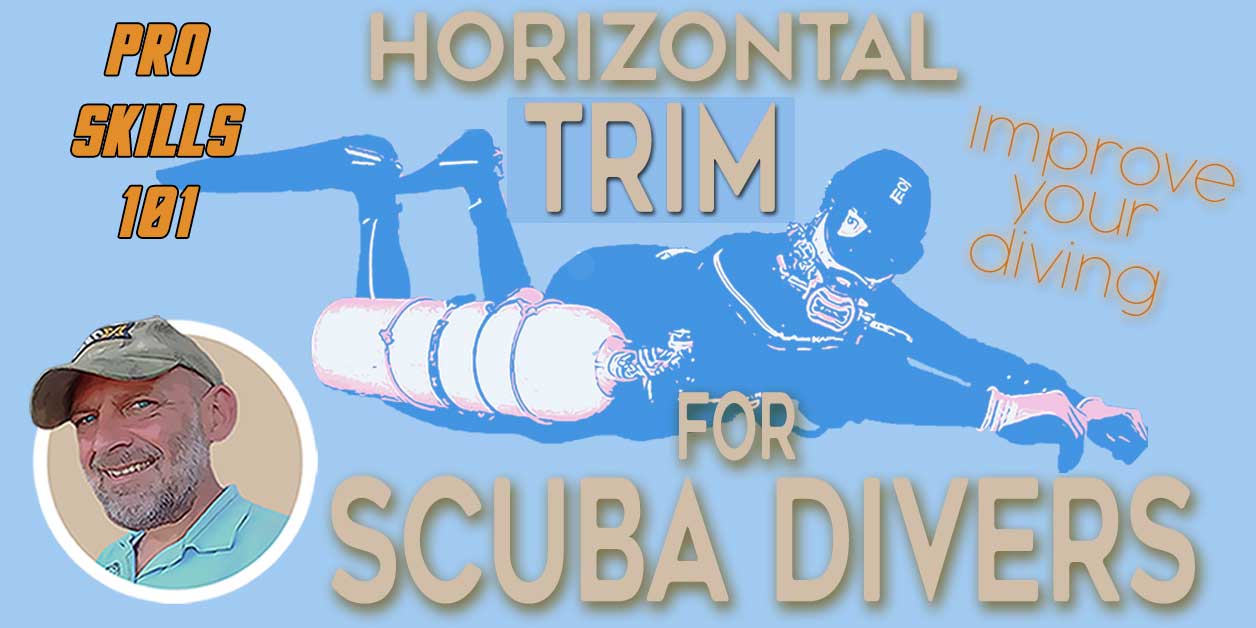
For many divers, the transition from beginner to advanced isn't marked by a plastic card or a specific depth on a computer; it is marked by the moment they stop fighting the water and start existing within it. This state of grace is known as trim. While the term is often used interchangeably with buoyancy, they are distinct concepts. If buoyancy is your ability to maintain a specific depth, trim is your orientation in the water column—the horizontal, streamlined posture that allows a diver to glide with the efficiency of a shark rather than the drag of a vertical "seahorse."
Mastering trim is a prerequisite for the more nuanced aspects of underwater exploration. Without a perfectly horizontal profile, advanced propulsion techniques like the back-kick or the helicopter turn become physically impossible. To achieve this, we must move beyond the simple goal of "staying level" and dive deep into the underlying physical forces at play: the constant, silent tug-of-war between gravity and buoyancy.
The Anatomy of Force: Center of Gravity (CoG) Explained
To understand trim, we must first identify the two primary forces acting upon a diver. The first is gravity. Even in the weightless environment of the ocean, gravity exerts a downward pull on your mass. In physics, this is simplified as the Center of Gravity (CoG)—the specific point where the total weight of the diver and all their equipment is concentrated.
In a standard recreational setup, your CoG is dictated by high-density components. This includes your lead weights, the heavy metal of your cylinder (especially steel tanks), and the mass of your fins. For most divers, the CoG is located somewhere near the hips or lower abdomen, but this is highly dependent on gear configuration.
One of the most important characteristics of the CoG is that it remains relatively static throughout the dive. While you do lose a small amount of weight as you consume the gas in your tank—a phenomenon we will explore later—the physical location of your weights and the heavy metal of your regulator and tank valves does not move. Understanding that your CoG is your "anchor" is the first step in mastering the physics of your position.
The Upward Force: Understanding the Center of Buoyancy (CoB)
Opposing the downward pull of gravity is the upward force of buoyancy, governed by Archimedes' Principle. This principle states that any object, wholly or partially immersed in a fluid, is buoyed up by a force equal to the weight of the fluid displaced by the object. The point where this upward force is concentrated is known as the Center of Buoyancy (CoB).
The CoB is essentially the geometric center of the displaced volume of water. Unlike the CoG, which is tied to weight, the CoB is tied to volume. The primary contributors to your CoB are:
- Lung Volume: The air in your chest.
- BCD Air Cell: The bubble of gas you use to compensate for depth.
- Exposure Suit Loft: The thickness and air trapped within your neoprene or drysuit.
Because the CoB is tied to air, it is inherently "fluid." It shifts every time you inhale, every time you add air to your BCD, and even as your suit compresses at depth. In a typical horizontal diver, the CoB is usually located higher up the body, closer to the lungs and the center of the BCD air cell, than the CoG.
The Rotational Couple: The Physics of Pitch
The secret to perfect trim lies in the spatial relationship between the CoG and the CoB. When these two points are not vertically aligned, they create what physicists call a rotational couple. This is a pair of forces, equal in magnitude but opposite in direction, whose lines of action do not coincide. This creates torque, which causes the diver to rotate or "pitch" around a central axis.
Visualize your body as a see-saw. If your CoB (the upward push) is located at your chest and your CoG (the downward pull) is located at your hips, your upper body will be pushed up while your lower body is pulled down. The result? You become "feet-heavy," tilting into a diagonal position.
| Alignment Scenario | Physical Result | Diver Experience |
|---|---|---|
| CoG behind CoB | Tail-down torque | The "Seahorse" (feet-heavy) |
| CoG ahead of CoB | Head-down torque | The "Lawn Dart" (head-heavy) |
| CoG under CoB | Zero torque | Stable horizontal equilibrium |
To achieve a stable equilibrium, you must manipulate your gear and posture so that the CoG sits directly vertically aligned with the CoB. When they are aligned, the forces cancel out each other's rotational energy, allowing you to hover effortlessly without using your fins to "scull" or maintain position.

Leverage and Moment Arms: Why Small Adjustments Matter
Many divers struggle with trim because they underestimate the power of leverage. In physics, the effectiveness of a force in causing rotation depends on the distance from the pivot point (the fulcrum). In diving, your hips often act as the primary fulcrum of your body's lever system.
Moving a 1kg weight just 10cm up your torso has a disproportionate impact on your trim compared to adding more weight to your waist. This is the "Teeter-Totter" effect. If you are slightly feet-heavy, you don't necessarily need less weight; you may simply need to move your existing weight further toward your head to shorten the "moment arm" that is pulling your fins down.
This is why tall divers often face different trim challenges than shorter divers. A taller diver has a longer lever (longer legs), meaning the weight of their fins exerts more torque on their CoB. They may require trim pockets on their upper tank cam band to counteract the leverage of their long legs.
Expert Tip: If you find yourself constantly kicking to keep your feet up, don't just add air to your BCD. Try sliding your tank up 2 inches in the cam bands. This moves the heavy tank valve (CoG) closer to your head, shifting your balance point without changing your total weight.
The Gear Factor: How Equipment Shifts the Balance
Your choice of equipment dictates the "baseline" of your physics. As we discussed in our guide on Jacket vs. Back-Inflate BCDs, the geometry of your air cell is critical. A jacket BCD wraps air around your torso, which can create a very stable vertical position but often makes horizontal trim difficult because the CoB is spread out. A back-inflate BCD or a wing system places the CoB directly behind your torso, which naturally encourages a horizontal "flat" profile.
Other gear factors include:
- Tank Positioning: Moving the cylinder up or down in the cam bands is the easiest way to shift your CoG along your longitudinal axis.
- Fin Weight: Heavy rubber fins (like the classic Jet Fin) are excellent for technical maneuvers but can act as heavy weights at the end of a long lever arm. Divers with "heavy legs" may benefit from lightweight neutral travel fins.
- Weight Distribution: Using integrated weight pockets vs. a weight belt vs. trim pockets. Trim pockets on the upper tank strap are specifically designed to move the CoG forward to counter feet-heavy tendencies.
The Variable of Depth: Compression and Gas Shift
Physics underwater is never static. As you descend, the increasing hydrostatic pressure causes the neoprene in your wetsuit to compress. This reduces your total volume, which in turn reduces your buoyancy and shifts your CoB.
Furthermore, you must account for the "Light Tank" phenomenon. A standard Aluminum 80 cylinder holds about 2.7kg (6 lbs) of air when full. As you breathe that gas down, the tank becomes significantly more buoyant, usually becoming positive by the end of the dive. Because the tank is behind you, this shift in mass changes your CoG. A diver who is perfectly trimmed at the start of a dive may find themselves "butt-light" or head-heavy by the safety stop.
Finally, consider the movement of gas within your BCD. Air will always seek the highest point. If you are slightly head-down, the air in your BCD will migrate toward the "tail" of the cell. This creates a positive feedback loop: the air moves to your tail, making your tail more buoyant, which pushes your head further down. This is why maintaining a "flat" profile is easier than recovering from a tilted one.

Lungs as a Trim Tool: Dynamic Stability
While your BCD and lead weights provide the "macro" adjustments, your lungs are your "micro" adjustment tool. By controlling your inhalation volume, you can shift your CoB in real-time.
When you take a deep breath and hold it (briefly and safely within the context of continuous breathing), you increase the volume of your chest. This moves your CoB toward your head. If you feel your legs starting to sink, a slightly deeper inhalation can provide the upward lift needed to pull your torso back into alignment. Conversely, a long, controlled exhalation reduces chest volume, allowing the CoG of your upper body to sink. Mastering this "fine-tuning knob" is what separates the experts from the intermediates.
Diagnostic Drills: Identifying Your Personal Pivot Point
To master your trim, you must first diagnose where your CoG and CoB currently sit. Try these drills on your next safety stop or in a shallow pool:
- The Neutral Hover Test: Cross your arms and legs to eliminate the ability to "scull." Try to remain perfectly still. Do your feet sink? (CoG is too far aft). Does your head dip? (CoG is too far forward).
- The Roll Test: While horizontal, try to roll 45 degrees to one side and hold it. If you immediately "turtle" or flip back, your CoG is likely too far below your CoB, creating high lateral stability but low maneuverability.
- The "Finger-Tip" Pivot: Have a buddy gently push down on your head or fins. See how long it takes for your body to return to horizontal. A well-trimmed diver should feel like a balanced scale.
- Check tank height (is the valve hitting your head? It might be too high).
- Verify weight distribution (are all weights on the waist?).
- Test fin buoyancy (do your fins float or sink in fresh water?).
- Practice the "statue" hover for 60 seconds without moving a muscle.
Conclusion: Achieving Zen Through Physics
Achieving perfect trim is not about having the most expensive gear or the most logged dives; it is about understanding and respecting the laws of physics. When you align your Center of Gravity with your Center of Buoyancy, the water stops being an obstacle and becomes a support system.
The benefits of this alignment are profound. You will notice a significant reduction in your Surface Air Consumption (SAC) rate because you are no longer fighting to stay level. Your decompression safety improves as you maintain a consistent depth more easily—a critical skill when navigating complex environments like The Pit Cenote in Tulum. Most importantly, you become a more environmentally conscious diver, as your streamlined profile prevents accidental contact with delicate reef structures.
Treat your trim as a continuous scientific experiment. Every time you change your suit, your tank, or even your undergarments, the physics of your dive will change. Embrace the adjustment process, and you’ll find that the "effortless glide" is well within your reach.