Surface Tension and Silent Bubbles: The Role of Surfactants in Decompression Safety
Introduction: The Molecular Guard of the Deep
When we discuss decompression theory, we often focus on the "macro" variables: depth, time, and gas mixtures. We visualize nitrogen moving in and out of tissues like water through a sponge. However, at the microscopic interface where gas meets liquid—the alveoli of our lungs and the boundary of every "silent bubble"—a complex molecular guard is at work. This is the realm of pulmonary surfactant.
Pulmonary surfactant is a sophisticated mixture of lipids (fats) and proteins secreted by specialized cells in the lungs known as Type II pneumocytes. While its primary biological role is to keep our lungs from collapsing with every breath, its implications for the advanced diver are far-reaching. Surfactants dictate the efficiency of gas exchange, influence the "Work of Breathing" (WOB) at depth, and, perhaps most critically, govern the stability of the microbubbles that form during ascent 24.
For the technical diver or the dedicated recreationalist, understanding surfactants is the "missing link" in modern decompression models. It explains why some bubbles persist longer than predicted and why our physiological state—not just our dive computer—determines our ultimate decompression safety.
The Physics of Surface Tension: Laplace’s Law in the Lungs
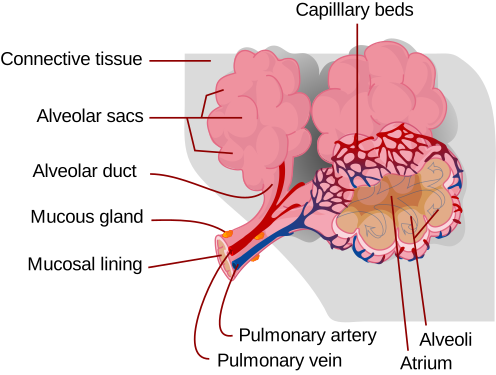
To understand why surfactants are vital, we must first look at the physics of surface tension. Water molecules are highly cohesive; they want to stick together. In the tiny, grape-like clusters of the lungs called alveoli, this cohesive force creates an inward pressure that wants to collapse the air space.
This phenomenon is described by Laplace’s Law, which states that the pressure ($P$) required to keep a sphere open is proportional to the surface tension ($T$) and inversely proportional to the radius ($r$):
$$P = \frac{2T}{r}$$
Without surfactant, smaller alveoli would have a much higher internal pressure than larger ones, causing them to collapse and empty their air into the larger ones (a process called atelectasis). This would drastically reduce the surface area available for nitrogen off-gassing 4. Surfactants solve this by lowering the surface tension of the fluid lining the lungs. As an alveolus gets smaller during exhalation, the surfactant molecules become more concentrated, reducing surface tension even further and preventing total collapse.
Gas Exchange and Lung Compliance at Depth
As we descend, the gas we breathe becomes denser 1. This increased density creates more resistance within the airways, significantly increasing the Work of Breathing (WOB) 3. Surfactants play a critical role here by maintaining lung compliance—the ease with which the lungs expand.
When surfactants are functioning optimally, they reduce the muscular effort required to initiate each breath. However, hydrostatic pressure and body position also play a role. In our previous discussion on [/diving-theory/the-physics-of-perfect-trim-mastering-the-interaction-of-gravity-and-buoyancy](The Physics of Perfect Trim), we explored how a horizontal profile optimizes blood flow. From a respiratory perspective, "perfect trim" also ensures a more even distribution of surfactant and better "alveolar recruitment," meaning more of your lung capacity is actively participating in gas exchange rather than being compressed by the weight of the water column.
| Factor | Impact on Surfactant | Effect on Diver |
|---|---|---|
| Increased Depth | Gas density increases WOB | Higher CO2 retention risk 3 |
| Horizontal Trim | Even alveolar recruitment | Efficient nitrogen elimination |
| Cold Water | May increase fluid viscosity | Increased respiratory effort |
The Surfactant-Bubble Interface: Stabilizing Gas Nuclei
One of the most fascinating aspects of surfactant science is its interaction with "silent bubbles." We know that gas bubbles can form in the body even when decompression guidelines are followed precisely 2. These are often referred to as subclinical bubbles.
When a microbubble forms in the bloodstream or tissue, it doesn't remain a "pure" pocket of gas. It is immediately coated by the body’s surfactants and lipoproteins 2. This coating acts as a stabilizing shell. While this shell prevents the bubble from expanding uncontrollably, it also creates a barrier that slows down the diffusion of nitrogen back into the blood.
This contributes to the phenomenon of Kinetic Asymmetry, which we detailed in [/diving-theory/kinetic-asymmetry-why-nitrogen-leaves-your-body-slower-than-it-enters](Kinetic Asymmetry). Because the surfactant-stabilized shell makes the bubble more "persistent," nitrogen leaves the body much slower than it enters. These coated bubbles can block micro-circulation and provoke an immune response, where the body treats the bubble as a foreign invader, further complicating the off-gassing process 2.
Pulmonary Oxygen Toxicity and Surfactant Degradation
For deep and long-duration divers, oxygen management is as critical as nitrogen management. While we often worry about Central Nervous System (CNS) toxicity (the Paul Bert Effect), the Lorrain Smith Effect—pulmonary oxygen toxicity—is a more insidious threat to our surfactant system 4.
Prolonged exposure to a high partial pressure of oxygen (PO2) causes oxidative stress that specifically targets the Type II pneumocytes. When these cells are damaged, surfactant production drops.
- Oxidative Damage: High PO2 creates free radicals that denature surfactant proteins.
- Reduced Compliance: As surfactant levels fall, the lungs become "stiff."
- Inflammation: The lung lining becomes irritated, leading to a cough or burning sensation upon deep inhalation.
Understanding the balance between these two effects is vital, a topic we covered extensively in [/diving-theory/the-paul-bert-vs-lorrain-smith-effect-navigating-the-two-faces-of-oxygen-toxicity](The Paul Bert vs. Lorrain Smith Effect). If you degrade your surfactant layer through excessive oxygen exposure, your ability to off-gas nitrogen on subsequent dives is significantly compromised.

Immersion Pulmonary Edema (IPE) and Surface Tension
Immersion Pulmonary Edema (IPE) is a condition where fluid from the capillaries leaks into the alveoli during a dive. This is often triggered by a combination of cold water, heavy exertion, and high blood pressure.
When fluid enters the air spaces, it causes a "washout" of the surfactant layer. Without surfactant to lower the surface tension, the affected alveoli collapse, and the fluid creates a barrier that prevents oxygen from entering the blood and nitrogen from leaving it. This creates a dangerous feedback loop: the harder the diver tries to breathe, the more negative pressure they create in the chest, drawing even more fluid into the lungs.
Maintaining surfactant integrity is a primary defense against alveolar flooding. This is why avoiding extreme exertion and managing thermal stress are not just about comfort—they are about protecting the molecular lining of your lungs.
Hydration and Hematocrit: The Fluid Dynamics of Surfactants
The health of the surfactant layer is inextricably linked to your overall hydration status. The surfactant film sits atop a thin layer of water (the hypophase). If a diver is severely dehydrated, the volume and composition of this layer can change.
As we noted in [/diving-theory/hydration-hematocrit-and-hemodynamics-why-blood-viscosity-dictates-your-decompression-safety](Hydration, Hematocrit, and Hemodynamics), dehydration increases blood viscosity and hematocrit levels 2. This sluggish blood flow makes it harder for the body to transport the lipids and proteins necessary to replenish the surfactant layer. Furthermore, thick, viscous blood makes it more likely that surfactant-coated "silent bubbles" will become trapped in the microvasculature rather than being safely transported to the lungs for elimination 2.
Expert Tip: Hydration isn't just about "thinning the blood." It's about maintaining the aqueous environment that allows surfactants to move and function at the alveolar interface.
Practical Takeaways: Protecting Your Respiratory Health
Protecting your surfactant system is a proactive way to enhance your decompression safety. Here is a checklist for maintaining optimal respiratory health:
- Manage your Oxygen Clock: Keep your PO2 levels within safe limits to avoid the Lorrain Smith effect 4.
- Stay Hydrated: Ensure your body has the fluid balance required to maintain the lung's lining and blood flow 2.
- Practice Ascent Discipline: Adhere to a 9 meters per minute (30 feet per minute) ascent rate to minimize the formation of stabilized microbubbles 1.
- Optimize Your Trim: Maintain a horizontal position to ensure even gas distribution and reduce WOB.
- Avoid "Bounce" Profiles: Frequent depth changes can disrupt the surfactant film and lead to "bubble seeding."
- Service Your Gear: Reducing regulator breathing resistance lowers the mechanical stress on your alveoli 3.
Gas Management Strategies
Using the right gas for the job can protect your surfactant integrity. While Nitrox is excellent for reducing nitrogen loading, the higher PO2 must be balanced against the duration of the dive 2. For deep dives, Trimix reduces gas density, which lowers WOB and the mechanical "wear and tear" on the surfactant layer 3.
| Gas Type | Benefit to Surfactant/Lungs | Consideration |
|---|---|---|
| Air | Simple, no O2 toxicity at shallow depths | High density and nitrogen load |
| Nitrox | Faster off-gassing of nitrogen 2 | Watch the "Oxygen Clock" 4 |
| Trimix | Lower density = Lower WOB 3 | Requires specialized training |
Conclusion: The Future of Decompression Research
The study of pulmonary surfactants is shifting decompression science from a purely mathematical "pressure-in, pressure-out" model to a more biological, personalized approach. We are beginning to understand that the "silent bubbles" we once ignored are actually complex biological entities, stabilized by the very substances that keep us breathing 2.
As we move forward, the synergy between physics and physiology will become even clearer. By respecting the molecular guard of the deep—our surfactant system—we can dive deeper, stay longer, and emerge safer. Decompression is not just about the numbers on your computer; it is about the health of the microscopic interface where life meets the pressure of the sea.
Stay safe, breathe easy, and keep your bubbles silent.