Loading...
marine-life#pelagic marine life#seamount diving#ocean upwelling
The Blue Highway: Why Pelagic Giants Congregate Around Seamounts and Drop-offs
Pro Dive Vibes
March 31, 20268 min read

Imagine descending into a vast, featureless expanse of sapphire. For miles in every direction, there is nothing but the rhythmic sound of your own regulator and the shimmering light of the "blue desert." In the open ocean, life is often sparse, a nomadic existence where every calorie counts. But then, a dark silhouette emerges from the depths. A jagged peak rises thousands of meters from the seafloor, or a vertical wall plunges into an abyss so deep the blue turns to ink. Suddenly, the silence is shattered.
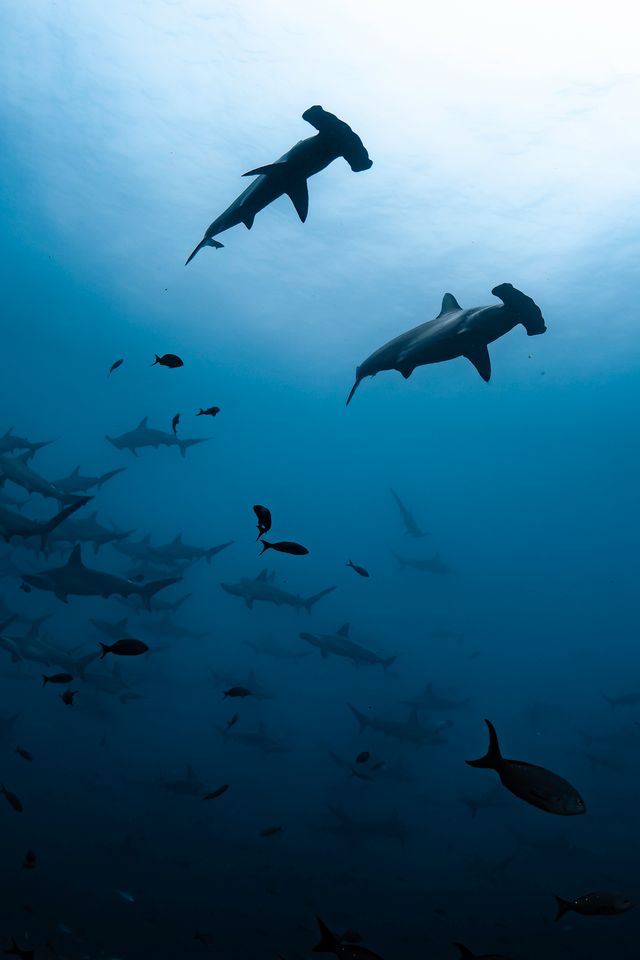
Thousands of fusiliers stream past like silver ribbons. A school of Scalloped Hammerheads materializes from the gloom, their peculiar heads swinging in a synchronized dance. This is the Blue Highway—a complex network of underwater topography that acts as the transit hub for the ocean’s greatest travelers. For scuba divers, these seamounts and drop-offs are the ultimate "big animal" destinations, offering a front-row seat to the most dramatic spectacles in the marine world.
The Physics of Productivity: Upwelling and the Nutrient Buffet
The primary reason pelagic giants congregate at these sites isn't just for the view; it’s about the food. To understand this, we have to look at the physics of the ocean floor. When massive deep-ocean currents—cold, dense, and packed with nutrients from the decaying matter of the deep—hit a solid obstacle like a seamount or a steep drop-off, they have nowhere to go but up.
This phenomenon is known as upwelling. As these nutrient-rich waters reach the sunlit "photic zone," they trigger a massive explosion of life. Phytoplankton bloom, followed by zooplankton, which then attracts the "fish soup" of small baitfish and anthias. This is the same biological engine that fuels the world-record biodiversity seen at Cape Kri Raja Ampat.
The result is a trophic cascade:
- Nutrient Injection: Cold water brings nitrates and phosphates to the surface.
- Primary Production: Sunlight + Nutrients = Massive plankton growth.
- The Gathering: Small fish arrive to graze, creating a concentrated feeding ground.
- Apex Arrival: Tuna, billfish, and sharks arrive to harvest the bounty.
| Feature | Impact on Marine Life | Why Divers Love It |
|---|---|---|
| Upwelling | Brings cold, nutrient-rich water to the surface | Triggers massive schools of baitfish |
| Current Compression | Speeds up water flow around corners | Attracts large predators like Grey Reef Sharks |
| Thermoclines | Creates distinct temperature layers | Often marks the "ceiling" for certain species |
Magnetic Waypoints: How Giants Navigate the Deep
How does a Whale Shark or a Great White find a single submerged rock in the middle of a million square miles of ocean? The answer lies in the very "bones" of the seamounts themselves. Many seamounts are volcanic in origin, composed of basaltic rock that contains high concentrations of magnetite.
Scientists believe that many pelagic species possess a "sixth sense" called magnetoreception. By sensing the Earth’s magnetic field and the specific magnetic anomalies created by these volcanic structures, animals use seamounts as magnetic signposts. They aren't just random stops; they are the essential waypoints on a cross-ocean migration.
Sharks wander aimlessly through the ocean — actually, they follow highly specific "corridors" that connect these underwater peaks. For a migrating Whale Shark, a seamount is the equivalent of a highway rest stop where they can refuel, rest, and reorient themselves before the next leg of their journey.

Cleaning Stations and Social Hubs
While food is the main draw, hygiene and social life are close seconds. Pelagic giants like Oceanic Manta Rays spend most of their lives in the open sea, where parasites can become a significant health burden. When they reach a seamount or a prominent drop-off, they head straight for the "spa."
As we explored in The Reef’s Spa Day, cleaning stations are governed by a unique social contract. Large predators—who would normally eat anything that moves—will hover motionless, mouth agape, while tiny Cleaner Wrasse and Butterflyfish pick off parasites and dead skin.
Beyond hygiene, these sites serve as the ocean's premier "singles bars." Because so many individuals of a species congregate at these specific waypoints, they become ideal locations for socializing and mating. Scalloped Hammerheads, for instance, are known to form massive schools around seamounts like those in the Galapagos or Cocos Island specifically for social heirarchy and mating rituals.
Expert Tip: When diving a cleaning station at a drop-off, never swim into the center of the station. Stay low, maintain neutral buoyancy, and let the animals settle. If you interrupt the "cleaning," the giants will quickly depart for the safety of the blue.
The Vertical Commute: Connecting the Deep to the Surface
Seamounts and drop-offs aren't just horizontal transit hubs; they are vertical elevators. In the open ocean, a massive migration happens every single day, which we call The Deep Sea's Daily Commute.
As the sun sets, organisms from the mesopelagic zone (the Twilight Zone) rise toward the surface to feed. When this vertical migration hits a seamount or a wall, it creates a concentrated "Wall of Mouths." Predators don't have to hunt far; they simply wait at the edge of the drop-off for the buffet to come to them.
This interaction creates a unique hunting ground for nocturnal predators. If you’ve read about The Midnight Shift, you know that sharks and jacks use the cover of darkness and the topography of the wall to ambush prey that is disoriented by the transition from deep to shallow water.
Iconic Blue Highway Destinations
If you want to witness the Blue Highway in action, there are a few legendary locations that every diver should have on their bucket list. These sites are characterized by extreme depths, powerful currents, and high-octane action.
- The Galapagos & Cocos Island: These islands are essentially the tops of massive underwater mountain ranges. They are the world's best spots to see "walls" of hammerheads.
- The Red Sea (The Brothers & Daedalus): These are two small islands rising from the floor of the Red Sea. Because they are surrounded by deep water, they act as magnets for Oceanic Whitetips and Thresher Sharks.
- Palau’s Blue Corner: A world-class example of current-driven biodiversity. As we discussed in our guide to Diving Blue Corner Palau, the use of a reef hook is essential here to watch the pelagic show without being swept away.
The Diver’s Perspective: Strategy and Safety
Diving these environments is exhilarating, but it requires a specific skillset. You aren't just diving a reef; you are diving the edge of the wild blue.
Managing the "Wash"
Where the Blue Highway meets a wall, you often get "up-currents" and "down-currents." These can be disorienting and dangerous if you aren't prepared.
- Check your depth constantly: Without a reef for reference, it's easy to drift deeper than intended.
- Stay close to the wall: If a current becomes too strong, the "boundary layer" (the water closest to the rock) is often calmer.
Observational Etiquette
To see the big stuff, you have to act like you don't belong there.
- Check your bubbles: Avoid heavy, erratic breathing.
- Don't chase: You will never outswim a shark or a tuna.
- Use a reef hook (where permitted): This allows you to stay stationary in high current without kicking and scaring off the wildlife.
- Watch the "scouts": Often, a single shark will approach first. If you stay still, the rest of the school will follow.

Conservation: Protecting the Highway's Intersections
Because seamounts and drop-offs concentrate life so effectively, they are unfortunately also targets for industrial fishing. "Longlining" around these hubs can decimate a population of migratory sharks or billfish in a matter of weeks.
This is why Marine Protected Areas (MPAs) are so critical. By protecting these "intersections" on the Blue Highway, we aren't just protecting a single reef; we are protecting the entire migratory path of species that travel thousands of miles. As divers, we play a vital role as citizen scientists. Every photo of a Manta Ray belly or a Whale Shark’s spot pattern uploaded to databases like Manta Matcher or Wildbook helps researchers track these animals along the highway.
Conclusion: Into the Blue
The Blue Highway is a testament to the ocean's hidden complexity. What looks like an empty void to the untrained eye is, in reality, a bustling network of travel, trade, and survival. Seamounts and drop-offs are the cathedrals of the deep, where the physics of the planet meets the biology of its most magnificent inhabitants.
Whether it’s the adrenaline of a high-speed drift at Blue Corner or the quiet awe of watching a Manta Ray hover at a cleaning station, these sites offer a connection to the wild heart of the ocean that few other places can match.
What’s your most memorable "big animal" encounter on the Blue Highway? Did you see a wall of sharks in the Galapagos or a lone giant in the Red Sea? Share your story in the comments below!