The Snell’s Law Delusion: Calculating True Distance for Precision Tasks
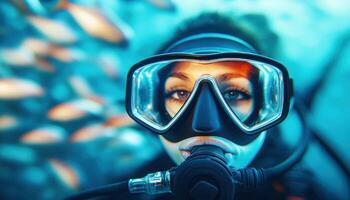
The Visual Lie: Why Your Eyes Deceive You Underwater
Every entry-level certification course introduces the "rule of thumb" regarding underwater vision: objects appear 33% larger and 25% closer than they actually are 1. For the recreational diver enjoying a coral reef, this distortion is a harmless novelty. However, as we transition into technical, scientific, and overhead environments, this visual deception—mathematically dictated by Snell’s Law—becomes a significant hurdle to precision.
The fundamental disconnect between what your retinas receive and where an object exists in physical space is not merely an optical quirk; it is a systemic error in the diver's sensory input. Standard training often underestimates the impact of this distortion on high-stakes tasks. When you are surveying a narrow restriction in a cave or attempting to measure the carapace of a specimen for a biological survey, relying on "the eye test" is a recipe for failure. The brain is effectively viewing a virtual image rather than the real object, leading to a profound sensory mismatch that can compromise both data integrity and safety 5.
The Physics of Refraction: Breaking Down Snell’s Law
To master the underwater environment, we must first understand the medium. Light travels at different speeds depending on the density of the substance it passes through. This change in speed causes the light rays to bend, a phenomenon known as refraction 15.
Defining the Refractive Index (n)
The refractive index, denoted as n, is a dimensionless number that describes how fast light travels in a medium compared to a vacuum.
- Air:
n≈ 1.00 - Freshwater:
n≈ 1.33 - Seawater:
n≈ 1.34 (varying with salinity)
The Interface
When light travels from the water, through your tempered glass mask lens, and into the air pocket surrounding your eyes, it crosses two distinct boundaries. Because light travels significantly faster in the air inside your mask than in the water outside, the rays bend away from the "normal" (an imaginary line perpendicular to the surface) 1. This creates the magnification effect that tricks the human eye.
The Mathematical Formula
The behavior of this light is governed by Snell’s Law:
n1 sin(θ1) = n2 sin(θ2)
In practical diving terms, this means that the angle at which light enters your mask is shifted. Your brain, evolved for terrestrial life, assumes light always travels in a straight line. It traces the incoming rays back to a point of origin that is closer and larger than the true source, effectively projecting a "magnified" version of reality onto your retina 1.
The Proprioceptive Gap: Sensory Mismatch in the Water Column
The distortion of light creates more than just a visual error; it triggers a neurological conflict. In our exploration of Proprioceptive Distortion: The Neuroscience of Spatial Disorientation in Diving, we discussed how the brain struggles to maintain spatial awareness when gravity and tactile feedback are neutralized. Refraction adds a layer of complexity to this "proprioceptive gap."
When you reach for a carabiner on a wreck or attempt to clip a stage bottle, your brain is attempting to reconcile two conflicting data sets:
- Visual Input: The object appears to be 3 feet away.
- Proprioceptive Input: Your arm extension and muscle memory suggest the object is further.
This results in the "reach-and-miss" phenomenon. Because the object is actually further away than it appears (the real object sits behind the virtual image), divers frequently undershoot their grasp 15. In high-flow environments or emergency scenarios, this split-second miss can lead to entanglement or lost equipment.
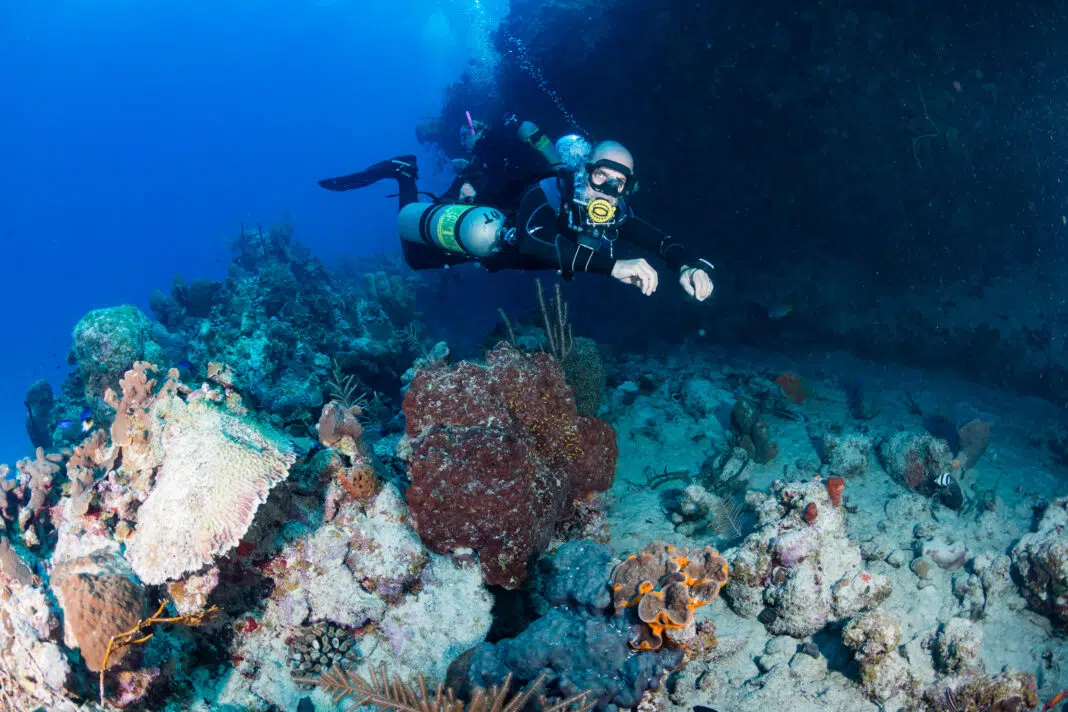
Precision Tasks Where the Delusion Becomes Dangerous
For the advanced diver, the "33% larger" rule isn't just a fun fact—it’s a variable that must be accounted for in every calculation.
Scientific Diving
Accuracy is the currency of science. If a researcher records the size of an endangered species based on visual estimation, they are introducing a massive 25-33% margin of error into the dataset 1. In biomass calculations, where length is often cubed to estimate weight, a 33% error in length can lead to a 135% error in total biomass.
Cave and Wreck Survey
Mapping an underwater system requires precise measurements of "stations" and "legs." If a surveyor estimates the width of a passage to determine if it is "passable with backmount," the visual delusion could lead them into a Mechanical Trap where the equipment physically cannot fit despite "looking" large enough.
Search and Recovery (SAR)
In low-visibility SAR operations, the "reach-and-miss" phenomenon is exacerbated. Divers often have to work by touch, but when they do catch a glimpse of a target, the refraction can cause them to misjudge the distance, leading to wasted bottom time and increased exertion 23.
Underwater Photography
Photographers using manual macro lenses must understand that the focal distance marked on the lens barrel refers to the distance in air. Because of the water-to-air interface at the flat port of a camera housing, the lens "sees" the object as closer, requiring the photographer to adjust their physical position to achieve sharp focus on the real subject.
The Math of Correction: Calculating True Distance
To navigate the underwater world with precision, you must learn to reverse-engineer the visual data your brain receives.
The 4/3 Ratio
The refractive index of water (1.33) is approximately 4/3. This allows for a simple mental calculation:
- To find True Size: Divide the apparent size by 1.333 (or multiply by 0.75).
- To find True Distance: Multiply the apparent distance by 1.333 (or divide by 0.75) 14.
| Measurement Type | Visual Perception (Apparent) | Mathematical Correction (True) |
|---|---|---|
| Object Length | 100 cm | ~75 cm |
| Distance to Wall | 3 meters | ~4 meters |
| Diameter of Pipe | 4 inches | ~3 inches |
| Range to Buddy | 15 feet | ~20 feet |
Flat Ports vs. Wide-Angle Dome Ports
In underwater imaging, the type of interface changes the math. A flat port maintains the Snell’s Law magnification, making subjects appear closer and larger. A dome port, however, acts as an additional lens element that corrects for refraction and restores the lens's original field of view, though it creates a "virtual image" that is much closer to the camera, requiring the lens to have a close-focus capability.
Environmental Variables: When the Index Shifts
The refractive index is not a static number; it fluctuates based on the chemical and physical properties of the water column.
Salinity and the Halocline
As explored in The Science of the Shimmer, the mixing of salt and fresh water creates a visual blur. This is because saltwater is denser and has a higher refractive index than freshwater 1. When you pass through a halocline, the light is bending at different angles through different layers, making distance estimation nearly impossible until you stabilize in one medium.
The Magnification Paradox (Turbidity)
While refraction generally makes things look closer, turbidity (suspended particulate matter) can actually reverse this effect 1.
- Clear Water: Objects at 50-70 feet appear closer 2.
- Turbid Water: Light scattering and loss of contrast can cause the brain to overestimate distance. An object only 3 or 4 feet away might appear much further because its edges are blurred and its colors are muted 25.
Expert Tip: In low-visibility or "milky" water, never trust your eyes for distance. Use your dive light to create a reference beam or use a physical guideline.
Overcoming the Delusion: Practical Training and Drills
Mastering Snell’s Law is less about doing mental calculus mid-dive and more about developing Refractive Intuition.
The 'Touch-and-Verify' Drill
In the shallows (3-5 meters), practice reaching for small, stationary objects like a specific rock or a bolt snap.
- Look at the object.
- Estimate the distance.
- Close your eyes and reach for it.
- Open your eyes to see how much you undershot the target. Repeat this until your muscle memory accounts for the 25% gap.
Using Reference Tools
Advanced divers rely on tools rather than "eye-balling."
- Dive Slates: Use the edge of your slate as a known ruler.
- Compass: Cross-reference your visual path with your compass to avoid errors caused by Magnetic Local Anomalies.
- Knotted Lines: In survey work, use lines with pre-measured knots to verify distances.
Precision Checklist for Technical Tasks
- Calibrate visual estimation against a physical ruler/tape at the start of the dive.
- Account for salinity changes if moving between fresh and salt layers.
- Use a dome port for wide-angle photography to minimize edge distortion.
- Verify all visual survey data with a physical measurement (tape or sonar).

Conclusion: Precision as a Safety Protocol
Mastering the "Snell’s Law Delusion" is a hallmark of the transition from a recreational observer to a technical practitioner. It requires a shift in mindset: moving from merely "seeing" the underwater world to "observing" it through a lens of physics and geometry.
Understanding that your eyes are effectively lying to you is the first step toward greater accuracy. Whether you are calculating the Specific Gravity of your environment to perfect your buoyancy or mapping a new discovery in a remote cenote, the ability to correct for refraction ensures that your data—and your navigation—remain flawless.
In the high-pressure world of technical diving, precision isn't just a preference; it is a fundamental safety protocol. By reconciling the physics of light with the neuroscience of proprioception, you move one step closer to true mastery of the silent world.