The Science of the Safety Stop: Why 5 Meters for 3 Minutes is the Mathematical Sweet Spot

Introduction: The Ritual vs. The Reason
For most recreational divers, the safety stop is a Pavlovian response. Your computer beeps at 6 meters, you ascend to 5 meters, and you hover for three minutes while checking your pressure gauge and perhaps signaling "OK" to your buddy. It is a ritual etched into our muscle memory from the very first open-water checkout dive. But why 5 meters? Why not 8 meters or 2 meters? And why is three minutes the magic number?
In the early days of scuba, the safety stop was often dismissed as an optional "recommendation." Today, we recognize it as a critical final buffer for "clean" off-gassing before the most volatile transition of the dive: the return to 1 atmosphere of pressure. Moving beyond "because the instructor said so" requires us to look at the underlying mathematics of decompression theory. The safety stop isn't just a pause; it is a calculated physiological intervention designed to manage the pressure gradient before you break the surface.
The Pressure Gradient Paradox: Why the Last 10 Meters Matter Most
To understand the safety stop, we must first revisit Boyle’s Law. While the pressure change between 40 meters and 30 meters is significant, the proportional change is relatively small. However, as we approach the surface, the physics become aggressive.
The transition from 10 meters (2 ATA) to the surface (1 ATA) represents a 50% reduction in ambient pressure. This is the greatest relative pressure change a diver experiences in the water column. If you were to ascend directly from 10 meters to the surface without a pause, the nitrogen gas dissolved in your tissues would expand rapidly.
The 5-meter mark serves as a physiological "staging area." By stopping here, we mitigate this massive relative change, allowing the body to off-gas in a controlled environment where the pressure is still high enough to keep bubbles small, but low enough to encourage nitrogen to leave the bloodstream. This process is heavily dependent on a controlled ascent. As established in our guide on Ascent Rates and Kinetic Energy, maintaining a rate of 9 meters per minute (30 fsw/min) is the necessary precursor to a successful stop 4. Without a slow ascent, the safety stop is merely a "band-aid" on an already compromised profile.
| Depth (Meters) | Pressure (ATA) | % Pressure Change to Surface |
|---|---|---|
| 40m | 5 ATA | 80% |
| 30m | 4 ATA | 75% |
| 20m | 3 ATA | 66% |
| 10m | 2 ATA | 50% |
| 5m | 1.5 ATA | 33% |
The 5-Meter Depth: Balancing Gradient vs. Bubble Formation
In decompression theory, we often talk about the M-Value, which represents the maximum amount of "overpressure" a specific tissue compartment can tolerate before the risk of decompression sickness becomes unacceptable. You can read more about this in The Mystery of M-Values.
The 5-meter depth is the mathematical "sweet spot" for several reasons:
- Maintaining the Gradient: To get nitrogen out of your body, the partial pressure of nitrogen in your tissues must be higher than the partial pressure of nitrogen in your lungs. At 5 meters, this gradient is high enough to drive efficient off-gassing.
- The Critical Volume Threshold: If we go too shallow too quickly, we risk crossing the "Critical Volume" threshold, where microscopic "silent bubbles" expand into larger, symptomatic bubbles. Staying at 5 meters keeps these bubbles in solution or keeps them small enough to be filtered by the lungs. This is a core concept in the Critical Volume vs. Critical Pressure debate.
By hovering at 1.5 ATA (5m), we are essentially giving our circulatory system a final chance to transport dissolved gas to the lungs before the final 33% pressure drop to the surface.
The 3-Minute Duration: Targeting the 'Fast' Tissues
Why three minutes? Why not one or ten? This duration is specifically calibrated for our "fast" and "medium" tissue compartments. In decompression modeling, tissues are categorized by their half-times—the time it takes for a tissue to become 50% saturated or desaturated with gas.
Fast tissues include the blood, brain, and heart. These tissues load nitrogen quickly during the dive but also release it quickly during ascent. The 5-minute half-time compartment is a primary focus during the safety stop. A 3-minute stop represents more than half of a half-time for these critical tissues, significantly reducing their gas load before surfacing.
Historically, the 3-minute rule emerged from early Haldanean models and was later reinforced by Doppler bubble research in the 1980s. Researchers found that divers who performed a 3-minute stop at 5 meters had significantly lower bubble counts than those who performed a direct ascent, even when the dive was well within "no-decompression" limits.
Kinetic Asymmetry and the 'Slow' Exit
One of the most frustrating aspects of diving physiology is that nitrogen is "sticky." Through a phenomenon known as Kinetic Asymmetry, nitrogen leaves the body slower than it enters. As we discuss in our article on Kinetic Asymmetry, the physiological mechanisms for off-gassing (primarily respiration and circulation) are less efficient than the simple pressure-driven diffusion that occurs during on-gassing.
The safety stop acts as a compensatory mechanism for this lag. It allows the circulatory system to "catch up" with the gas load in the tissues. Think of it as a traffic jam; the safety stop is the extra lane that prevents the highway from grinding to a halt as the cars (nitrogen molecules) try to exit at the surface.
Mitigating the 'Invisible' Risk: Subclinical DCS and VGE
Even if you don't feel "bent," every dive produces some level of bubble formation. These are known as Venous Gas Emboli (VGE), or "silent bubbles." While they may not cause immediate pain, they can trigger an inflammatory response in the body, leading to fatigue and "diving malaise."
The primary goal of the safety stop is to reduce VGE counts upon surfacing. Statistical evidence comparing Doppler bubble scores shows a stark difference:
- Direct Ascent: High VGE scores, often reaching Grade 3 or 4 on the Spencer Scale.
- 3-Minute Stop: Significantly lower VGE scores, often reduced by 50% or more.
By reducing these bubbles, we mitigate the risk of Subclinical DCS, which is the hidden physiological cost of repetitive diving. This is especially important for divers doing multiple dives over several days, where "silent bubbles" can accumulate and increase the risk profile of subsequent dives.
Advanced Customization: Gradient Factors and the Safety Stop
Modern dive computers allow for a high degree of customization through Gradient Factors (GF). Your computer's "GF High" setting directly influences how much of the M-value it will allow you to reach when you surface. If you set a conservative GF High (e.g., 70), your computer may actually extend your safety stop or require a longer stay at 5 meters to ensure you stay within that 70% margin.
For a deeper dive into personalizing your safety margins, check out Master Your Ascent.
Expert Tip: While the "Deep Stop" (a stop at half the max depth) was popular for a decade, modern research—including the famous NEDU study—has shown that deep stops may actually increase the gas load in slow tissues. Consequently, the industry has shifted back to the 5-meter stop as the gold standard for recreational profiles 2. You can read the full breakdown in The Deep Stop Debate.
Practical Execution for the Technical Diver
Executing a perfect safety stop is harder than it looks, especially at the end of a dive when your tank is "light" (buoyant) and you may be dealing with surface surge.
The Safety Stop Checklist:
- Neutral Buoyancy: Ensure you are weighted correctly so you can hover at 5m with ~30 bar (500 psi) in your tank.
- Horizontal Trim: Stay flat to ensure your entire body is at the same pressure gradient.
- Controlled Breathing: Avoid skip-breathing; maintain a steady, relaxed rhythm to facilitate gas exchange.
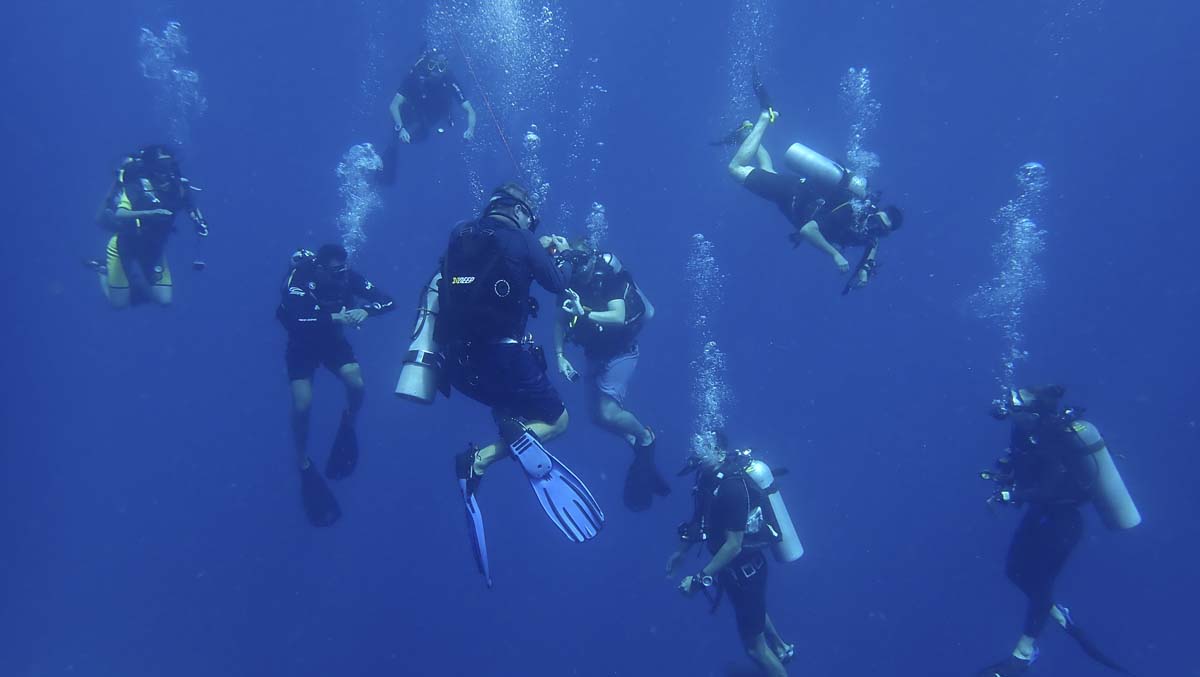
- Situational Awareness: Use the time to check your buddy, scan for boat traffic, and prepare your signaling device (SMB).
Beyond the physics, the safety stop offers a psychological benefit. It serves as a "cool down" period, allowing you to transition from the task-heavy environment of the dive to the surface. It is a moment of situational awareness—checking for boats and ensuring your buddy is ready to surface.
Blowing off a safety stop is a minor oversight — in reality, it is a calculated risk. While you may not get DCS on a single "omitted" stop, you are significantly increasing your VGE load and reducing your safety margin for the next dive.
Conclusion: Respecting the Math
The 5-meter, 3-minute safety stop is not an arbitrary rule created by training agencies to fill time. It is the intersection of Boyle’s Law, tissue half-times, and bubble mechanics. It is your final defense against the rapid pressure changes of the surface and the primary tool for managing subclinical DCS.
As an intermediate or advanced diver, your goal should be to master the stop. Treat it as a mandatory component of your dive profile, not an optional extra. Your dive computer is a powerful tool, but understanding the science behind the beep makes you a safer, more competent diver. Next time you find yourself hovering at 5 meters, remember: you aren't just waiting—you're letting the math work for you.
Ready to dive deeper into theory? Explore our guide on The Oxygen 'Off-Effect' to learn why risks can actually spike during your final ascent.