Acoustic Shadowing: Why Divers Struggle with Underwater Sound Localization

The Auditory Disorientation of the Deep
Every experienced diver knows the "ghost boat" phenomenon. You are mid-safety stop, hovering in the blue, when the rhythmic thrum of a marine engine fills your ears. It sounds close—dangerously close. You whip your head around, scanning the surface 360 degrees, but the water is empty. The sound seems to be coming from above, then below, then directly behind your left ear. By the time the boat actually passes, it is hundreds of yards away in a direction you never expected.
This isn't a lapse in concentration; it is a fundamental limitation of human physiology in a high-density medium. We call this phenomenon auditory disorientation, and it is driven largely by acoustic shadowing. In the simplest terms, acoustic shadowing is the process by which the physical mass of your head alters, blocks, or reflects sound waves, preventing the brain from using its standard "triangulation" software to locate a source 1.
For the recreational diver, this is a curiosity. For the advanced or technical diver, it is a critical safety variable. Whether you are navigating a low-visibility wreck or attempting to locate a buddy using a tank banger, understanding why your ears "fail" you underwater is the first step toward developing a more sophisticated level of situational awareness.
The Physics of Sound Propagation: Air vs. Water
To understand why we struggle to locate sound, we must first look at the medium itself. Sound is a form of mechanical energy—a pressure wave that travels through the compression and rarefaction of molecules 4.
The 4.4x Multiplier
In the thin gas of our atmosphere, sound travels at approximately 343 m/s (meters per second). However, water is roughly 800 times denser than air and significantly less compressible (higher elasticity) 1. Because the molecules in water are packed so tightly together, they can transmit mechanical energy much more efficiently.
Underwater, sound travels at approximately 1,500 m/s—roughly 4.4 times faster than it does in air 13.
| Medium | Speed of Sound (Approx.) | Density |
|---|---|---|
| Air | 343 m/s | Low |
| Fresh Water | 1,435 m/s | High |
| Salt Water | 1,500 m/s | High |
Wavelength and Frequency
Because the speed of sound is so high, the wavelength of a sound at any given frequency is also much longer than it is in air. This relationship is vital:
Speed = Frequency × Wavelength
When the wavelength of a sound is larger than the object it hits (like a human head), the sound tends to diffract or "wrap around" the object rather than being blocked by it. This is the first clue as to why we lose our sense of direction: the physical barrier of our skull becomes "invisible" to many underwater sound waves.
Mechanisms of Human Localization: ITD and ILD
On land, the human brain uses two primary methods to determine where a sound is coming from: Interaural Time Difference (ITD) and Interaural Level Difference (ILD).
Interaural Time Difference (ITD)
This is the micro-delay between a sound hitting one ear and then the other. If a dog barks to your right, the sound reaches your right ear a fraction of a millisecond before it reaches your left. The brain is incredibly sensitive to this, processing delays as small as 0.00001 seconds.
However, because sound travels 4.4 times faster underwater, that time delay is reduced to a level below the human neurological threshold 1. The sound reaches both ears almost simultaneously, tricking the brain into thinking the source is directly in front, directly behind, or even inside the head 3.
Interaural Level Difference (ILD)
ILD refers to the difference in volume (loudness) between the ears. On land, your head creates an "acoustic shadow." If a sound comes from the left, your head acts as a shield, making the sound slightly quieter in the right ear.
Underwater, the density of the human head is remarkably similar to the density of the surrounding water. Instead of being reflected or absorbed by the skull, sound waves pass through the bone and tissue with very little resistance. This effectively eliminates the volume difference that our brain relies on for directional cues.
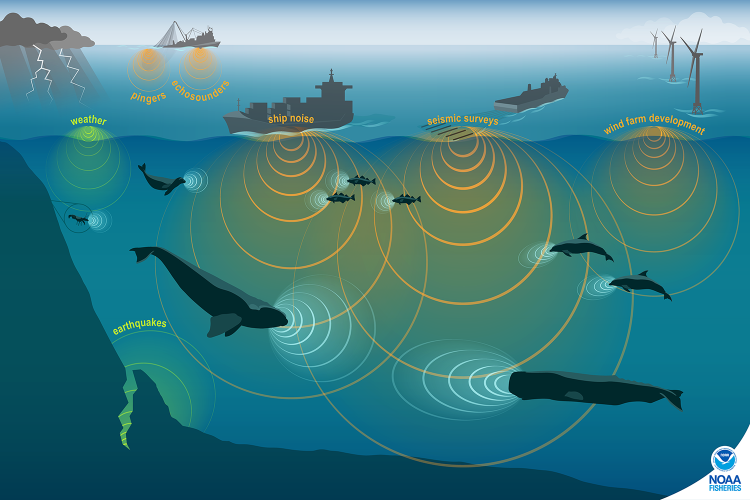
The Acoustic Shadow Effect and Diffraction
While the head is largely "acoustically transparent" underwater, it isn't perfectly so. This is where acoustic shadowing and diffraction come into play.
The Physics of Diffraction
Diffraction occurs when a wave encounters an obstacle. Low-frequency sounds (like the deep rumble of a large ship) have very long wavelengths that easily wrap around the diver's head, providing zero directional information. High-frequency sounds (like a high-pitched alarm or a small metal snap) have shorter wavelengths. These shorter waves are more likely to be blocked or scattered by the mass of the head, creating a true Shadow Zone.
The Shadow Zone and Thermoclines
Acoustic shadowing isn't just about your head; the environment creates its own shadows. Thermoclines—layers of water where the temperature changes abruptly—act as acoustic barriers 1. Because colder water is denser, it reflects sound energy.
A diver sitting just below a sharp thermocline might be completely "deaf" to a boat engine directly above them because the sound waves are being reflected off the temperature boundary 13. This creates a "Shadow Zone" where sound is undetectable until the source (or the diver) crosses the layer. This is a vital concept for technical divers who may be managing decompression in stratified water columns, similar to how they must manage Thermodynamics of the Deep during helium-based dives.
Bone Conduction: Bypassing the Tympanic Membrane
In air, we hear via air conduction: sound waves enter the ear canal and vibrate the tympanic membrane (eardrum). Underwater, the process shifts dramatically toward bone conduction.
Because your body is mostly water, sound waves vibrate the entire cranium. These vibrations stimulate the cochlea (the inner ear) directly, bypassing the outer and middle ear entirely.
Why bone conduction ruins localization:
- Loss of Stereo: Since the entire skull is vibrating as a single unit, the brain receives the signal from both inner ears at the exact same intensity and time.
- Omnidirectional Perception: The sound feels "internalized." This is why a diver cannot distinguish if a tank banger is 10 feet away or 50 feet away; the intensity of the bone vibration feels the same.
- The Hood Factor: Wearing a neoprene hood can actually exacerbate this. A hood acts as an acoustic barrier to the ear canal but does nothing to stop bone conduction, further isolating the diver from any faint directional cues that might have remained 1.
Safety Implications: Boats, Buddies, and Alarms
The inability to localize sound is not just a theoretical problem; it has real-world safety consequences.
The Danger of 'Omnidirectional' Boat Noise
The most significant hazard is the "omnipresent" boat engine. Because you cannot tell where a boat is, you should never assume that a faint sound means the boat is far away. In shallow water or enclosed spaces, reflections and echoes from the surface or reef can make a distant boat sound like it is right on top of you 1.
Expert Safety Tip: If you hear a boat engine getting louder, do not surface. Stay deep or move to a protected area (like a reef wall) until the sound fades. If you must surface, use a Surface Marker Buoy (SMB) and perform a 360-degree visual scan before breaking the surface.
Buddy Communication
In low-visibility environments, divers often rely on "shakers" or "tank bangers" to get attention. However, because of acoustic shadowing and the speed of sound, your buddy may hear your signal but swim in the wrong direction to find you. This is particularly dangerous in overhead environments like caves or wrecks where "lost buddy" protocols must be strictly followed.
Acoustic Hazards
It is also worth noting that while we struggle to locate sound, our bodies are still susceptible to the pressure of sound. High-intensity sounds, such as sonar or underwater explosions, can cause physiological damage to the lungs, sinuses, and ears 1. For a deeper dive into these risks, see our guide on Acoustic Hazards: Navigating Safe Sonar Distances.
Mitigation Strategies for the Intermediate Diver
Since we cannot change the physics of the ocean, we must change our behavior. Here is how to compensate for the "acoustic lie."
1. Visual-First Situational Awareness
You must train yourself to prioritize visual data over auditory data. If you hear a sound, do not trust your ears to tell you where to look. Instead, perform a systematic visual sweep.
- Scan the surface for hull shadows or wakes.
- Look for exhaust bubbles in the water column.
- Check your buddy’s position immediately.
2. The 'Rotation Technique'
While ITD is useless, you can sometimes use the "Rotation Technique" to find a source. By slowly rotating your body 360 degrees, you may find a specific orientation where the sound is slightly sharper or louder (due to the way sound interacts with your scuba cylinder or the air space in your mask). This is not precise, but it can provide a general "hemisphere" of the sound source.
3. Pre-Dive Briefings
Never rely on sound for complex communication. Your pre-dive briefing should establish clear visual signals for "I hear a boat" or "Listen for my shaker."
| Signal Type | Best Use Case | Limitation |
|---|---|---|
| Tank Banger | Emergency attention | Zero directionality |
| Sub-Duck | Surface signaling | Can be deafening to divers below |
| Light Flash | Night/Low-viz communication | Requires line of sight |

Conclusion: Integrating Acoustic Theory into Dive Mastery
Mastering the underwater environment requires an appreciation for how it differs from our terrestrial home. Just as we must understand Kinetic Asymmetry to manage our decompression or Center of Gravity vs. Center of Buoyancy to achieve perfect trim, we must respect the physics of acoustics.
We are, for all intents and purposes, directionally deaf once we submerge. Our brains are hardwired for a world where sound travels slowly through a thin gas. When we enter the high-density world of the ocean, our "triangulation" software breaks.
By understanding the roles of acoustic shadowing, bone conduction, and diffraction, you can move past the confusion of the "ghost boat" and develop a more scientific approach to situational awareness. Treat every sound as a warning, but never trust it as a compass. Stay deep, stay visual, and stay safe.
Ready to dive deeper into the science of the senses? Explore our guide on Underwater Vision and Color Loss to see how light behaves in the same medium.