Loading...
marine-life#The Physics of Manta Ray Feeding: Cyclone Feeding and Cleaning Site Science#marine-life#a scuba diving and underwater adventure website
The Physics of Manta Ray Feeding: Cyclone Feeding and Cleaning Site Science
Pro Dive Vibes
November 22, 20264 min read
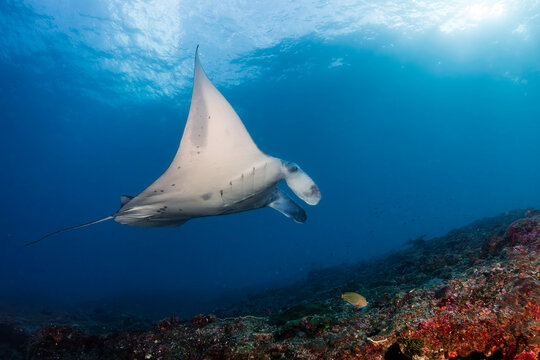
Introduction: The Aquatic Marvel of Manta Ray Fluid Dynamics
Welcome to Pro Dive Vibes, your go-to scuba diving and underwater adventure website! If you have ever been fortunate enough to kneel on a sandy seabed and watch a giant manta ray (Mobula birostris) glide effortlessly overhead, you know it is one of the most hypnotic encounters in all of marine-life exploration.
With wingspans that can stretch over 7 meters (23 feet) and body masses tipping the scales at 2 metric tons, these megafauna should, theoretically, require immense energy to move through a fluid environment 800 times denser than air. Yet, mantas move through water with the delicate precision of stealth aircraft.
Beyond their sheer beauty lies a masterclass in fluid mechanics. In this deep dive, we break down The Physics of Manta Ray Feeding: Cyclone Feeding and Cleaning Site Science. From the bio-engineered filtration systems inside their mouths to the complex hydrodynamics of group vortex feeding and mid-water cleaning station hovers, we will explore the physics that allow these gentle giants to conquer the ocean's nutrient highways.
Cephalic Fins as Hydrofoils: Steering the Plankton Highway
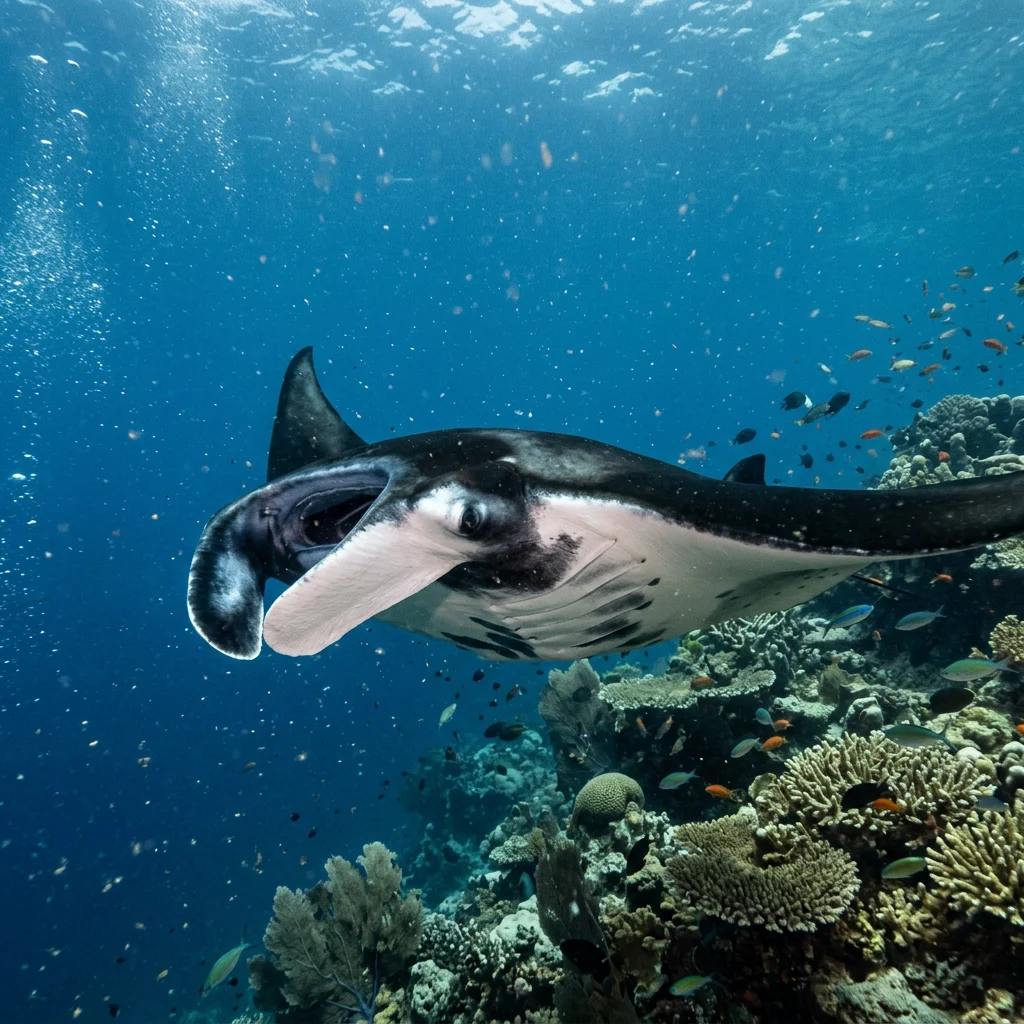
When mantas cruise lazily through open water, you will often notice two horn-like appendages rolled tightly at the front of their heads. These are cephalic fins—flexible, muscle-driven lobes derived from modified pectoral fin tissue. While they give manta rays their mythical nickname ("devil rays"), their function is purely hydrodynamic.
When it is time to feed, mantas unroll these lobes into broad, curved hydrofoils. Unrolled cephalic fins serve two major aerodynamic—or rather, hydrodynamic—purposes:
- Intake Flow Channeling: They act as active fluid scoops, creating a wide funnel that captures plankton-rich water ahead of the ray's bow wave and forces it directly into the gaping oral cavity.
- Drag Reduction: By directing water smoothly into the mouth rather than letting it crash against the flat frontal plane of the head, cephalic fins reduce drag coefficient (
Cd), preventing the ray from pushing a high-pressure "wall" of water ahead of itself that would push tiny plankton out of reach.
Lift-to-Drag Ratio and Flapping Kinematics
Unlike sharks, which rely on heterocercal tails for forward propulsion, mantas move using high-aspect-ratio pectoral wings. Their swimming stroke is a biomechanical masterpiece of mobuliform locomotion.
By oscillating their wingtips at low frequencies (typically 0.5-1.0 Hz), mantas generate forward thrust on both the upstroke and downstroke. Their wing cross-sections mimic an asymmetric NACA airfoil, maximizing the lift-to-drag ratio (L/D). This incredible efficiency allows a manta to swim at speeds exceeding 2-3 knots during active feeding while expending minimal metabolic energy.
The Engineering Feat of Ricochet Filtering: How Mantas Feed Without Clogging
For decades, marine biologists assumed manta rays filtered microscopic zooplankton through a simple sieving process—much like pasta straining through a colander.
Manta rays use simple colander-like sieves to strain plankton from seawater.
If mantas used traditional sieve-like mesh, their gill rakers would clog within minutes of swimming through dense plankton blooms, forcing them to constantly stop and flush their throats. Instead, mantas utilize a revolutionary fluid dynamic mechanism called ricochet filtering (or cross-step non-clogging filtration).
Incoming Water + Plankton --->  [ Filter Lobe ] ---> Clean Water Out Gill Slits
                                     |
                                  (Vortex)  <-- Particles

## Further Reading

- [Manta ray - Wikipedia](https://en.wikipedia.org/wiki/Manta_ray)
- [What Do Manta Rays Eat? Feeding, Diet, and Cleaning Stations — Marine Megafauna Foundation](https://marinemegafauna.org/species/manta-rays/guide/feeding)
- [Mobulid Behavioural Ecology | Feeding, Cleaning & Courtship — Manta Trust](https://www.mantatrust.org/mobulid-behavioural-ecology)
- [Frontiers | Eat-clean-repeat: reef manta rays (Mobula alfredi) undertake repetitive feeding-cleaning cycles at an aggregation site in Seyche](https://www.frontiersin.org/journals/marine-science/articles/10.3389/fmars.2024.1422655/full)