Loading...
marine-life#Pufferfish and Porcupinefish: The Physics and Biology of Underwater Inflation#marine-life#a scuba diving and underwater adventure website
Pufferfish and Porcupinefish: The Physics and Biology of Underwater Inflation
Pro Dive Vibes
September 1, 20263 min read
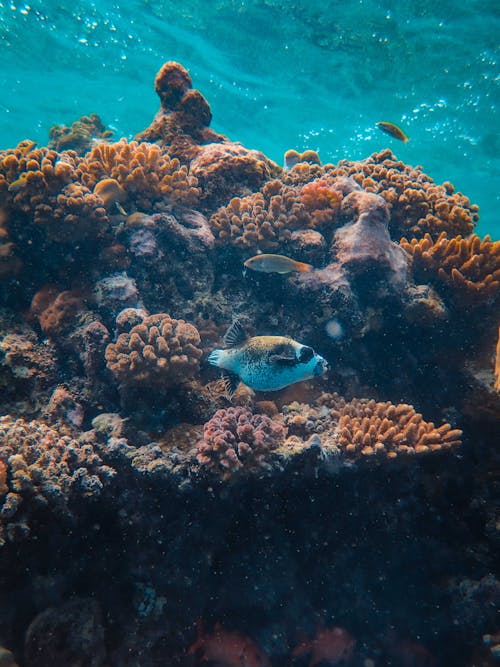
Imagine you are cruising along a vibrant coral wall, watching the gentle sway of sea anemones, when you spot a clumsy, hovering little fish with big, puppy-dog eyes. It looks completely harmless—until a larger predator approaches, and in a split second, this slow-moving creature transforms into a spiky, spherical balloon.
For divers on a scuba diving and underwater adventure website, witnessing this transformation is one of the most captivating sights on the reef. The sheer physical improbability of underwater inflation seems to defy the laws of biology. How can a vertebrate expand its body volume by several hundred percent in a matter of seconds without tearing its skin or breaking its bones?
Understanding Pufferfish and Porcupinefish: The Physics and Biology of Underwater Inflation reveals a mind-boggling intersection of evolutionary biology, biomechanics, and fluid physics. These slow-swimming reef residents have traded speed for one of the most effective—and physically demanding—defense mechanisms in the animal kingdom.
Pufferfish vs. Porcupinefish: Spotting the Difference on a Dive
While divers often use the terms interchangeably, pufferfish and porcupinefish belong to two distinct families. Spotting the differences between them during a dive adds a whole new layer of enjoyment to your underwater adventures.
Taxonomic Differences
Pufferfish belong to the family Tetraodontidae, a name derived from the Greek words for "four teeth." This refers to the four heavy teeth fused into a beak-like structure, which they use to crack open hard-shelled prey like crabs, clams, and sea urchins.
Porcupinefish belong to the family Diodontidae ("two teeth"), possessing a single, solid beak-like plate on the upper and lower jaws.
Physical Differences
The most obvious difference lies in their skin texture. Pufferfish generally have smooth, leathery skin, sometimes covered in tiny, sandpaper-like prickles that only become prominent when the fish is fully inflated.
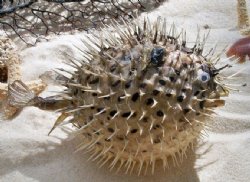
Porcupinefish, on the other hand, are covered in heavy, conspicuous spines. When the fish is relaxed, these spines fold flat against the body, pointing backward to maintain a semi-streamlined shape. Upon inflation, these spines stand completely erect, transforming the fish into an impenetrable, spiky sphere.
Swimming Styles and Fluid Dynamics
Neither family is built for high-speed chases. Instead of using their caudal (tail) fins for propulsion, they rely on diform propulsion, using their pectoral, dorsal, and anal fins to hover, spin, and maneuver through tight reef crevices. This slow, helicopter-like swimming style is incredibly precise but highly inefficient for escaping fast predators.
Their swimming kinematics contrast sharply with the streamlined, synchronized schooling fish we observe on the reef. To understand how fluid dynamics shape different fish behaviors, check out our article on [why do fish school and the surprising physics of group swimming for divers](/blog/why-do